The Annual Fraser Valley Problem That Did Not Exist a Decade Ago
Before 2017, “wildfire smoke season” was not a phrase anyone in the Fraser Valley used regularly.
Now it is a planning category.
Mission sits in a particularly bad position - at the confluence of the Fraser Valley’s smoke channel and the outflow paths from interior BC fires. When the Okanagan, Kootenays, or Cariboo burn, the smoke concentrates into the Fraser Valley and often settles heaviest in Mission and Abbotsford.
Mission regularly sees AQHI (Air Quality Health Index) readings above 10 during July and August wildfire events - multiple tiers worse than the “high risk” threshold.
This guide covers what actually works for protecting indoor air in Mission homes, what does not, and the upgrades that make the real difference when smoke season arrives.
What Wildfire Smoke Actually Is
Wildfire smoke is a mix of particulate matter (PM2.5 and PM10), volatile organic compounds, and gases.
The health-critical component is PM2.5 - particles small enough to penetrate deep into lung tissue and cross into the bloodstream.
A standard residential furnace filter (MERV 8, what came with your system) captures maybe 20 to 30% of PM2.5. The rest passes through into the home.
That is the gap this guide is about closing.
AQHI Levels and What They Mean
| AQHI | Risk Level | What to do |
|---|---|---|
| 1 - 3 | Low | Normal activity |
| 4 - 6 | Moderate | Reduce outdoor exertion if sensitive |
| 7 - 10 | High | Reduce all outdoor activity; close windows; run filtration |
| 10+ | Very High | Stay indoors; filtered air only; vulnerable people especially careful |
During major smoke events Mission has hit AQHI 15+ for multi-day stretches. Health Canada’s guidance at those levels is essentially “stay indoors with filtered air.”
Filter Options: What Each MERV Rating Actually Does
| Filter Type | PM2.5 capture | Airflow impact | Typical cost (per filter) |
|---|---|---|---|
| MERV 8 (standard) | 20 - 30% | None | $10 - $25 |
| MERV 11 | 60 - 75% | Minimal | $20 - $40 |
| MERV 13 | 85 - 90% | Slight on older systems | $25 - $55 |
| MERV 16 | >95% | Significant - may require duct modifications | $60 - $120 |
| True HEPA (portable) | >99.97% | N/A (standalone unit) | $300 - $800 unit |
MERV 13 is the sweet spot for most Mission homes. It catches 85 to 90% of wildfire smoke particles while running on a standard residential furnace without significant modifications.
MERV 16 requires a larger return duct or a media filter cabinet designed for higher pressure drops. Worth the upgrade for homes with asthma, COPD, or sensitive occupants.
Portable HEPA vs. Whole-Home: Which to Use
Portable HEPA
Standalone air purifiers with true HEPA filters.
Pros:
- Filters to true HEPA standard (99.97% of PM2.5)
- No HVAC modifications needed
- Can prioritize specific rooms
- Works even when HVAC is not running
Cons:
- Single-room coverage only
- Need to buy multiple units for whole-home coverage
- Filter replacement costs stack up (one per unit)
- Some units are noisy at high speed
Best for: bedrooms, home offices, rooms with sensitive occupants. A $400 HEPA purifier in the master bedroom is often the single highest-impact smoke-season purchase a Mission homeowner makes.
Whole-Home Filtration
Upgraded filtration integrated into the HVAC system.
Options range from dropping a MERV 13 filter into the existing slot (under $50 per change) to installing a dedicated media filter cabinet or electronic air cleaner ($800 to $2,500 installed).
Pros:
- Cleans air in every conditioned room
- Integrated into existing HVAC operation
- No visible equipment to live around
- Generally quieter than portable units
Cons:
- Only runs when HVAC is running
- Cannot match true HEPA filtration in all cases
- Older systems may not tolerate high-MERV filters
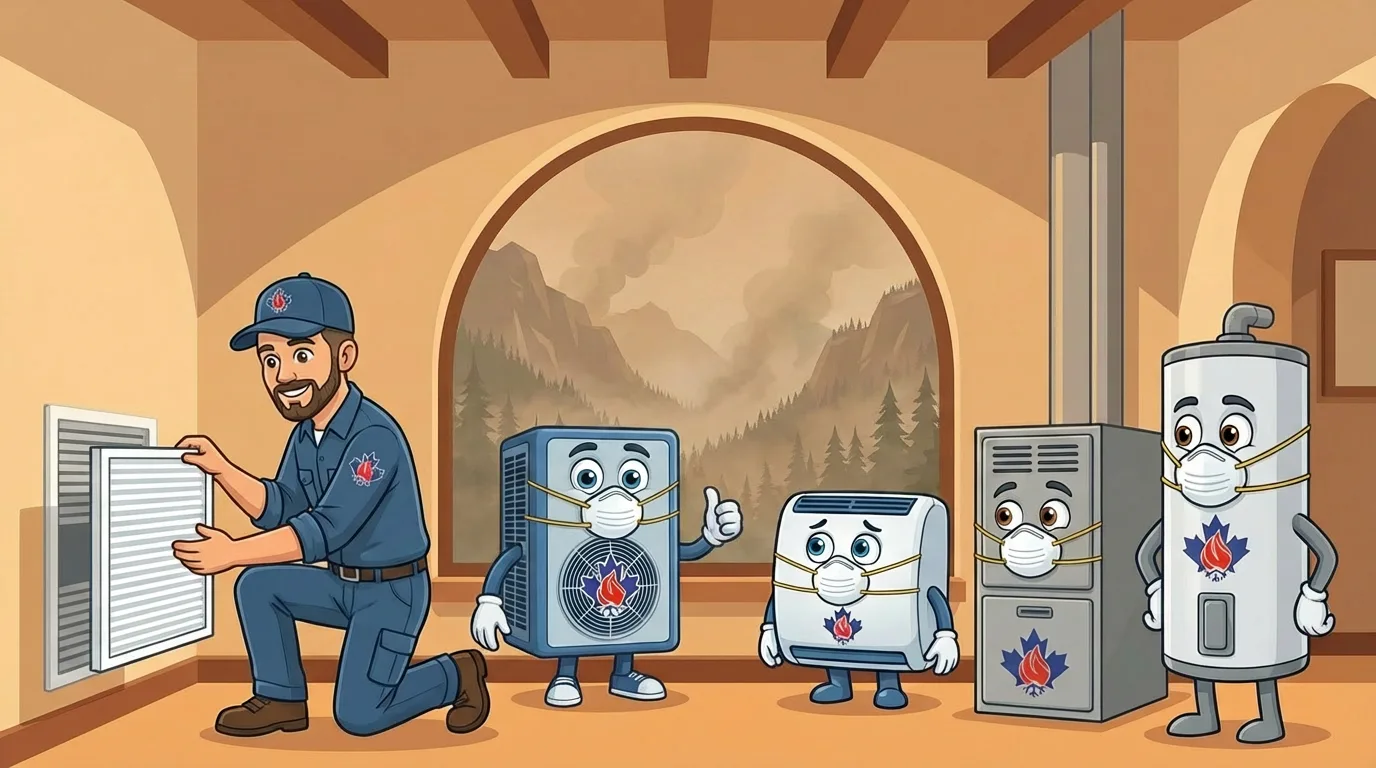
The best smoke-season setup for most Mission homes: MERV 13 in the HVAC system + one portable HEPA in the main sleeping area. Covers the whole house during HVAC operation, and the bedroom at night regardless.
Running the AC During Smoke Events
A common question: “Should I run the AC when it is smoky outside?”
Short answer: yes, if you have a properly filtered system.
Here is why:
- Your home’s HVAC system recirculates indoor air - it does not bring in outdoor air (unless you have a fresh-air intake, which is rare in BC residential)
- Recirculated indoor air, passed through a MERV 13 filter repeatedly, gets cleaner over time
- Running the AC gives you cooling without opening windows, which is the primary source of outdoor smoke entry
Exceptions
- Homes with fresh-air ventilation systems - HRV or ERV units bring in outdoor air; during smoke events, switch them off or set to recirculate
- Kitchen range hoods - avoid running during smoke events; they pull outdoor air in through any gaps in the envelope
- Bathroom exhaust fans - same issue; minimize use during high AQHI
Sealing Strategies
Air sealing matters more during smoke events than during any other time.
Quick wins:
- Keep windows and exterior doors closed - the obvious one
- Check weather-stripping on doors; replace if visibly damaged
- Seal around window AC units if you have them - they leak significantly
- Close fireplace dampers - a major smoke entry point often overlooked
- Minimize in-and-out traffic - each door opening brings a small cloud of outdoor air with it
For homes with recurring respiratory issues during smoke events, investing in whole-home sealing (blower door testing, targeted air sealing) is often the highest-impact long-term upgrade.
When to Shelter vs. When to Leave
For most healthy adults, sheltering in a filtered indoor environment through a smoke event is safer than traveling.
For vulnerable individuals - young children, elderly, asthma or COPD patients, pregnancy - extended AQHI 10+ events may warrant temporary relocation to the coast or interior where air is cleaner.
Environment Canada provides real-time AQHI readings at weather.gc.ca - check before making travel decisions.
Mission Geography: Why Smoke Settles Here
- Fraser Valley channel - surrounded by mountains, smoke concentrates rather than disperses
- East-of-Abbotsford position - catches smoke from both interior BC fires and Washington state fires
- Elevation gradient - Mission benches trap smoke at lower elevations during temperature inversions
- Cascade outflow patterns - summer wind patterns often push smoke west along the valley floor, concentrating in Mission before hitting the coast
This is not going to improve. Mission homeowners who invest in filtration infrastructure now pay for it many times over across a 10-year horizon.
Bottom Line for Mission Homeowners
Three actions, in order of impact:
- Upgrade your HVAC filter to MERV 13 (under $50, 5-minute job)
- Buy a portable HEPA purifier for the primary bedroom ($300 to $500)
- Address envelope sealing issues if respiratory symptoms persist indoors during smoke events
For families with sensitive occupants, add whole-home media filtration or HEPA-rated HVAC filtration to the list.
Call 604-991-4894 or book an assessment for a Mission home smoke-season readiness check. We can test your current filtration, measure your system’s compatibility with higher-MERV filters, and recommend the intervention that gives you the most protection for the budget.
Frequently Asked Questions
Most modern furnaces handle MERV 13 without issues. Older furnaces (pre-2005) or systems with undersized return ducts may see reduced airflow that affects performance. Static pressure measurement during a tune-up tells you definitively. If your system cannot handle MERV 13, a media filter cabinet upgrade or MERV 11 is the alternative.
Every 30 to 45 days during active smoke events, versus the normal 60 to 90 day interval. Smoke particles load filters fast. A visibly grey filter that was white 3 weeks ago is normal during a major event and warrants replacement.
True HEPA filtration in a standard residential HVAC system is rare because of airflow restriction. HEPA-bypass systems (that filter a portion of airflow through HEPA while most air passes through MERV) are available for $1,500 to $3,000 installed and bridge the gap.
For wildfire smoke specifically, no - electronic air cleaners have variable performance on PM2.5 and require regular cleaning of collection plates. A properly sized MERV 13 media filter typically outperforms an electronic air cleaner on particulate capture and requires less maintenance.
HRVs and ERVs bring in outdoor air, which is counterproductive during smoke events unless paired with high-MERV pre-filtration on the fresh air intake. For homes without smoke concerns, HRVs improve IAQ. For Mission homes with annual smoke exposure, careful system design matters - get an IAQ-focused installer.
For homes with recurring respiratory issues during smoke events, yes. Whole-home air sealing (typically $1,500 to $4,500) reduces infiltration by 20 to 40%, which is the difference between indoor air being 70% of outdoor smoke concentration and 20%. Smoke season is the period when leaky envelopes cost the most.