The One Mechanical System That Can Close Your Restaurant
Bad refrigeration will cost you a dinner service.
Bad HVAC will cost you a week of complaints.
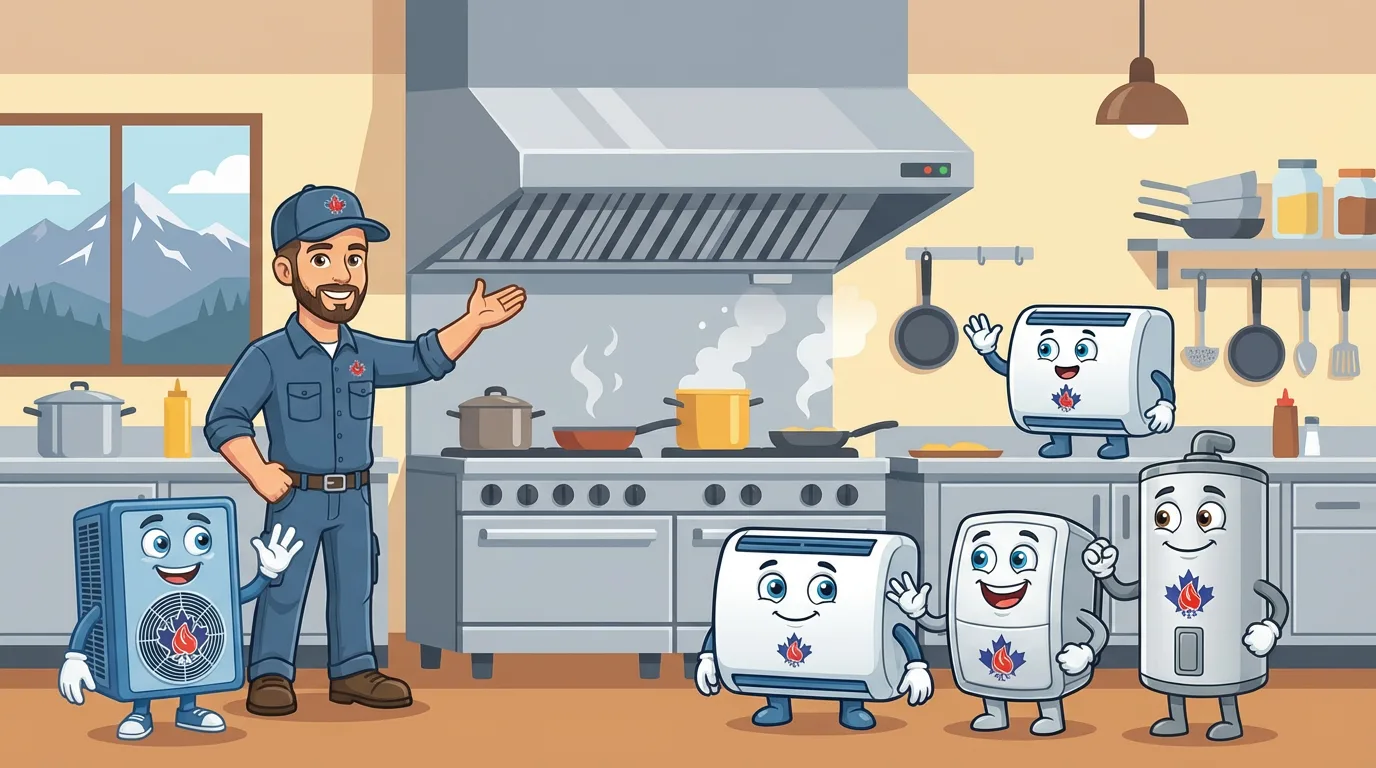
Bad kitchen ventilation can cost you your business.
Fraser Health inspectors close more Chilliwack restaurants for ventilation-related issues than for any other HVAC category. Grease buildup, inadequate exhaust, missing makeup air - each of those can trigger a shutdown until remediated.
This guide covers what a properly designed and maintained commercial kitchen ventilation system actually looks like, the code requirements that apply in BC, the common traps that catch first-time restaurant owners, and realistic costs for Chilliwack.
Written for restaurant owners, not engineers. If you need code citations for your architect, your mechanical consultant will provide them.
What a Commercial Kitchen Ventilation System Actually Includes
A working kitchen ventilation system has five components, and all five have to work together.
- Exhaust hood - captures smoke, grease, steam, and heat over the cooking line
- Exhaust fan - pulls the captured air out of the building through ductwork
- Grease duct - code-compliant ductwork from hood to exterior
- Makeup air unit - replaces the air being exhausted with tempered outdoor air
- Fire suppression system - integrated into the hood, triggered by the exhaust shutdown
Miss any one of these and the others do not work properly.
Hood Types: Getting This Right Matters
| Hood Type | What it captures | Typical applications |
|---|---|---|
| Type I | Grease, smoke, heat | Fryers, grills, ranges, charbroilers |
| Type II | Heat and steam only (no grease) | Dishwashers, ovens, steam kettles |
| Condensate hood | Steam and condensation | Pasta cookers, steamers |
The critical rule: any appliance producing grease-laden vapour requires a Type I hood.
A Type II hood over a fryer is a code violation and a fire hazard. It is also one of the most common oversights we see when a restaurant is retrofitted from a previous non-cooking tenant.
Sizing: CFM Requirements by Appliance
Exhaust volume is measured in cubic feet per minute (CFM). Each type of cooking appliance has a minimum CFM requirement per linear foot of hood.
| Appliance Type | Exhaust CFM per linear foot of hood |
|---|---|
| Light duty (ovens, steamers) | 150 - 200 |
| Medium duty (ranges, griddles) | 200 - 300 |
| Heavy duty (fryers, charbroilers) | 300 - 400 |
| Extra heavy duty (solid fuel, wood-fired) | 400 - 550 |
A 10-foot hood over a line that includes a charbroiler and two fryers is likely sitting in the 3,500 to 4,500 CFM range. That is a serious piece of equipment.
The Makeup Air Trap
Here is the mistake that catches more Chilliwack restaurant owners than any other.
A hood exhausts 4,000 CFM. That air has to come from somewhere.
Without a proper makeup air unit, the exhaust fan pulls air from:
- The HVAC system (sucking conditioned dining room air into the kitchen)
- Gaps in the building envelope (pulling in unconditioned outdoor air)
- Gas appliance combustion vents in reverse (major safety issue)
- Any path of least resistance, usually the dining room entry door
A kitchen exhaust without balanced makeup air will reverse the combustion venting on your gas appliances. This is a carbon monoxide hazard and an automatic code violation.
Makeup air units are sized to match or slightly exceed exhaust capacity. For most Chilliwack restaurants, this is a dedicated rooftop MAU heating the incoming air in winter and providing untempered outdoor air in summer.
Code Requirements You Cannot Skip
BC Building Code, CSA B149.1, and NFPA 96 all apply to commercial kitchen ventilation. The highlights:
- Type I hood discharge - minimum 10 feet horizontally from any opening into the building, minimum 40 inches above the roof
- Grease duct - must be liquid-tight welded construction, minimum 16 gauge steel
- Duct access panels - required at 12-foot intervals and every change of direction for cleaning
- Fire suppression - UL 300 compliant wet chemical system, integrated with exhaust fan shutdown and gas shutoff
- Makeup air - balanced to exhaust, with interlock ensuring MAU runs when exhaust runs
- Grease filter type - baffle filters required for Type I; mesh filters are not code-compliant
Maintenance Schedule
The single most common reason for a ventilation-related restaurant closure is inadequate cleaning.
| Task | Frequency | Why |
|---|---|---|
| Clean baffle filters | Daily or weekly | Grease accumulation = fire risk |
| Wipe hood interior | Weekly | Visible grease accumulation |
| Professional hood + duct degrease | Every 3 to 6 months | NFPA 96 and insurance requirement |
| Inspect fire suppression | Every 6 months | Code requirement, certified inspector |
| Inspect exhaust fan bearings and belts | Every 6 months | Fan failure = emergency closure |
| Makeup air unit service | Annually (spring and fall) | Filter change, combustion check, controls |
Your insurance certificate almost certainly requires documented quarterly hood cleaning by a certified service. Self-cleaning does not count.
Typical Costs for a Chilliwack Restaurant Build
| Component | Typical Chilliwack Cost (2026) |
|---|---|
| 10-ft Type I hood (stainless, UL listed) | $8,000 - $14,000 |
| Upblast exhaust fan (4,000 CFM) | $3,500 - $5,500 |
| Grease duct installation (typical run) | $4,500 - $9,000 |
| Makeup air unit (4,000 CFM, gas-heated) | $12,000 - $20,000 |
| Fire suppression system | $4,500 - $7,500 |
| Controls and interlock wiring | $2,000 - $4,000 |
| Commissioning and permits | $1,500 - $3,000 |
| Total for a typical 10-ft line | $36,000 - $63,000 |
The range reflects kitchen size, ceiling height, duct routing complexity, and whether gas piping upgrades are required.
Most Expensive Mistakes We See
1. Buying a Used Hood That Does Not Fit the New Kitchen
Used hoods are tempting at 30 to 50% of new pricing.
The trap: hoods are sized for specific cooking equipment and specific capture distances. A hood that was correct for the previous tenant is often wrong for your menu.
2. Undersizing the Makeup Air Unit
MAUs are expensive. Skimping here creates the reverse-venting problem and turns a code pass into a code fail on first inspection.
3. Ignoring Duct Routing Early
Grease ducts have rules about vertical rise, horizontal runs, and access panel spacing. If these are not considered at lease signing, the build-out can require ceiling replacement or structural changes.
4. Cheap Fire Suppression
The fire suppression system has to be UL 300 rated, integrated with the gas shutoff, and certified by an authorized installer. Off-brand systems often fail inspection and have to be replaced.
Chilliwack-Specific Notes
- Downtown core - older buildings with limited roof access often require creative duct routing. Budget extra for vertical rise installations.
- Sardis and Vedder developments - newer construction typically has MAU provisions already in place, simplifying installs.
- Food processing heritage - several buildings in Chilliwack were designed for industrial food use and have existing heavy-duty ventilation infrastructure that can be adapted.
- Fraser Health jurisdiction - inspections tend to be more thorough than coastal Metro Van equivalents. Plan accordingly.
Bottom Line for Chilliwack Restaurant Owners
Kitchen ventilation is not where you save money on a restaurant build.
A properly designed and installed system runs 20 to 30% more than the cheapest quote. That premium pays back in:
- Passing first-inspection instead of scheduling costly remediation
- Lower fire insurance premiums
- Fewer service calls over the life of the system
- Better kitchen working conditions (which reduces turnover)
Call 604-991-4894 or request a consultation for Chilliwack commercial kitchen ventilation design, installation, or maintenance. We work with restaurant owners from first lease through opening and beyond.
Frequently Asked Questions
NFPA 96 sets the minimum at quarterly for most menu types, monthly for solid-fuel cooking (wood-fired pizza ovens, charcoal grills), and semi-annually for light-use applications. Your insurance policy may require more frequent cleaning. Keep cleaning certificates on file - inspectors ask for them.
Sometimes. The hood must be sized for your menu, meet current code, and pass an inspection. Older hoods may have grease duct that does not meet current welding and access panel requirements. Budget for a full inspection before counting on reuse.
Usually yes. Any exhaust system over approximately 400 CFM typically requires balanced makeup air in BC. Smaller café-style operations with Type II hoods only (no grease appliances) may be exempt. Confirm with your mechanical designer during planning.
For a new restaurant build, 2 to 4 weeks from rough-in to commissioning, coordinated with other trades. For a retrofit in an existing operating space, plan for 3 to 7 days during a closure period. Complex duct routing or MAU installation on older buildings can extend this.
Fraser Health can issue an order to close until remediated. Remediation typically requires engineering drawings, corrected installation, and re-inspection. Lost revenue during closure plus remediation cost usually exceeds the original savings from cutting corners on the initial install.
No. Commercial kitchen ventilation involves gas piping (TSBC licensed), grease duct welding (CWB certified), fire suppression (authorized installers only), and inspections at multiple stages. Even the exhaust fan wiring has requirements that a licensed electrician must handle.