The Breaker Trip That Only Happens in the Heat
A heat wave hits West Vancouver.
Your AC runs for an hour.
The breaker trips.
You reset it. The system runs another hour. Trips again.
A breaker that only trips during heat waves is telling you something specific. The problem is almost always electrical load, not the AC itself - though the root cause is worth understanding before you assume it will go away.
This guide walks through the five most common causes for heat-wave breaker trips on West Van homes, in the order we check them. The first two you can rule out yourself in 15 minutes. The last three need a tech.
West Vancouver has a particular pattern here because of the housing stock - many homes have electrical panels from the 1970s and 1980s that were never upgraded when AC was added later. That combination creates the exact conditions for summertime breaker trips.
Quick Diagnostic Table
| Symptom | Likely cause | Priority |
|---|---|---|
| Trips after 30-90 minutes of continuous running | Marginal breaker, heat soak | High |
| Trips instantly on startup | Short circuit or seized compressor | Call immediately |
| Trips only on hottest days above 30°C | Dirty coil, low refrigerant, capacitor weakening | Moderate |
| Trips when the dryer or oven is also running | Panel overload | High |
| Trips repeatedly, feels warm to touch | Failing breaker, wiring fault | Call immediately - safety |
| Smell of burning at the panel | Electrical fault, imminent failure | Shut off all power, call |
1. The Breaker Itself
Breakers are wear parts. They do not last forever.
A breaker that has tripped 100+ times over its life - which is typical for a 20-year-old AC circuit - slowly loses its ability to carry its rated current without tripping nuisance. This is especially common in:
- West Van homes built in the 1970s or earlier
- Homes with Federal Pacific or Zinsco panels (both problematic brands)
- Homes where the AC was retrofitted onto an existing undersized panel
A healthy 30-amp breaker in a 20°C ambient room should carry 27 amps indefinitely. The same breaker in a hot panel enclosure on a 35°C day may trip at 24 amps.
Test: have an electrician measure the actual current draw of your AC at peak load and compare to the breaker rating. If draw is near 80% of rating, the breaker is marginal and should be replaced - or the circuit may need upsizing.
2. Dirty Filter or Dirty Coil
A restricted airflow path forces the AC to work harder, draw more current, and run longer cycles. All three contribute to breaker trips.
Common culprits:
- Filter - if you cannot see light through it, replace it
- Outdoor condenser coil - leaves, pollen, dryer-vent lint; needs a gentle hose rinse
- Indoor evaporator coil - dust buildup from a year of dirty filters
- Blocked returns or supply vents - furniture, rugs, closed dampers
This is the cheapest fix on the list. Free if the filter is all that is needed, $200 to $400 for a professional coil cleaning.
3. Failing Capacitor
The compressor’s start capacitor helps it kick on against high head pressure. A weakening capacitor forces the compressor motor to draw higher-than-normal current during each startup.
Over time, that elevated draw trips the breaker - especially on hot days when head pressures are highest.
Symptoms of a failing capacitor:
- Outdoor unit hums for a second before the fan starts
- Fan spins slowly on startup, then speeds up
- Occasional “clicks” from the outdoor unit that do not result in startup
- Breaker trips more often on hotter days
Capacitors are wear parts. They typically last 7 to 12 years in BC’s climate. A capacitor replacement ($180 to $350) often solves breaker-trip issues on otherwise healthy systems.
4. Compressor Approaching End of Life
A compressor that is mechanically worn or has internal winding damage draws higher current than spec.
This is not repairable - a failing compressor means compressor replacement, which is typically $3,500 to $7,000 installed, or the signal that the entire AC is worth replacing rather than repairing.
Signs:
- System age 12+ years
- Breaker trips becoming more frequent each summer
- Cooling capacity has been declining - takes longer to reach setpoint
- Louder operation than in previous summers
- Visible oil around the outdoor unit (refrigerant leak, often compressor-related)
5. Electrical Panel or Wiring Issues
The most serious category. Issues in this bucket are fire risks, not just inconveniences.
Aluminum Wiring
Some West Van homes built between 1965 and 1975 have aluminum branch wiring. At connection points, aluminum oxidizes and creates high-resistance junctions that heat up under load.
Under air conditioner loads during heat waves, those junctions can reach fire-starting temperatures.
Loose Connections
Every electrical connection loosens slightly over time due to thermal cycling. Loose connections heat up, trip breakers, and in worst cases arc.
Shared Circuits
Some older installs share the AC circuit with other loads. When the washer or oven kicks in, total current exceeds the breaker rating and it trips.
Warning signs:
- Breaker or panel feels warm to touch
- Discolouration or burn marks on breakers
- Buzzing or humming from the panel
- Burning smell, even faint
Any of these warrants shutting off power at the main and calling immediately. Do not try to diagnose electrical issues at the panel level yourself.
West Vancouver Specifics
West Van’s housing stock skews older than the Metro Van average, with significant concentrations in:
- Ambleside, Dundarave, and Sandy Cove - many homes from the 1950s to 1970s with original panels that were never upgraded when AC was added
- British Properties - larger homes with AC loads that push the limits of even upgraded 100-amp panels
- Caulfield, Bayridge, and Horseshoe Bay - mix of ages, with frequent retrofit installations
Common West Van pattern: a 100-amp panel feeding a 3-ton AC, heat pump water heater, electric vehicle charger, and typical household loads. Any two of these running simultaneously can push the main breaker to its limit, with localized breaker trips on the AC circuit as the symptom.
When to Call an Electrician vs. an HVAC Tech
The diagnostic flow:
- Start with HVAC - filter, coil cleaning, capacitor, refrigerant charge. Most trips resolve here.
- Move to electrician if HVAC tech rules out mechanical causes and current draw is normal. Panel assessment, breaker replacement, potential circuit upsizing.
- Both may be needed if the home has marginal panel capacity and the AC needs upgrading - the two trades coordinate for a coherent solution.
Bottom Line
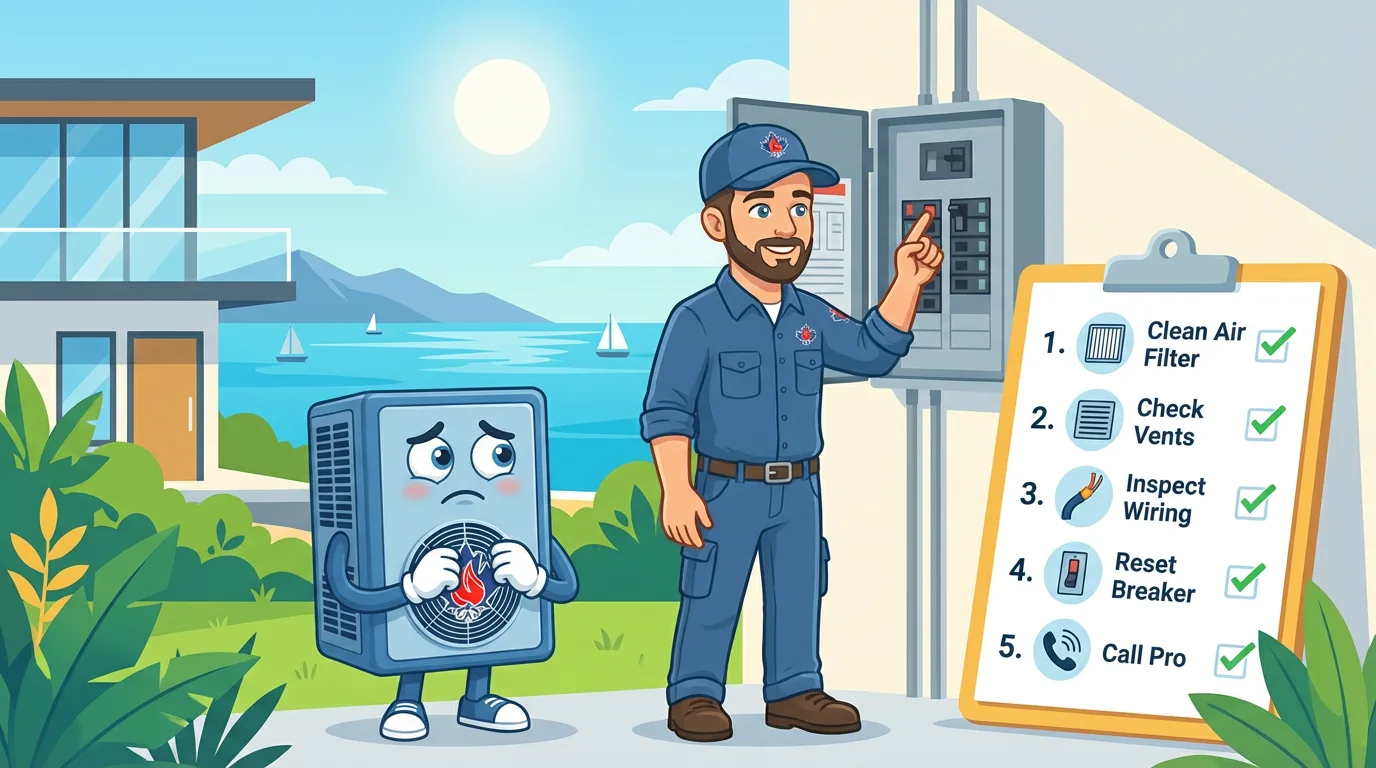
A breaker that trips only during heat waves is diagnosable. Work through in order:
- Filter and outdoor coil (DIY, 15 minutes)
- Capacitor check (HVAC tech)
- Refrigerant charge verification (HVAC tech)
- Compressor current draw (HVAC tech with clamp meter)
- Panel and wiring inspection (electrician)
Most West Van heat-wave breaker trips resolve at step 1 or 2. The ones that do not are worth solving before next summer.
Call 604-991-4894 or book service to diagnose a West Vancouver AC breaker trip. We coordinate with trusted electrical contractors when the issue turns out to be panel-side rather than equipment-side.
Frequently Asked Questions
Once or twice to confirm it trips again is fine. Repeatedly resetting a breaker that keeps tripping is not safe - the breaker is doing its job protecting the circuit from something real. A breaker that trips three times in one day should not be reset again until the underlying cause is diagnosed.
No, and in most cases it is not legal. Breaker size is matched to wire gauge. Upsizing the breaker without upsizing the wire creates a fire hazard - the wire can overheat before the breaker trips. Only an electrician can properly upsize a circuit, which involves replacing wire as well as breaker.
Capacitors typically last 7 to 12 years in BC conditions. A capacitor replacement during a tune-up when readings show 10 percent or more below rated microfarads is preventive maintenance. Waiting for failure means an emergency service call during the summer.
In West Vancouver, panel upgrades from older 100-amp to modern 200-amp service run $3,500 to $7,500 depending on service entrance length and permit requirements. For homes adding heat pumps, EV chargers, and modern AC, the upgrade often pays for itself in capacity headroom alone.
Higher risk than copper, not inherently catastrophic. Aluminum wiring can be made safer through proper terminations using aluminum-rated connectors and antioxidant compound, or by pigtailing copper at each connection. An electrician should assess your specific wiring condition.
Most consumer smart thermostats do not measure current. Energy monitoring devices at the panel level (Sense, Emporia) can track AC current draw and flag increases over time. For homes with older panels or recurring breaker issues, this data is valuable for preventive diagnosis.