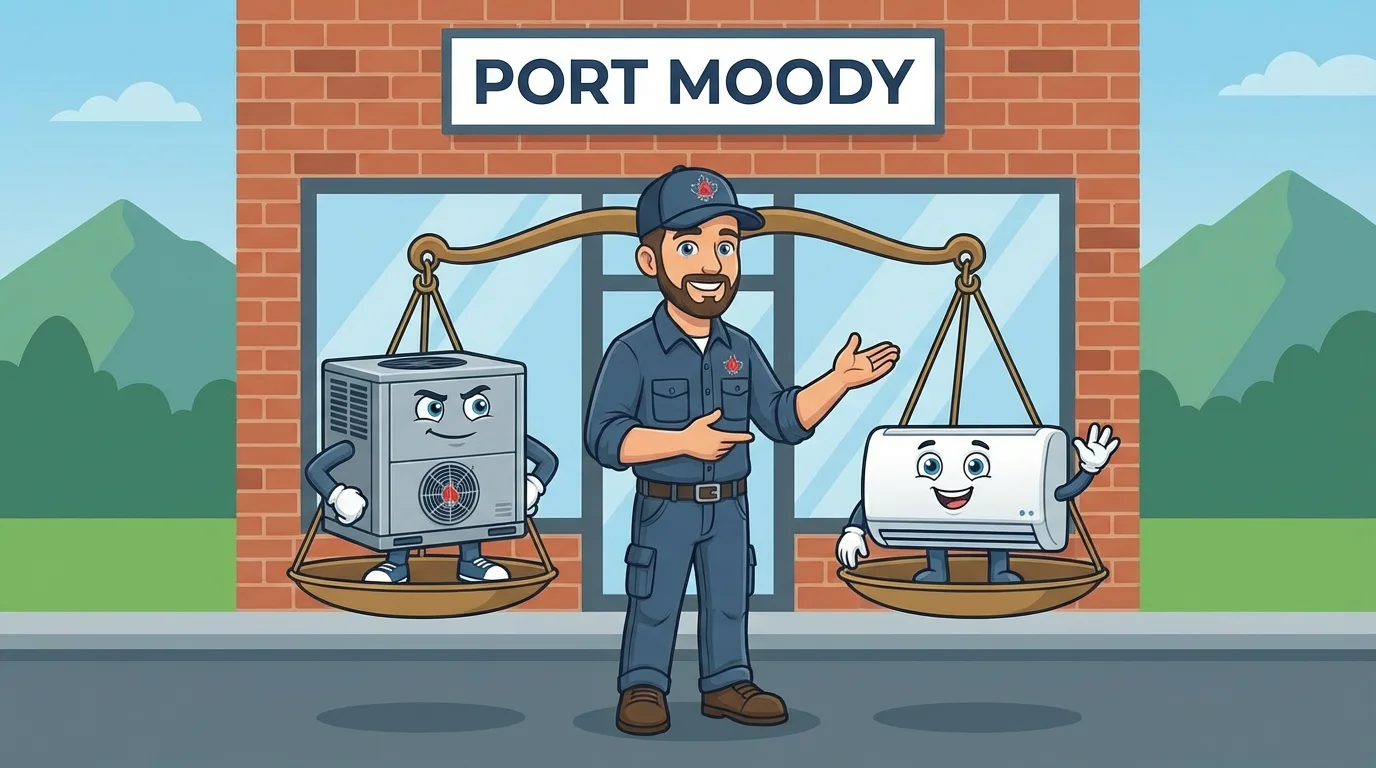
The Short Answer for Port Moody Businesses
If you operate out of a single-storey commercial building with roof access and predictable hours, an RTU (rooftop unit) is almost always the right call.
If you are in a mixed-use strata building, a multi-tenant retail strip, a basement office, or anywhere with shared roof or limited mechanical access, a split system usually wins.
Most Port Moody small businesses inherit whichever system the previous tenant or developer installed - and that decision quietly shapes your HVAC operating costs for the next 15 years. This post is the framework we use when a Port Moody business owner asks us, “should I match what is here, or change?”
What Each System Actually Is
For business owners who have not had to think about this before:
Rooftop Unit (RTU)
A self-contained heating-and-cooling unit that sits on the roof of the building. It pulls outside air, conditions it (heating or cooling), and pushes it through ductwork into the conditioned space below. Most strip-mall retail, standalone fast food, and single-tenant office buildings use RTUs.
One unit. One roof curb. Service is from the roof. Replacement is a crane and a half-day shutdown.
Split System
An indoor air handler (often in a mechanical closet or above a drop ceiling) plus an outdoor condenser or heat pump (on the ground or a side wall). The two are connected by refrigerant line sets. Splits can also be ductless (mini-split heads in each zone) for smaller, more flexible installs.
Two pieces of equipment instead of one. Service is from inside the building plus an outdoor location. More flexible to size, easier to retrofit into existing space.
The Five Real Decision Factors
1. Building Type and Roof Access
This is the single biggest filter:
- Single-storey, dedicated roof, easy crane access - RTU wins on simplicity and lifecycle cost.
- Multi-storey or mixed-use building - Split system. You typically cannot install an RTU above someone else’s space, and roof access is usually controlled by the strata council.
- Strip mall with shared roof - Split system, or careful RTU sizing. Strata bylaws often dictate which.
- Basement business space - Split system, by necessity. There is no roof to put an RTU on.
2. Capacity Needs
RTUs are typically sized in 3- to 25-ton ranges (one ton = 12,000 BTU/h). Most Port Moody small businesses fall in the 3- to 10-ton range, where RTUs are highly cost-competitive.
Below 3 tons, ductless splits often deliver better part-load efficiency. Above 25 tons, multi-unit RTU arrays or larger dedicated systems take over.
3. Service Access and Downtime
This is where many Port Moody owners get surprised:
- RTU service requires a roof access ladder or hatch, weather-permitting visits, and often coordination with property management. Service calls cost $50 to $150 more than equivalent indoor work because of the access logistics.
- Split system service happens largely from inside, with brief outdoor work at the condenser. Lower per-call cost, faster turnaround.
For businesses that cannot tolerate cooling downtime in summer (cafes, restaurants, IT-dependent offices), the split system’s faster service window is a real operational asset.
4. Energy Bills (Operating Cost)
Modern RTUs and split systems both deliver high efficiency in their respective categories. The differences are in part-load behaviour:
- Single-stage RTUs (still common in older Port Moody buildings) cycle hard in shoulder seasons and over-condition the space. Operating costs are 15 to 25 percent higher than the same square footage with a variable-speed split.
- Variable-speed RTUs (newer) close most of the gap, but cost 30 to 50 percent more upfront.
- Variable-speed splits (especially heat pump versions) deliver the best operating cost for businesses with variable hours or partial-occupancy spaces.
5. Replacement Timeline
RTUs typically last 15 to 20 years; splits 12 to 18 years. RTU replacement requires a crane day and full system shutdown. Split replacement is staged - you can replace the outdoor condenser without touching the indoor air handler in many cases. For businesses concerned about future capital allocation, splits offer more incremental upgrade flexibility.
Cost Comparison: Install + 10-Year Operating
For a typical 5,000 sq ft Port Moody storefront or office (about 12 tons of cooling load):
| System Type | Install Cost | 10-Year Operating | 10-Year Total |
|---|---|---|---|
| Single-stage 12-ton RTU | $22,000 - $28,000 | $78,000 - $92,000 | $100,000 - $120,000 |
| Variable-speed 12-ton RTU | $32,000 - $42,000 | $58,000 - $70,000 | $90,000 - $112,000 |
| 3-zone variable-speed split (heat pump) | $38,000 - $52,000 | $48,000 - $62,000 | $86,000 - $114,000 |
Real takeaways: the cheapest install is rarely the cheapest 10-year cost. Variable-speed equipment - whether RTU or split - typically pays back its premium within years 4 to 7 in operating savings.
Common Mistakes Port Moody Business Owners Make
- Replacing like-for-like without recalculating load. Many Port Moody buildings have had use changes (retail to restaurant, office to fitness studio) that shift cooling load by 30 to 50 percent. The system that worked for the previous tenant may be wrong for yours.
- Ignoring strata bylaws until the equipment is on order. Suter Brook and Newport Village mixed-use buildings often have specific equipment placement and sound-level rules. Verify before committing.
- Underestimating service access costs over the system’s life. An RTU on a difficult-access roof can cost $200 to $500 extra per service call - over 15 years that is real money.
- Defaulting to the cheapest install and ignoring efficiency tier. A single-stage RTU saves $10,000 upfront and costs $30,000 more over a decade.
The Suter Brook and Newport Village Mixed-Use Context
Most Port Moody small businesses in Suter Brook or Newport Village are in mixed-use buildings where commercial space sits below residential strata units. Three rules apply nearly universally:
- Roof access is controlled by strata. RTU placement requires strata approval and often a one-time architectural review fee.
- Outdoor unit placement near residential balconies has dB limits. Quieter equipment (which usually means premium variable-speed) becomes a permitting requirement, not a preference.
- Refrigerant line set runs are often constrained. The path between mechanical room and outdoor placement may not be the shortest possible route, which affects efficiency and adds install cost.
For these buildings, a properly designed multi-zone variable-speed split system is almost always the right answer. RTU installs are restricted or impossible in most Suter Brook and Newport Village commercial bays.
The Clarke Street and Industrial Avenue Context
Older Port Moody commercial along Clarke Street and into the Murray Street industrial area is mostly single-storey with dedicated roofs. This is RTU territory. Most existing systems are 1990s and early-2000s single-stage RTUs that are nearing end of life - the replacement window over the next 5 years is significant.
For these buildings, the live decision is rarely RTU vs. split - it is single-stage vs. variable-speed RTU, and whether to convert to a heat pump RTU for compliance with future emissions regulations.
When Hybrid Makes Sense
Some Port Moody businesses with mixed space types benefit from hybrid systems: an RTU handling the bulk of conditioned space and a small ductless split handling specific zones with different load profiles. Common in:
- Restaurants with separate kitchen and dining HVAC needs
- Offices with dedicated server rooms
- Retail with attached prep or storage spaces
- Fitness studios with specialized humidity needs in steam rooms or pool spaces
Hybrid is often the right answer for businesses that have outgrown a simple single-system approach but do not need to redesign the entire mechanical layout.
Bottom Line
For Port Moody small businesses in 2026:
- Single-storey, dedicated roof, simple use - RTU, ideally variable-speed
- Mixed-use strata, residential above - Variable-speed split system
- Multi-zone with mixed needs - Hybrid (small RTU plus targeted ductless)
- Heavy summer cooling load with high downtime cost - Split system for service-window advantage
The right answer is rarely the cheapest install quote. Total cost of ownership over 10 years is the only honest way to compare, and that math usually favours premium variable-speed equipment regardless of whether you go RTU or split.
If you want a real assessment of your Port Moody commercial space - including load calculations, strata-bylaw verification, and side-by-side TCO modelling - call 604-991-4894 or send us a message. We service Port Moody commercial daily.
Frequently Asked Questions
An RTU is a self-contained heating and cooling unit installed on a building roof, with one piece of equipment handling everything. A split system has an indoor air handler and a separate outdoor condenser connected by refrigerant lines. RTUs are common in single-storey commercial buildings with roof access; splits are common in multi-storey or mixed-use buildings.
Modern variable-speed equipment is highly efficient in both categories. The biggest efficiency divide is single-stage vs. variable-speed, not RTU vs. split. Variable-speed splits often edge out variable-speed RTUs at part-load, but the gap is small in most Port Moody small business applications. The bigger savings come from upgrading from single-stage to variable-speed regardless of architecture.
RTUs typically last 15 to 20 years in Lower Mainland conditions. Split systems last 12 to 18 years for the outdoor condenser, with indoor air handlers often lasting 18 to 25 years. Both ranges are extended by regular preventive maintenance and shortened by deferred service.
Usually not. Mixed-use strata buildings in Suter Brook and Newport Village typically restrict RTU placement because of residential noise concerns and shared roof structural limits. A multi-zone variable-speed split system is almost always the right answer for ground-floor commercial space in these buildings.
For a typical 5,000 sq ft space (about 12 tons of cooling load), expect $22,000 to $28,000 for a single-stage RTU, $32,000 to $42,000 for a variable-speed RTU, and $38,000 to $52,000 for a multi-zone variable-speed split. The premium tier almost always pays back through lower 10-year operating cost.
Twice a year minimum: once before cooling season (typically March or April) and once before heating season (October or November). Restaurants and high-occupancy spaces benefit from quarterly service because of accelerated filter loading and grease accumulation. Annual single-visit service is rarely sufficient for commercial equipment under steady use.