The “Warm-Then-Cold” Problem
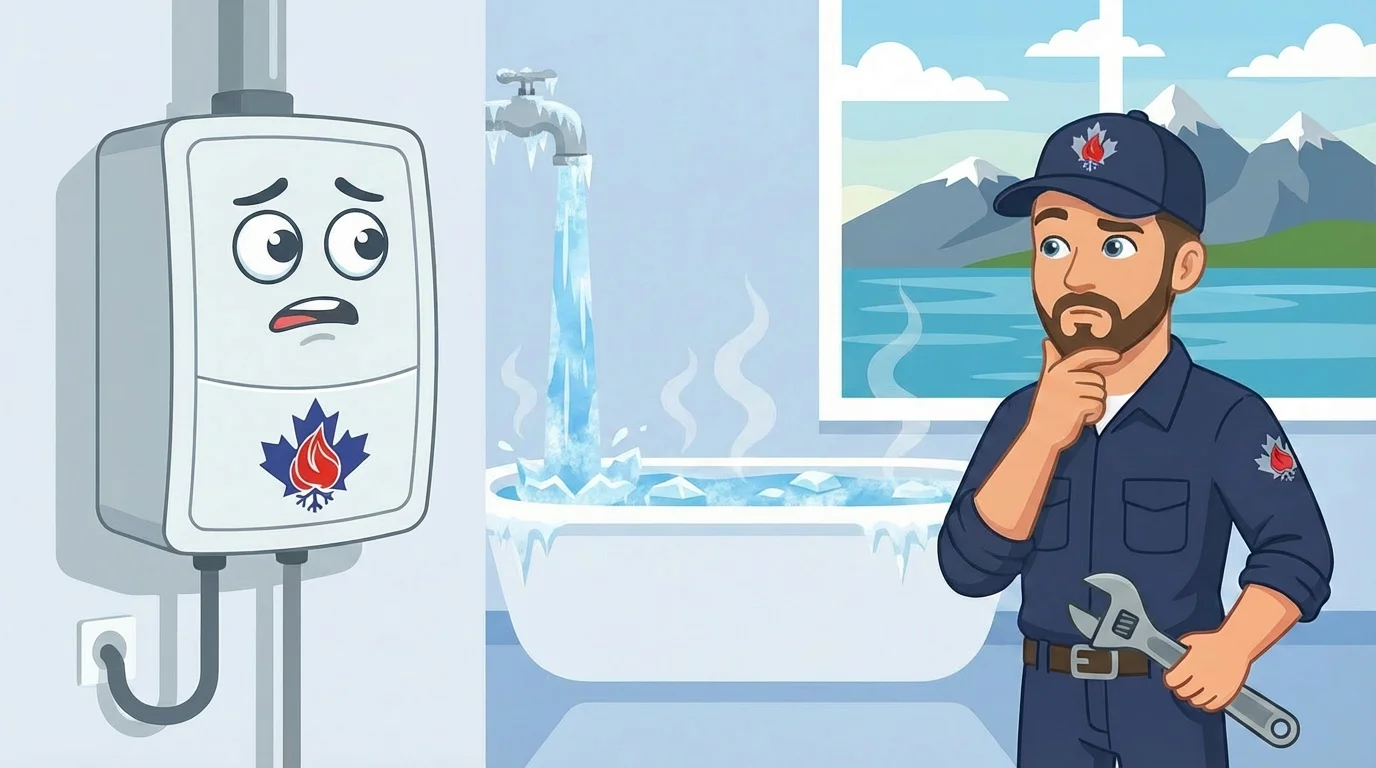
You turn on the shower. Hot water arrives quickly. Halfway through, the temperature drops to lukewarm, then briefly to cold, then occasionally back to warm. The flow seems normal. The tankless unit’s display shows no obvious error. But the shower is now a mid-stream temperature roller coaster.
This is one of the most common tankless water heater service calls we get in West Vancouver. It rarely means the unit is dying - more often it points to one of three specific issues, each of which has a different fix and a different cost profile.
This post is the diagnostic walk we use before quoting any repair, plus the West Vancouver-specific factors (long pipe runs in larger homes, capilano water characteristics) that affect the typical decision.
The Three Most Common Causes
1. Cold Water Sandwich
The classic “tankless turning off and on” symptom. Tankless units only fire when water is flowing above a minimum threshold. If you turn off the tap briefly (to lather, shave, or rinse a dish), the burner stops. When you turn the tap back on, the column of water sitting in the pipe - already cooled - reaches the tap before the burner can ramp back up. You feel a pulse of cold, then warm again.
This is normal tankless behaviour, not a malfunction. But it can be reduced or eliminated.
Diagnostic clue: Cold pulse happens specifically when you turn the tap on and off. Continuous draws stay hot.
Fix: Install a small recirculation buffer or pre-heating loop. $400 to $1,200 depending on the existing plumbing layout. Some newer tankless units have built-in buffer tanks (1 to 2 gallon mini-tanks) that handle this without external plumbing.
2. Gas Supply Issue
Tankless units need significantly higher gas supply than tank-type water heaters - typically 150,000 to 199,000 BTU/h versus 35,000 to 40,000 for a tank. If gas supply is marginal, the burner fires but cannot maintain full output, and the temperature drops mid-stream as demand exceeds supply.
Common reasons gas supply is marginal:
- Undersized gas line from the meter to the unit (typical in older West Van homes where the tankless was retrofit onto a line originally sized for a tank)
- Other gas appliances running simultaneously (furnace, range, fireplace)
- Low gas pressure from the supply side (occasionally an issue in upper British Properties during peak demand)
Diagnostic clue: Cold drops happen when other gas appliances are running, or when multiple hot water draws are happening simultaneously. Display sometimes shows a low-flame or low-input fault code briefly.
Fix: Gas line upsizing or supply pressure verification. $400 to $1,800 depending on whether the line needs to be replaced from the meter, or just at the connection. This is the most common cause of “warm-then-cold” complaints in West Van homes where a tankless was retrofit into an older system.
3. Scale Buildup or Failing Flow Sensor
Tankless units have a flow sensor that detects when water is flowing and triggers the burner. Mineral scale (from hard or moderately hard water) accumulates on the sensor and inside the heat exchanger, eventually disrupting both the flow trigger and the heat transfer.
The result: the unit fires inconsistently, ramps up slower than designed, and produces unstable temperature output.
Diagnostic clue: Problem worsens gradually over months. Display shows occasional flow-sensor or heat-exchanger-related fault codes. Hot water output noticeably weaker than when the unit was new.
Fix: Descaling service (also called flushing). $200 to $400 for a routine flush. On units that have not been descaled in 5+ years, the heat exchanger may be partially permanently scaled and a more thorough service is needed - $400 to $800.
The 15-Minute DIY Diagnostic
Before calling a tech:
- Note the unit’s age and last service date. Tankless units installed 6+ years ago that have never been descaled are statistically due for service regardless of symptoms.
- Reproduce the cold drop deliberately. Run the shower and time how long until the cold pulse hits. Note whether it happens on continuous flow or only after on/off cycling.
- Check whether other gas appliances are running. Try the shower with the furnace and range off, then again with both running. If the problem worsens with multiple appliances on, you have a gas supply issue.
- Check the tankless display for fault codes. Most units log recent faults even when they appear to be running normally. Common codes: 11 (no ignition), 12 (flame failure), 16 (overheat), 79 (intake blockage). Brand-specific code lookup tables are in your owner’s manual.
- Test multiple fixtures. If only one fixture has the problem, it may be a fixture-side issue (mixing valve, supply line) rather than a tankless issue.
Common Tankless Error Codes (Quick Reference)
| Code (typical) | What It Means | Likely Fix Range |
|---|---|---|
| 10/11 | Ignition or flame issue | Service call, $250 - $500 |
| 12 | Flame failure mid-cycle | Gas supply or ignition - $300 - $1,200 |
| 14 | High temperature shut-off | Scale or flow sensor - $250 - $500 |
| 16 | Overheat protection | Often scale - $300 - $600 |
| 29 | Condensate or venting | $300 - $800 |
| 76 | Communication/control | $200 - $600 |
| 79 | Intake or exhaust blockage | Usually inexpensive, $150 - $300 |
Codes vary by brand. Rinnai, Noritz, Navien, and Rheem each use slightly different numbering schemes - check your unit’s manual for the definitive lookup.
Repair vs. Replace Decision
| Unit Age | Symptom | Recommendation |
|---|---|---|
| 0 - 6 years | Any single symptom | Repair almost always |
| 7 - 10 years | Scale or flow sensor | Descale and service |
| 7 - 10 years | Heat exchanger or major fault | Run the math; often replace |
| 11 - 14 years | Any symptom | Replace (warranty likely expired) |
| 15+ years | Any symptom | Replace immediately |
Tankless units typically last 15 to 20 years with proper maintenance, longer than tank-type water heaters. But scaled, never-serviced units rarely make it past 12.
The West Vancouver Factor
Long Pipe Runs in Larger Homes
West Vancouver homes are often larger than the regional average, with long horizontal and vertical pipe runs from the mechanical room to bathrooms. The cold water sandwich problem is more pronounced because there is more cooled water sitting in the pipe between draws.
For homes over 4,000 sq ft or with bathroom-to-mechanical-room distances over 25 metres, a recirculation pump is often the right add-on. $800 to $1,500 installed, eliminates the cold sandwich, and reduces total water waste during shower warm-up.
British Properties and Hillside Pressure
Upper British Properties homes occasionally see lower city water pressure during peak demand. Tankless units have minimum flow rates to fire (typically 0.5 to 0.8 GPM) - homes with low pressure can have tankless units that struggle to engage on low-flow fixtures. This is rarely a serious issue but can show up as “the bathroom sink does not get hot” complaints.
Capilano and Seymour Water
West Vancouver water comes primarily from the Capilano reservoir, which produces relatively soft water (low mineral content) compared to interior BC. That is good news for tankless units - scaling rates are slower than in hard-water regions. But “slower” is not “never” - tankless units in West Vancouver still benefit from descaling every 4 to 6 years, versus 2 to 3 years in harder-water areas.
Older British Properties Homes With Retrofit Tankless
Many British Properties and Caulfeild homes had tankless retrofit onto plumbing originally designed for tank-type water heaters. The most common issue we see: undersized gas lines that struggle to deliver the higher BTU input tankless requires. This is fixable but adds $400 to $1,800 to a tankless install or replacement.
Cost Benchmarks (West Vancouver, 2026)
| Service or Replacement | Typical Cost |
|---|---|
| Diagnostic visit | $150 - $250 |
| Descaling service | $200 - $400 |
| Flow sensor replacement | $300 - $500 |
| Gas line upsize from meter | $400 - $1,800 |
| Recirculation pump install | $800 - $1,500 |
| Mid-tier tankless replacement | $5,500 - $7,500 |
| Premium tankless replacement | $7,500 - $9,500 |
Bottom Line
If your West Vancouver tankless is delivering inconsistent hot water, run the 15-minute diagnostic above. The three causes - cold water sandwich, gas supply issue, scale buildup - have very different cost profiles, and getting the diagnosis right is the difference between a $300 service and a $1,500 plumbing retrofit.
For units under 7 years old: almost always a service or maintenance fix. For units 11+ years old that have never been descaled: replacement often makes more sense than repair.
If you want a tech who will diagnose properly before recommending equipment, call 604-991-4894 or send us a message. We service West Vancouver daily including British Properties, Caulfeild, and the waterfront.
Frequently Asked Questions
Three main causes: cold water sandwich (normal tankless behaviour when you cycle the tap on and off, fixable with a buffer or recirculation), insufficient gas supply (common in older West Van homes where tankless was retrofit onto an undersized gas line), or scale buildup on the flow sensor and heat exchanger. The diagnostic to tell them apart takes about 15 minutes.
Every 4 to 6 years for West Vancouver homes on Capilano water, which is relatively soft. Every 2 to 3 years in harder-water regions. Tankless units that have never been descaled at age 7+ are statistically due regardless of symptoms - and skipping descaling is the leading cause of premature heat exchanger failure.
Technically yes if the unit has service valves installed (most modern units do), and you are comfortable connecting a circulation pump and white vinegar or commercial descaler solution. For most homeowners the $200 to $400 professional descaling service is the better value because the tech also inspects the flame, sensors, and venting at the same time.
Typically 15 to 20 years with proper maintenance (descaling every 4 to 6 years and annual visual inspection). Units that are never descaled rarely make it past 12. The Capilano water profile in West Van favours longer life compared to harder-water regions, but does not eliminate the need for periodic service.
Worth considering if your home is over 4,000 sq ft or if your bathrooms are more than 25 metres from the mechanical room. Eliminates the cold water sandwich problem, reduces water waste during shower warm-up, and improves the overall hot water experience. $800 to $1,500 installed; some newer tankless units have built-in mini-tanks that handle this without an external pump.
For a mid-tier replacement, $5,500 to $7,500 fully installed. Premium units run $7,500 to $9,500. Add $400 to $1,800 if the gas supply line needs to be upsized to meet tankless BTU requirements, which is common in older British Properties retrofit situations.