Replacing a Hot Water Tank is the Most Common Water Heater Call We Take
Every Surrey homeowner eventually faces the same decision.
Your existing hot water tank is 10 or 12 years old. It is starting to show its age - maybe a slight leak, maybe slower recovery, maybe the pilot needs relighting more often than it used to.
Time to replace.
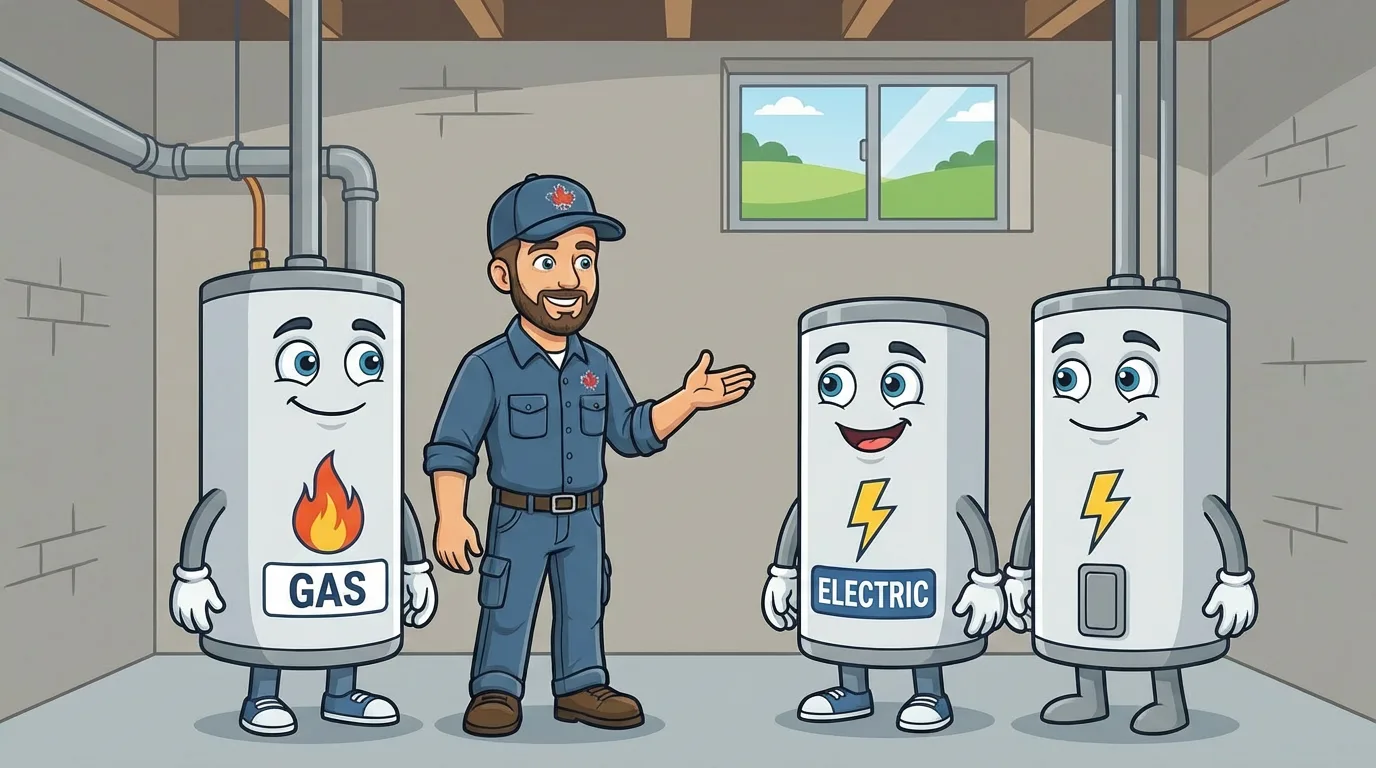
The first question: gas or electric?
This guide covers the honest answer for Surrey homes - the real installed costs, the operating costs over 10 years, the sizing math, the brands we actually install, and the scenarios where each fuel wins.
For clarity: this post is about traditional tank water heaters, not tankless (which is a separate decision) and not heat pump water heaters (different technology entirely). See our tankless guide or tank service page for those.
Gas vs. Electric: Head to Head
| Gas Tank | Electric Tank | |
|---|---|---|
| Typical installed cost (50 gal, Surrey) | $2,400 - $3,400 | $1,900 - $2,800 |
| Annual operating cost (family of four) | $380 - $520 | $480 - $680 |
| Recovery rate (gallons per hour) | 40 - 60 | 20 - 25 |
| Typical lifespan | 10 - 13 years | 10 - 15 years |
| Requires gas line | Yes | No |
| Requires venting | Yes | No |
| Works during power outage | Yes (gas tanks with pilot light) | No |
| Maintenance complexity | Higher | Lower |
Sizing: How Big a Tank Do You Actually Need?
Undersize the tank and you run out of hot water during peak demand. Oversize it and you pay to heat water you never use.
Here is the Surrey sizing rule of thumb:
| Household Size | Gas Tank (recommended) | Electric Tank (recommended) |
|---|---|---|
| 1 to 2 people | 40 gallon | 50 gallon |
| 3 to 4 people | 50 gallon | 60 gallon |
| 4 to 5 people | 60 gallon | 75 gallon |
| 6+ people or heavy demand | 75 gallon | 80+ gallon |
Electric tanks need to size up by one tier because their recovery rate is roughly half of gas.
Running out of hot water during morning showers is almost always an undersized-tank problem, not a “tank is failing” problem. Check the size on the label before you assume the tank is shot.
When Gas Wins
You Have Heavy Simultaneous Demand
Multiple showers at the same time, a large tub, high-flow fixtures.
Gas recovers roughly twice as fast as electric. For a Surrey family of 4+ with overlapping morning showers, gas is usually the better answer.
You Lose Power Regularly
Gas tanks with a standing pilot light will continue to heat water during a power outage.
Some newer gas tanks use electronic ignition and require power - check the spec sheet before assuming. Older standing-pilot tanks are the truly outage-proof option.
Your Home Already Has Gas
If your furnace, cooktop, or fireplace is already on a gas line, adding or replacing a gas water heater is a minor extension.
Running a new gas line to an all-electric home costs $1,200 to $3,500 on top of the tank - which usually kills the case for switching to gas.
When Electric Wins
You Have No Gas Connection
Running gas to an all-electric Surrey home rarely pencils out. Stick with electric unless you have other reasons to bring gas in (whole-home conversion, new fireplace).
You Want Simpler Installation
No venting. No gas line. No combustion air requirements.
Electric tanks can sit in a closet, under stairs, or in a utility room that would never pass code for a gas install.
You Value Lower Upfront Cost
Electric tanks are typically $400 to $700 cheaper to install than equivalent-capacity gas tanks. For homeowners planning to sell within 5 years, the electric’s higher operating cost may never catch up to the install savings.
You Use Little Hot Water
Singles, couples, empty-nesters, and vacation properties often never push an electric tank past its recovery limit. In that case the slower recovery of electric is invisible, and the simpler install wins.
Brand Landscape in Surrey
The tank market in BC has consolidated to a handful of brands worth considering.
Bradford White
American-made, widely considered the tank quality leader in the Canadian market. Longer warranty periods, better anode quality, fewer in-service failures.
Typical premium: 15 to 25% over budget brands.
Best for: homeowners planning to stay 10+ years.
Rheem
American-made, strong middle-of-the-market option. Broad Canadian dealer network, reliable, reasonable warranty.
Best for: the default Surrey family-home install when Bradford White is not available.
Giant (John Wood)
Canadian-made (Quebec), common in BC new construction. Good warranty terms, solid reliability.
Best for: mid-range budgets, homeowners who like a Canadian-manufactured option.
A.O. Smith
American-made, broad product line from budget to premium. Available at big-box retailers, which means DIY-accessible but quality varies by tier.
Best for: either premium (ProLine XE) or rental properties (budget line).
10-Year Cost of Ownership
The headline install cost is only half the picture. Over 10 years, operating cost often matters more than the initial premium.
| 50 gal Gas | 60 gal Electric | |
|---|---|---|
| Install cost | $2,800 | $2,300 |
| 10-year operating cost (family of 4) | $4,500 | $5,800 |
| Expected replacement within 10 years? | Possible | Possible |
| Total 10-year cost | $7,300 | $8,100 |
For a typical Surrey family of four, gas wins by roughly $800 over a decade. For a couple or single-person household, the operating-cost advantage shrinks and electric often wins overall.
Surrey-Specific Notes
- Gas permits - Surrey requires a TSBC gas permit for tank replacement on gas. We handle this as part of the install.
- Hard water areas - parts of Cloverdale and South Surrey have harder water than the Fraser Heights / North Surrey average. Consider an anode rod check every 3 to 4 years to extend tank life.
- Suite water heaters - legal suites in Surrey often require a dedicated water heater, separate from the main house. Electric is the common choice for code and space reasons.
- Condo regulations - most Surrey stratas have replacement rules about licensed installers and warranty terms. Check your bylaws before buying.
When to Replace vs. Repair
Tank water heaters are largely non-repairable once they reach a certain age.
Repair:
- Thermostat failure (cheap part, easy swap)
- Heating element replacement on electric tanks (under 5 years old)
- Pilot assembly or thermocouple on gas tanks
- Anode rod replacement (preventive)
Replace:
- Any tank leaking from the body (not the valves)
- Tanks older than 10 years with any major component failure
- Rust-coloured hot water from the tap (tank interior corroding)
- Tanks that no longer deliver their rated capacity after de-scaling
Bottom Line for Surrey Homeowners
The decision tree is simpler than it looks:
- Have gas already? Family of 4+? Gas tank, 50 or 60 gallons.
- All-electric home, normal family use? Electric tank, 60 gallons, do not try to bring in gas.
- Couple or empty-nesters? Electric 50 gallon is usually fine regardless of whether you have gas.
- Rental, suite, or investment property? Default to electric for simpler installation and lower upfront cost.
Call 604-991-4894 or request a quote for a Surrey hot water tank replacement. Most installs are same-day or next-day when we have the right size in stock.
Frequently Asked Questions
A like-for-like replacement (gas to gas or electric to electric) is typically 2 to 4 hours. Fuel conversions (gas to electric or vice versa) are 4 to 8 hours because of new venting, gas line, or electrical work. Most installs are completed in a single visit.
For gas tanks, yes - TSBC gas permits are required for any work on gas piping. Your installer handles this. Electric tank replacements do not require a permit in Surrey if the install uses existing electrical connections. Fuel conversions require both a permit and an inspection.
Traditional tank replacements generally do not qualify for major rebates. Heat pump water heaters qualify for CleanBC and BC Hydro rebates. If rebates matter to you, ask about heat pump water heaters as an alternative to standard tanks.
Annually for most Surrey homes, twice a year in areas with harder water (parts of Cloverdale, South Surrey). Flushing removes sediment that reduces efficiency and shortens tank life. A 10-minute task that can add 2 to 4 years to tank lifespan.
Electric tank replacements are technically DIY for homeowners comfortable with plumbing and 240V wiring, but local code enforcement and insurance implications vary. Gas tank work legally requires TSBC-licensed tradespeople. For most homeowners, the risk of improper install voiding manufacturer warranty is not worth the savings.
Signs include rust-tinted hot water, banging or popping noises during heating cycles, reduced recovery rate, water pooling around the base, or visible corrosion on the tank body. Most tanks provide 1 to 3 months of warning signs before catastrophic failure. Replacing on schedule is cheaper than replacing after the tank floods a basement.