The Claim Call Most Business Owners Make Wrong
Your commercial HVAC system fails on a Friday afternoon.
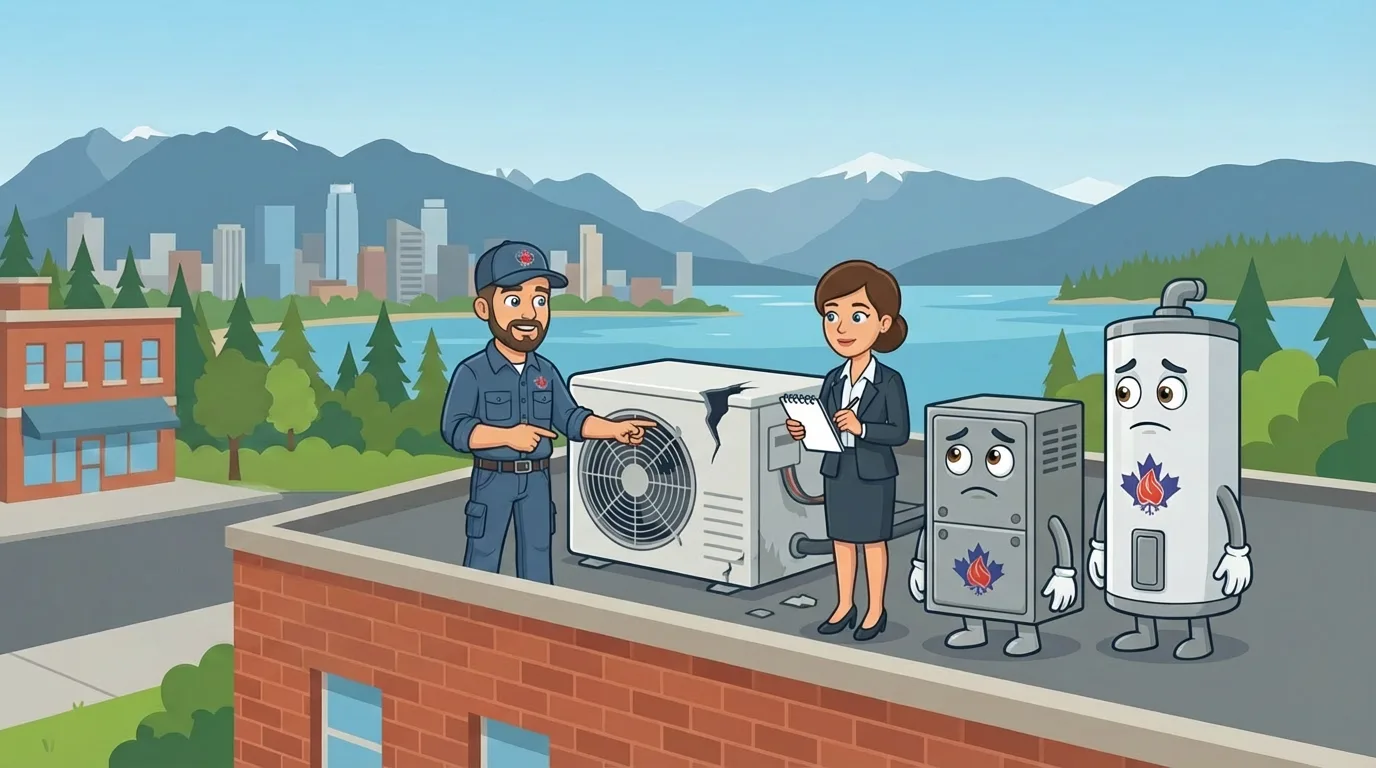
By Saturday morning, the freezer stock is compromised, ceiling tiles are soaked from a leaking air handler, and you have a $40,000 problem.
You call your insurance broker Monday.
The answer to “is this covered?” is determined more by what you did between Friday afternoon and Monday morning than by the fine print of your policy.
This guide covers how commercial HVAC insurance claims actually work in BC - what is typically covered, what is not, the 24-hour documentation window, and the common mistakes that turn approvable claims into denials.
Written for Port Moody business owners. Specific policy terms vary; use this as a framework, not legal advice. For policy-specific questions, talk to your broker.
What Commercial Insurance Typically Covers
| Scenario | Typically Covered? | Under Which Policy Section |
|---|---|---|
| Water damage from a burst HVAC pipe | Yes | Property damage |
| Ceiling damage from condensate overflow | Yes | Property damage |
| Spoiled inventory from HVAC failure | Often yes (policy-dependent) | Business interruption + equipment breakdown |
| Lost revenue during HVAC repair closure | Sometimes | Business interruption |
| Fire damage from an HVAC electrical fault | Yes | Property damage |
| Replacing the failed HVAC unit itself | Usually NOT (wear and tear) | Equipment breakdown endorsement if applicable |
| Compressor failure from age | NOT covered | N/A - maintenance category |
| Damage from deferred maintenance | Usually NOT | N/A - exclusion applies |
The Critical Distinction: Damage vs. Failure
The core principle:
- Insurance typically covers damage caused by a failure
- Insurance typically does NOT cover the failure itself
A leaking evaporator coil that ruins a drop ceiling: the ceiling is covered, the coil is not.
A compressor that quits from age: neither the compressor nor the cost of keeping the business comfortable during repair is covered, unless you carry an equipment breakdown endorsement.
Equipment breakdown coverage is a separate endorsement on most BC commercial policies. It is often optional. Check whether you have it - and whether the limit is realistic - before the failure happens.
The First 24 Hours Matter Most
Documentation captured in the first 24 hours determines claim outcome more than anything else.
Immediate Steps
- Stop additional damage - shut off water, shut off power to the failed unit, contain any leaking
- Take photos - wide shots and close-ups of visible damage, the failed component, standing water, ruined inventory
- Record timeline - when you last saw the system working, when you discovered the failure, what you did and in what order
- Contact your insurance broker - even if you are not yet sure the event is claimable, start the paper trail
- Call for emergency repair - your policy has a duty to mitigate; waiting “to avoid racking up costs” is the opposite of what the adjuster wants to see
Do Not
- Throw anything out until the adjuster has seen it (including soaked inventory)
- Pay for major repairs before the adjuster approves the claim approach
- Make structural changes to damaged areas until assessment is complete
- Dispose of the failed equipment before the claim is closed
What Maintenance Records Prove
Insurance adjusters look for evidence that the failure was not the result of neglect.
The documents that matter:
- Annual maintenance records - spring and fall tune-ups, with measurement data
- Filter replacement log - even informal, date-stamped receipts work
- Previous service invoices - showing responsive repair history, not deferred issues
- Refrigerant handling records - required by law and often requested in claims
- Commissioning reports - from the original install
A business with 3 years of documented quarterly maintenance is in a fundamentally different position on claim approval than one that can only produce a receipt from when the unit was installed 11 years ago.
Common Port Moody Business Claim Scenarios
Scenario 1: Restaurant Cooler Failure
A walk-in cooler fails on a Saturday night. $8,000 in inventory loss, $12,000 in lost weekend revenue.
What gets covered: inventory loss (property damage) and lost revenue (business interruption) if the policy includes equipment breakdown. The cooler itself is not covered unless the breakdown endorsement applies.
Scenario 2: Retail HVAC Ceiling Leak
An indoor air handler develops a condensate line leak overnight. Morning arrival finds ceiling tiles collapsed and product soaked in a 400-square-foot retail section.
What gets covered: ceiling repair, product loss, cleanup. The air handler repair itself is usually not covered unless the cause was sudden and accidental rather than gradual.
Scenario 3: Office Electrical Fire
An aging rooftop unit experiences an electrical fault that causes a small fire. Smoke damage throughout the office, minimal structural damage.
What gets covered: smoke remediation, any structural damage, business interruption during cleanup. The RTU is covered if the fire is considered accidental; typically yes if maintenance records are current.
Working With the Adjuster
Adjusters are not adversaries, but they are also not on your side in the way your broker is.
Their job is to verify the claim aligns with policy terms and to settle fairly. “Fairly” from their perspective is often lower than “fairly” from yours.
A few practices help:
- Provide complete documentation upfront - not in pieces
- Keep a single point of contact - one person from your side coordinates with the adjuster
- Be responsive - adjusters have competing claims and prioritize files that move quickly
- Get multiple repair quotes - adjusters often ask for these to validate pricing
- Do not settle hastily - initial offers are sometimes negotiable, especially on replacement cost vs. actual cash value
Temporary Repairs vs. Full Repairs
During a claim, you face a choice: temporary fix to reopen quickly, or wait for full repair authorization.
The right answer depends on the policy:
| Policy Situation | Recommended Approach |
|---|---|
| Business interruption coverage active | Temporary repair to minimize BI duration; document all costs |
| Strong equipment breakdown endorsement | Often better to wait for proper repair approval |
| Basic property coverage only | Temporary repair to prevent additional damage, then full repair on your own budget |
| Claim denial likely | Full repair fast; fight the denial through your broker later if needed |
Your broker should advise on which path fits your specific coverage.
Preventing Claim Denials
The top reasons commercial HVAC claims get denied:
- Gradual damage - evidence suggests the failure developed over weeks and should have been caught
- No maintenance records - adjuster cannot verify the damage was sudden rather than neglect-driven
- Wrong policy section - damage was caused by failure, but no equipment breakdown coverage exists
- Delayed reporting - claim filed weeks after the event
- Undocumented temporary repairs - paid for repairs before adjuster assessment, no invoices saved
Annual Review With Your Broker
Not a sales pitch, genuine advice: review your commercial property policy annually with your broker.
Questions to ask:
- Do I have equipment breakdown coverage, and what is the limit?
- Does business interruption cover lost revenue from HVAC-caused closures?
- What maintenance documentation does the policy require?
- Are there coverage upgrades that would pay for themselves given my equipment age?
- What is the claim notification timeline, and who handles after-hours claims?
How Veteran HVAC Supports Claim Documentation
We provide claim-ready documentation as part of our commercial maintenance agreements:
- Detailed tune-up reports with measurement data
- Photo documentation of pre-existing conditions
- Refrigerant handling logs
- Post-failure damage assessments when events occur
- Repair invoices itemized for adjuster clarity
For Port Moody businesses that have gone through a claim with us, the documentation alone has tilted several otherwise-borderline cases to approval.
Call 604-991-4894 or get in touch for commercial HVAC service in Port Moody, including emergency response during an active insurance claim situation.
Frequently Asked Questions
Standard property insurance covers damage caused by HVAC failure (water damage, fire damage, inventory loss) but rarely covers the HVAC equipment itself. To cover the equipment, you need an equipment breakdown endorsement - a separate addition that many BC policies offer but not all carry.
As soon as practical. Most policies require notification within 24 to 72 hours for significant damage. Delayed reporting without valid reason is one of the common grounds for claim denial. When in doubt, call your broker immediately even if you are not sure the event is claimable.
Usually yes, if you have equipment breakdown coverage and business interruption protection. Without equipment breakdown, coverage depends on the specific cause - electrical surge may be covered under standard property, mechanical wear typically is not.
Almost always yes, but the adjuster may require multiple quotes to validate pricing. Some policies have preferred contractor networks that streamline the approval process. Check your policy terms; using your usual contractor rarely causes issues if they provide detailed itemized invoices.
All maintenance invoices, annual tune-up reports with measurement data, filter replacement dates, refrigerant handling records, original install documentation, and photos of equipment condition at regular intervals. Digital copies are fine - most adjusters prefer them.
For many Port Moody businesses, yes. The documentation alone often saves more on a single significant claim than the agreement costs over several years, and the agreement ensures the maintenance actually happens rather than getting deferred. Some insurers offer premium discounts for documented quarterly maintenance.