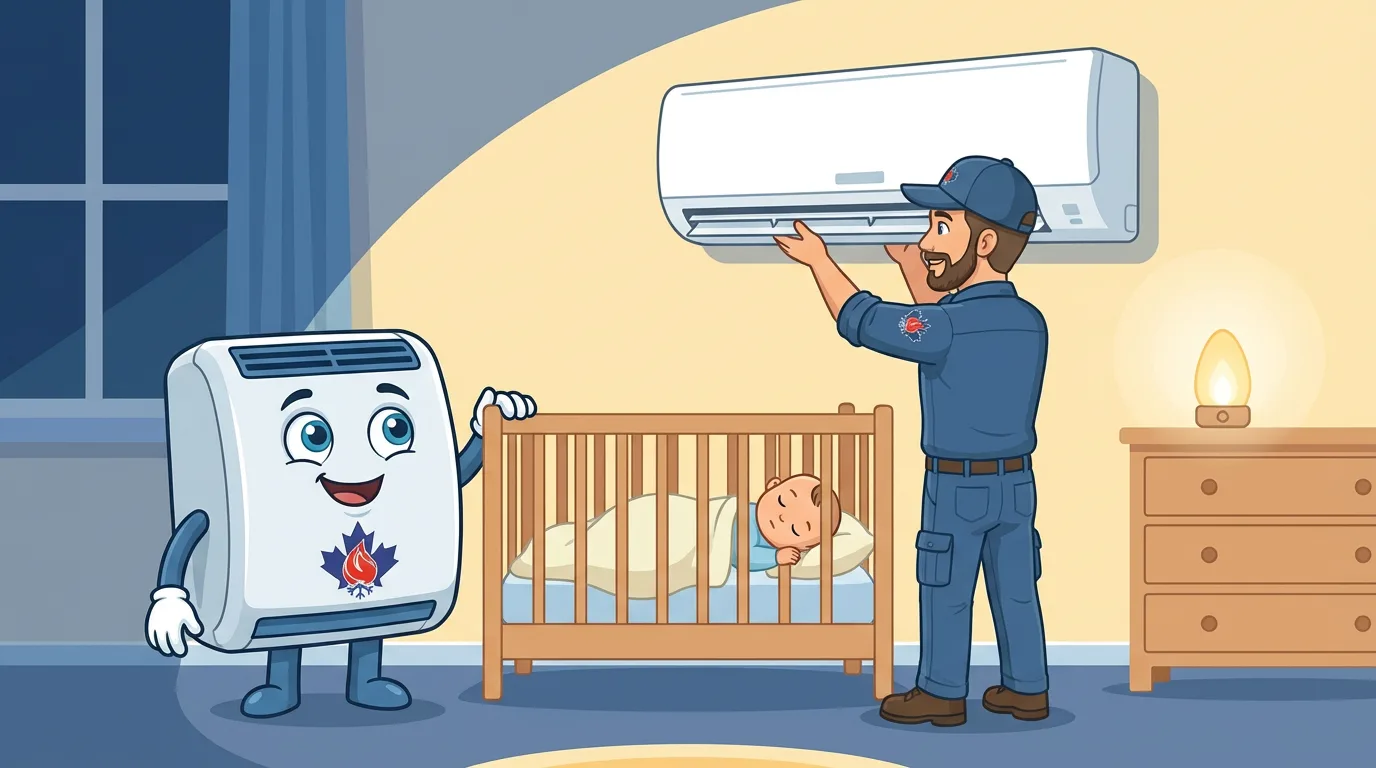
The 3 AM Call We Get From New Parents
It goes something like this.
“The baby is crying. The nursery is 28 degrees. The thermostat says the house is 22. What do I do tonight?”
Every summer in White Rock brings a wave of these calls. Older homes near the beach, newer developments on the bluff, ocean marine influence - and upstairs bedrooms that stay hot long after the rest of the house has cooled down.
A central AC set to 22°C can easily leave the master and nursery bedrooms at 27 or 28°C. That is not a system malfunction. It is the normal physics of a single-zone system in a two-storey home.
This guide covers what actually works for keeping a nursery cool during a heat wave - ranked by effectiveness, safety, and realistic cost. Written for White Rock parents who have tried the obvious things and need a better answer.
Safe Nursery Temperature Ranges
Pediatric sleep guidance for temperature:
| Child Age | Ideal Nursery Temperature | Maximum Safe |
|---|---|---|
| Newborn (0 to 3 months) | 19 to 21°C | 24°C |
| Infant (3 to 12 months) | 19 to 22°C | 25°C |
| Toddler (1 to 3 years) | 19 to 22°C | 26°C |
| Preschool+ (3+ years) | 20 to 23°C | 27°C |
Above the “maximum safe” number, overheating is a genuine health concern - not just comfort. SIDS risk for infants rises in overheated sleep environments.
Health Canada and the Canadian Paediatric Society both recommend keeping infants’ sleep environments below 24°C during heat events. For a White Rock nursery in July, that usually requires active cooling.
Why Nurseries Run Hot
Nurseries are often the worst room in the house for heat, for three overlapping reasons:
- Upstairs location - heat rises, upper floors run 3 to 6°C warmer than main floors in most BC homes during heat waves
- Small room volume - smaller space heats up faster from internal loads (baby monitors, night lights, body heat)
- Blackout curtains closed all day - traps solar heat from morning sun even with curtains closed
Add west-facing exposure (common in White Rock homes with an ocean view orientation) and you have a room that is physically designed to stay hot.
Options Ranked by Effectiveness
Option 1: Portable Fan
A simple fan circulates air, which helps skin feel cooler through evaporation.
Cost: $40 to $150.
Effectiveness: mild. Does not lower air temperature.
Safety notes:
- Keep out of reach of the crib - cords and blades are both risks
- Use tower or pedestal fans with enclosed blades for rooms where a child can reach
- Avoid pointing directly at an infant for extended periods (drying, comfort issues)
Best for: rooms that are 1 to 2°C above comfort range, or as a supplement to other cooling.
Option 2: Portable AC
Standalone AC unit with a window exhaust hose.
Cost: $400 to $900 for quality units.
Effectiveness: moderate. Can drop room temperature 5 to 8°C below outdoor in most conditions.
Safety notes:
- Noise levels 50 to 60 dB - may affect infant sleep
- Window seal kit quality matters for real performance
- Single-hose models pull conditioned air from the rest of the house (inefficient)
- Dual-hose models (more expensive) are significantly more effective
Best for: renters, temporary solutions, families who prefer a mobile unit.
Option 3: Window Unit AC
Window-mounted AC, installed in the nursery window.
Cost: $250 to $600 for the unit, plus install.
Effectiveness: good. Dedicated cooling for that room.
Safety notes:
- Blocks the window - safety egress consideration for older children
- Heavier models can be unsafe without proper mounting brackets
- Noise varies by model; some are nursery-friendly, others are not
- Security concerns - window units are easier to push in from outside
Best for: rentals or homes where a permanent install is not feasible. Not ideal for nurseries long-term due to window access and security.
Option 4: Ductless Mini-Split (Best for Long-Term)
Permanent ductless heat pump head installed on the nursery wall, connected to an outdoor unit.
Cost: $4,500 to $7,500 installed for a single zone.
Effectiveness: excellent. Dedicated temperature control, quiet operation, independent of the main HVAC.
Safety notes:
- Mounted high on the wall, out of reach of children
- Quieter than any portable AC option (19 to 32 dB on low speed)
- No cords, no blocked windows, no security concerns
- Provides heating in winter as well as cooling - year-round utility
Best for: owners planning to stay 5+ years, families who value quiet operation, homes where the nursery has been a persistent problem room.
The ductless mini-split is almost always the right answer for families with multiple children, persistent nursery temperature issues, or plans to use the room long-term. The upfront cost is real; the sleep-quality return on investment is hard to overstate.
Quick Comparison
| Option | Cost | Effectiveness | Quiet for Sleep? | Permanent? |
|---|---|---|---|---|
| Portable fan | $40 - $150 | Mild | Variable | No |
| Portable AC | $400 - $900 | Moderate | Loud | No |
| Window AC | $250 - $600 + install | Good | Loud | Semi |
| Ductless mini-split | $4,500 - $7,500 | Excellent | Very quiet | Yes |
Quick Fixes During an Active Heat Wave
If the heat wave is here now and a permanent solution is not possible:
- Close blinds and curtains all day - even if the room already feels hot, opening lets in more heat
- Run the central AC on a lower setpoint during the afternoon - overcool the house before bedtime so thermal mass works in your favour
- Position a fan to pull cool air from downstairs - place a fan in the stairwell pointing up, or in the nursery pointing at the door
- Use thinner sleep clothing for the child - single layer, no sleep sack during heat waves
- Ice pack trick - a large frozen water bottle in a shallow pan with a small fan blowing across it can lower localized temperature 2 to 3°C
- Move the baby temporarily - if the nursery is truly unsafe, the main floor is usually cooler
White Rock Specifics
- Beach-area bungalows - single-floor homes often cool more evenly, but poorly insulated attics above bedrooms can trap heat
- Older cottages (pre-1980) - minimal insulation, west-facing exposure typical; these homes benefit most from ductless
- Newer bluff-top homes - more likely to have AC already, but often single-zone central systems that leave upstairs bedrooms hot
- Marine influence - overnight cooling is usually more effective than 5 km inland, which helps; but hot marine air holds humidity that makes comfortable sleep harder even at moderate temperatures
Noise and Sleep Quality
Nursery cooling has a second consideration most guides ignore: noise.
Infants and young children are highly sensitive to sleep-environment noise. A cooling solution that drops the temperature but creates 55 dB of continuous noise may make sleep worse, not better.
Ranked by noise profile (quieter is better):
- Ductless mini-split on low (19 to 32 dB) - whisper quiet
- Modern ceiling fan (20 to 35 dB)
- Premium window AC on low (40 to 45 dB)
- Tower fan (35 to 50 dB)
- Portable AC (50 to 60 dB)
- Older window units (55 to 70 dB)
For children sensitive to sleep noise, the ductless option’s acoustic advantage alone often justifies the cost.
Bottom Line for White Rock Parents
Three realistic answers:
- Active heat wave, need tonight: fan + closed blinds + lower central AC setpoint during the afternoon
- This summer only: portable or window AC for the nursery, budget $400 to $700
- Multiple children, staying 5+ years: ductless mini-split in the nursery, $4,500 to $7,500 one-time - eliminates the problem for the rest of the home’s ownership
For most White Rock families with ongoing nursery temperature issues, a single-zone ductless mini-split is the upgrade that pays back in sleep quality, child health, and your own sanity through every subsequent heat wave.
Call 604-991-4894 or book an in-home assessment to discuss options for a White Rock nursery. We can often have a ductless install completed within 7 to 10 days of assessment during non-peak times.
Frequently Asked Questions
Health Canada recommends keeping infant sleep environments below 24°C. The Canadian Paediatric Society echoes this. Above 25°C for extended periods raises SIDS risk for young infants. For older children, 26 to 27°C is acceptable though not ideal for sleep quality.
Yes, with noise considerations. Portable ACs run 50 to 60 dB, which can disrupt infant sleep. If using one, position it away from the crib and plan for white-noise tolerance. Single-hose models are less efficient; dual-hose units are worth the extra cost for serious use.
Yes - ceiling fans are generally safe above sleeping children, and the Canadian Paediatric Society notes they may reduce SIDS risk by improving air circulation. Keep the fan speed low. Position the crib so the child is not directly under the airflow.
Single-zone installs (one indoor head for the nursery) are typically one-day jobs. We arrive around 8 AM, finish by mid-to-late afternoon. Minimal dust or disruption - no ducts, no major openings. Your baby can sleep in the room that night.
Single-zone ductless installs in homes already heated by electricity typically qualify for smaller BC Hydro rebates. Homes converting from gas heat see larger rebates but require whole-home cold-climate system qualification. Most single-zone nursery installs see $500 to $1,500 in rebates.
Ductless systems can route refrigerant lines up to 50 metres from the outdoor unit, so most homes can be serviced regardless of room location. The installer handles line routing during the assessment. If line length is a concern, a detailed site visit gives you a definitive answer.