Most Homeowners Buy the Wrong Filter
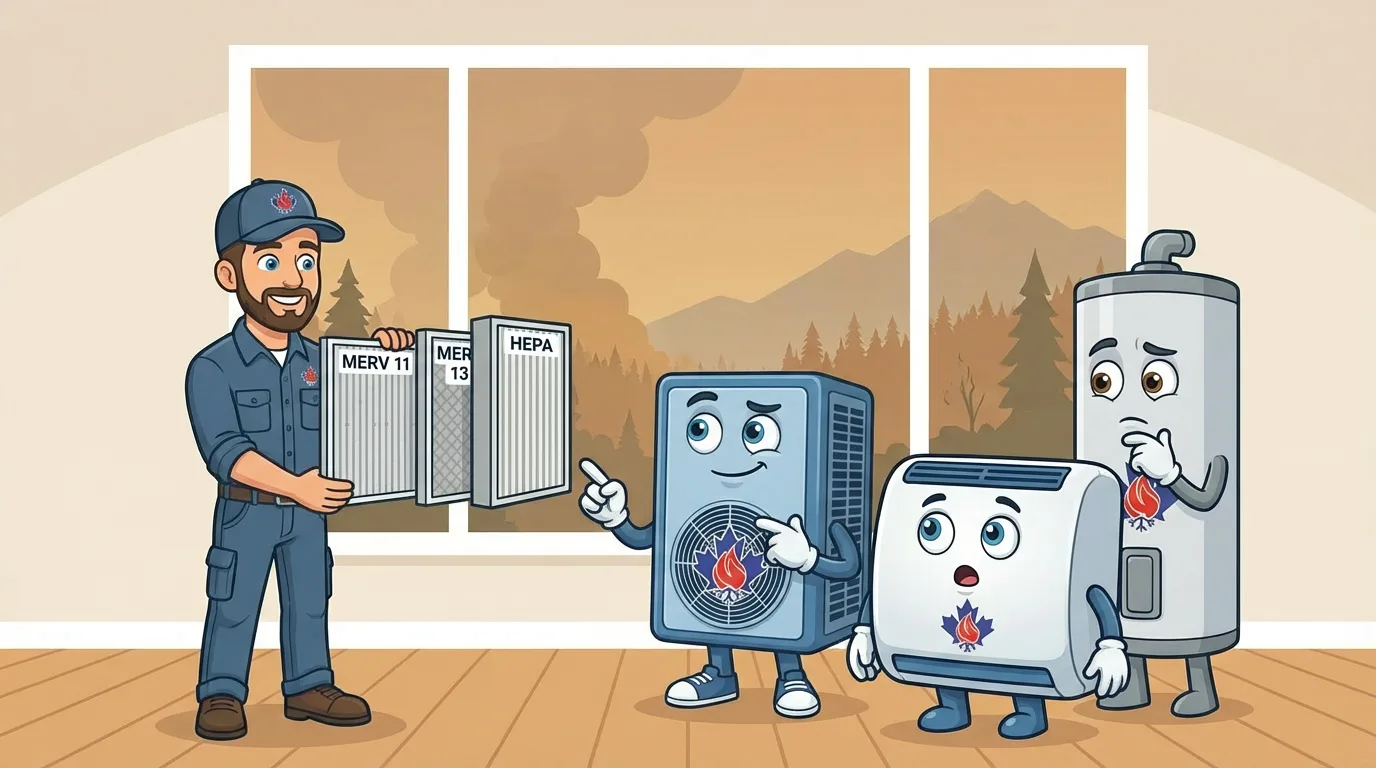
Walk down the filter aisle at any hardware store and you will see a confusing wall of ratings: MERV 5, MERV 8, MERV 11, MERV 13, “allergen”, “pet”, “HEPA-grade”.
Most of those labels are marketing.
Only two measurements actually matter for wildfire smoke: the MERV rating and whether your HVAC system can handle that filter without starving the blower.
For Pitt Meadows homeowners - sitting in the same Fraser Valley smoke channel that makes Mission difficult - this decision matters more than in Vancouver or the North Shore. This guide cuts through the marketing and covers what each rating actually does.
The MERV Scale, Explained Simply
MERV (Minimum Efficiency Reporting Value) is an industry standard that measures how effectively a filter captures particles of various sizes.
Higher MERV = smaller particles caught = better filtration.
Higher MERV also = more resistance to airflow.
That second point is what separates sensible choices from problematic ones.
| MERV Rating | Catches | Common Use |
|---|---|---|
| 1 - 4 | Large particles, lint, hair | Basic protection for the equipment only |
| 5 - 8 | Dust, pollen, pet dander | Most default builder-grade filters |
| 9 - 12 | Fine dust, mould spores, auto fumes | Upgraded residential standard |
| 13 - 16 | Bacteria, smoke particles, virus carriers | Premium residential, commercial |
| 17 - 20 (HEPA) | Sub-micron particles, smoke, pollen | Hospitals, cleanrooms, standalone units |
Particle Capture by Size
Wildfire smoke particles are overwhelmingly in the PM2.5 range - particles 2.5 microns or smaller.
Here is how each rating performs against particles in that size range:
| Filter | PM2.5 (smoke) capture | PM10 (dust, pollen) | 0.3 micron (virus, bacteria) |
|---|---|---|---|
| MERV 8 | 20 - 30% | 50 - 70% | Under 20% |
| MERV 11 | 65 - 75% | 85 - 90% | 30 - 40% |
| MERV 13 | 85 - 90% | >90% | 50 - 60% |
| MERV 16 | >95% | >95% | >75% |
| True HEPA | >99.97% | >99.97% | >99.97% |
For Pitt Meadows wildfire smoke, MERV 11 is the minimum worth considering. MERV 13 is the sweet spot. HEPA is overkill for most homes and usually impractical to install in a residential HVAC system.
The Airflow Trade-Off
Higher-MERV filters restrict airflow more.
Your furnace’s blower was sized for a specific range of filter resistance. Push the filter too high, and:
- The blower works harder, using more electricity
- Heating and cooling capacity drops (reduced airflow means reduced heat transfer)
- The blower motor wears faster due to higher load
- In worst cases, the system can overheat or freeze
This is why not every system tolerates every filter.
What Your System Can Handle
| System Age / Type | Safe MERV Ceiling |
|---|---|
| Pre-1995 furnace | MERV 8 - sometimes 11 with caution |
| 1995 - 2010 standard furnace | MERV 11 - sometimes 13 with caution |
| 2010+ furnace with ECM motor | MERV 13 is usually safe |
| Modern heat pump air handler | MERV 13 typically safe, some handle 16 |
| Any system with oversized return ducts | Higher ratings possible - verify with static pressure test |
If unsure, have a tech measure your system’s static pressure with the filter you are considering. Static pressure above 0.5 inches of water column means the filter is likely too restrictive.
MERV 11: Minimum Viable Option
MERV 11 catches roughly 65 to 75% of PM2.5 wildfire smoke particles.
For most homes that means noticeably better indoor air during smoke events, without any HVAC compatibility concerns.
Best for:
- Older furnaces or systems where MERV 13 causes airflow issues
- Vacation homes or rental properties with lower baseline expectations
- Households without specific respiratory concerns
Typical cost: $15 to $30 per filter. 60 to 90 day replacement interval normally, 30 to 45 days during active smoke events.
MERV 13: The Sweet Spot
MERV 13 catches 85 to 90% of PM2.5 - a meaningful jump from MERV 11.
It is the level recommended by Health Canada for wildfire smoke protection in residential settings.
Best for:
- Most Pitt Meadows homes with furnaces newer than 2005
- Households with asthma, allergies, or young children
- Homes in areas with recurring smoke exposure
Typical cost: $25 to $55 per filter.
Check airflow compatibility before first install - particularly for homes with undersized return ducts (common in pre-2000 builds).
HEPA: When It Actually Makes Sense
True HEPA (99.97%+ capture at 0.3 microns) is rarely practical in a residential HVAC system because of airflow resistance.
What you typically see marketed as “HEPA filtration” in home HVAC falls into two categories:
True HEPA - Bypass Systems
A sidestream HEPA unit that filters a portion of total airflow through HEPA while the rest passes through standard MERV.
Cost: $1,500 to $3,500 installed.
Best for: homes with serious respiratory conditions where true HEPA filtration matters.
Portable HEPA Units
Standalone room air purifiers with true HEPA filters.
Cost: $300 to $800 per unit.
Best for: specific rooms (bedrooms, nurseries, home offices) during smoke events.
For most Pitt Meadows families, MERV 13 in the HVAC + one portable HEPA in the primary bedroom is a better combination than trying to upgrade the entire HVAC system to HEPA standards.
Filter Thickness Matters
Standard 1-inch filters have limited surface area. 4 and 5-inch media filters have 4 to 6 times the surface area and:
- Last 3 to 6 months vs. 1 to 2 months
- Offer lower airflow restriction at the same MERV rating
- Usually cost 3 to 4x more per filter but last 3 to 6x longer
If your system has a media cabinet (built for 4-inch or 5-inch filters), use it. If it only has a 1-inch slot, upgrading the filter cabinet is a $400 to $800 install that pays back over the years.
Common Mistakes
Mistake 1: Buying Based on Marketing
“Allergen reduction” and “Germ Defense” and “Air Purifier Grade” are marketing labels. Check the actual MERV rating printed on the filter frame, not the front of the box.
Mistake 2: Upgrading Filter Without Checking System
Dropping a MERV 16 into a system sized for MERV 8 reduces airflow enough to damage the blower motor over time.
Mistake 3: Changing Filter Too Infrequently
During wildfire smoke events, filters load 2 to 3 times faster than normal. A MERV 13 that normally lasts 90 days may need replacement at 30 to 45 days during active smoke.
Mistake 4: Skipping Air Sealing
The best filter in the world cannot clean air that is entering through poorly sealed windows, leaky doors, and open fireplace dampers. Envelope matters as much as filtration.
Pitt Meadows Context
Pitt Meadows sits in the same Fraser Valley smoke channel that makes Mission difficult, with similar seasonal exposure patterns.
Local factors that matter:
- Newer housing stock than much of the Valley - most homes built after 2000 have systems that can tolerate MERV 13 without modification
- River-front proximity - humidity can be higher than the Valley average, which affects filter loading rates
- Open space exposure - homes near the Pitt Meadows Regional Airport or the dike system see more particulate loading during dry summer stretches
Bottom Line for Pitt Meadows
Three simple answers:
- Standard home, no respiratory concerns: MERV 11 is fine
- Children, allergies, or recurring smoke concerns: MERV 13
- Serious respiratory conditions or very sensitive occupants: MERV 13 in HVAC + portable HEPA in primary bedroom
Verify compatibility with your specific system before first install. If you are unsure whether your furnace can handle MERV 13, a static pressure check during a tune-up gives you a definitive answer.
Call 604-991-4894 or book an IAQ assessment for your Pitt Meadows home. We test your existing system’s filter compatibility and recommend the rating and replacement schedule that gives you the best smoke-season protection.
Frequently Asked Questions
For most furnaces made after 2005, yes. Older systems or those with undersized return ducts may see reduced airflow that warrants a system check first. A static pressure measurement during a tune-up gives you a definitive answer before you commit to a new filter standard.
Not directly. True HEPA filters restrict airflow too much for standard residential furnaces. HEPA-bypass systems or standalone portable HEPA units are the practical options. For most homes, a MERV 13 in the furnace plus a portable HEPA in key rooms is the better combination.
Every 30 to 45 days during active smoke events, versus the normal 60 to 90 day interval. Smoke particles load filters 2 to 3 times faster than ambient dust. A visibly grey or black filter that was white a few weeks ago is normal during a major event.
Usually not. Most homes built after 2000 have return ducts sized for MERV 13 operation. Older homes sometimes need a return duct upsize ($400 to $900) or a media cabinet upgrade to handle higher-MERV filters without airflow problems.
A 4-inch MERV 13 filter runs $45 to $90, roughly 3x the cost of a standard 1-inch MERV 13. But the 4-inch lasts 3 to 6 months vs. 1 to 2 months for a 1-inch, and has lower airflow restriction. Net cost per year is similar or slightly lower for the 4-inch, with better system performance.
Standard MERV filters catch particles but do not remove odours. Activated carbon filters address smell but do not typically capture fine particles effectively. Systems that combine both - such as media cabinets with a MERV 13 pleat plus a carbon pre-filter - handle both at once. Replacement frequency for carbon filters is more rigid (typically 3 to 6 months regardless of loading).