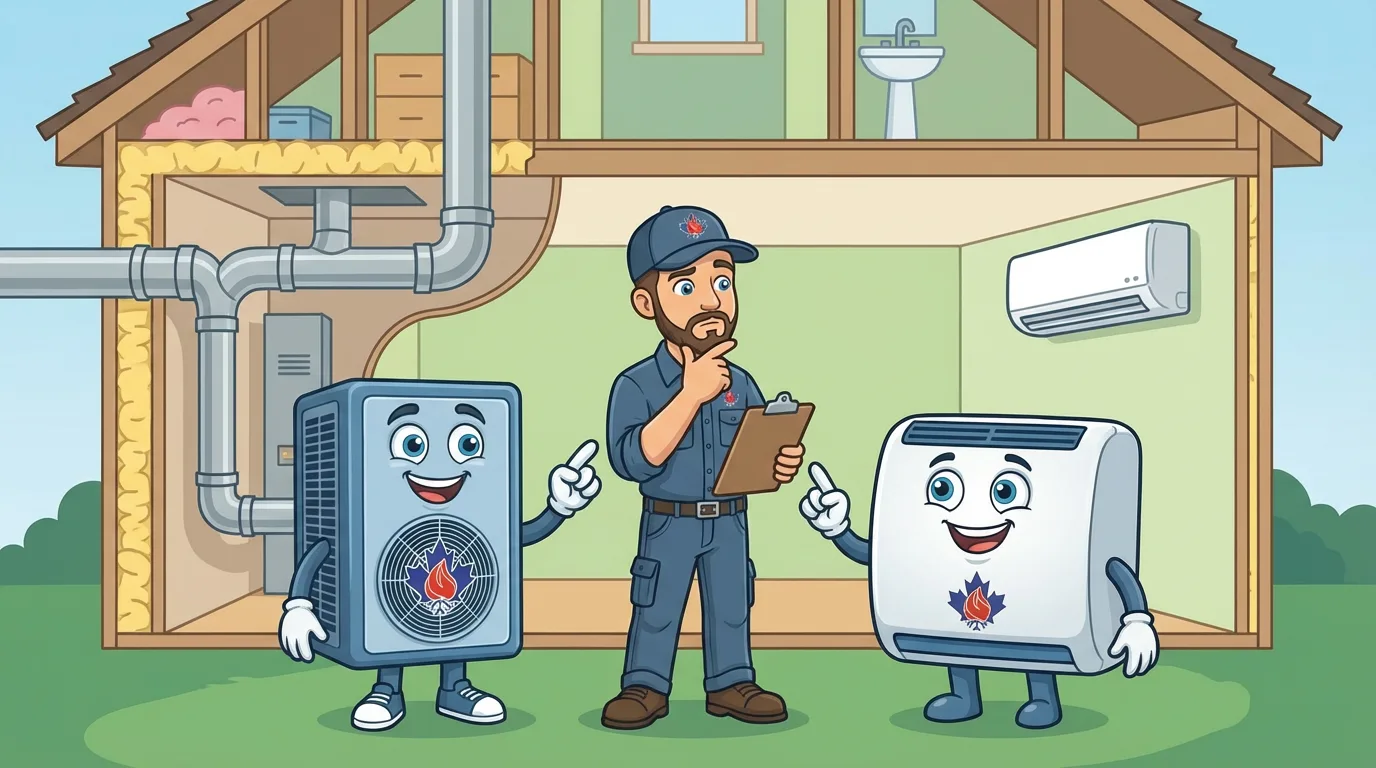
The Decision Most Langley Homeowners Face First
Almost every Langley homeowner researching a heat pump upgrade hits the same fork in the road within 48 hours:
Ducted or ductless?
The decision shapes everything downstream - budget, timeline, which brands and models make sense, how much disruption the install creates, and how the finished system feels to live with.
It is also the decision where advice circulating online is most likely to be wrong or dated. The cost delta between the two approaches has narrowed considerably in the last three years.
This guide is for Langley homeowners making that decision in 2026 - from older Brookswood bungalows to newer Willoughby townhouses to rural Langley acreage homes.
Written from the installer side, based on what we see in Langley homes after 5 and 10 years of service. Deliberately opinionated where we have seen one approach consistently outperform the other.
What Each Approach Actually Means
Ducted Heat Pump
A ducted heat pump uses the same air distribution system as a traditional forced-air furnace.
A single indoor air handler (or a heat pump coil integrated into your existing furnace) moves conditioned air through the ductwork to registers in each room.
The outdoor unit contains the compressor and condenser. The indoor unit contains the evaporator and blower.
From the homeowner’s perspective: it looks and feels like a central AC paired with a furnace - except it both heats and cools, and uses only electricity.
Ductless Heat Pump (Mini-Split)
A ductless heat pump uses one outdoor compressor connected to one or more indoor units - wall-mounted, ceiling-cassette, or floor-mounted.
Each indoor unit independently heats and cools a specific zone. No air distribution through ducts - each head conditions the room it is mounted in.
Multi-zone systems can run two to eight indoor heads from a single outdoor compressor.
Head-to-Head Comparison
| Ducted | Ductless | |
|---|---|---|
| Typical installed cost (Langley) | $11,000 - $16,000 | $4,500 - $14,000 (varies with zones) |
| Requires existing ducts? | Yes (or major reno) | No |
| Whole-home coverage | Yes, standard | Requires multiple zones |
| Per-room temperature control | Limited (zoning panel needed) | Built in per zone |
| Energy efficiency (typical SEER2) | 17 - 20 | 19 - 25 |
| Cold-climate performance | Good on cold-climate models | Excellent on top-tier models |
| Install timeline | 1 to 3 days | 1 day (single zone) to 3 days (multi-zone) |
| Indoor aesthetics | Registers only, ducts hidden | Wall heads or ceiling cassettes visible |
| Retrofit complexity | Low if ducts exist, high if not | Low for any home |
| Rebate eligibility (CleanBC + BC Hydro) | Full amounts available | Full amounts if whole-home coverage |
When Ducted Wins
Your Home Already Has Ducts in Good Condition
If your Langley home has existing ducts that are reasonably well-sized, accessible, and free of major leakage, a ducted heat pump is usually the right call. The install is fast (often a one-day job), the aesthetics are invisible (no wall-mounted heads), and the per-room airflow can be balanced with properly sized registers. Many of our Langley installs follow this path because the home already had a gas furnace with decent ductwork.
You Want Whole-Home Uniformity
If your priority is “comfortable temperature everywhere without thinking about it,” ducted delivers this more gracefully than multi-zone ductless. You set one thermostat, the system handles the whole house, and you rarely think about it again. For families with young kids, frequent guests, or anyone who prefers set-and-forget comfort, ducted is the lower-maintenance choice.
You Want to Hide the Equipment
Ducted systems are invisible once installed. The only indoor component is the air handler, typically in a mechanical room, basement, or crawl space. No wall-mounted heads, no cassettes in the ceiling, no indoor cables snaking along exterior walls. For homes where aesthetics are a serious consideration - or a spouse who is not enthusiastic about seeing equipment on the wall - ducted is the clear winner.
When Ductless Wins
You Do Not Have Ducts (or Have Bad Ones)
Langley has a large number of homes built before central forced-air was standard, especially in older Brookswood, Murrayville, and rural Langley. Adding ducts to these homes is often prohibitively expensive - sometimes $8,000 to $15,000 before the HVAC equipment itself is even purchased. For these homes, ductless is almost always the right answer.
You Need Per-Room Control
If some rooms are always too hot or too cold (upstairs bedrooms in summer, home offices above garages, additions with long duct runs), multi-zone ductless solves the problem at the root. Each zone has its own thermostat and operates independently. For split-level Langley homes where this pattern is nearly universal, ductless often delivers better comfort than a ducted system of the same total capacity.
You Want to Condition Only Part of the House
If your Langley home has a primary living area plus a rarely-used basement, or an addition you want to treat as its own zone, ductless lets you do that efficiently. You pay for capacity only where you need it, and the zones you do not use do not consume energy.
You Want Maximum Efficiency
Top-tier ductless systems (particularly single-zone installations) hit SEER2 ratings in the mid-20s and HSPF ratings above 11, which are genuinely industry-leading. For homeowners who prioritize energy efficiency above all other factors, a well-sized ductless system is typically 10 to 20 percent more efficient than the equivalent ducted system, all else equal.
The Hybrid Approach
A lot of our Langley installs end up as hybrids.
Ducted heat pump handling the main floor through existing ductwork. Plus one or two ductless mini-splits for areas that were always uncomfortable:
- A bonus room above the garage
- A finished basement suite
- A sunroom addition
This pairing captures the “set and forget” benefit of ducted for the bulk of the house. And it solves the specific comfort problems that ducts alone were never going to fix.
Hybrid installs qualify for the same rebates as either approach alone. The incremental cost of adding a ductless zone runs $3,500 to $5,500 per head on top of the base ducted install.
For a Langley home with one chronically uncomfortable room, that math often works out very favourably.
Langley-Specific Patterns We See
- Older Brookswood / Murrayville detached homes - often have forced-air ducts, but the ducts are undersized and leaky. Ducted heat pump works, but duct remediation is usually needed. Budget another $1,500 to $3,000.
- Rural Langley acreages - frequently have hydronic or electric baseboard heat with no ducts. Ductless is usually the right answer, sometimes with 3 to 5 zones.
- Willoughby and Yorkson townhouses - typically have newer forced-air ducts in good condition. Ducted is usually the straightforward choice.
- Fort Langley heritage homes - ducts, if they exist, are often inadequate. Ductless is common here, and more aesthetically accepted given the age of the homes.
- Coach houses and legal secondary suites - ductless single-zone is almost always the right call because running ducts between the main house and the suite is both expensive and often not code-compliant.
Cost Breakdown for a Typical Langley Single-Family Home
| Scenario | Typical Install Cost | Estimated Rebates | Net After Rebate |
|---|---|---|---|
| Ducted, existing ducts in good condition | $12,500 | $5,000 - $7,000 | $5,500 - $7,500 |
| Ducted, existing ducts need remediation | $15,500 | $5,000 - $7,000 | $8,500 - $10,500 |
| Ductless, single zone (one room) | $5,500 | $1,500 - $3,000 | $2,500 - $4,000 |
| Ductless, 3-zone whole-home | $13,500 | $5,000 - $7,000 | $6,500 - $8,500 |
| Hybrid (ducted main + 1 ductless zone) | $16,000 | $5,000 - $7,000 | $9,000 - $11,000 |
Rebate amounts depend on income qualification and the specific equipment chosen; see our rebates page for current program details, or the rebate-specific guide for CleanBC and BC Hydro stacking rules that apply equally across the Lower Mainland.
Bottom Line for Langley
Most Langley homeowners end up with one of three answers:
- Existing ducts in good condition? Ducted heat pump is usually the right default.
- No ducts, or ducts in poor shape? Ductless - typically 2 to 4 zones for whole-home coverage.
- Ducts cover most of the house but one or two rooms are always uncomfortable? Hybrid - ducted plus a ductless zone for the problem area.
Call 604-991-4894 or request a quote for an in-home assessment. We will size the system, walk through both options with real numbers for your specific Langley home, and identify any duct or electrical work that needs to happen before the heat pump goes in.
Frequently Asked Questions
Usually yes, if the ducts are reasonably sized and in good condition. A duct inspection during the quote process will identify undersizing, leakage, or insulation issues. Most Langley homes built after 1990 have ducts that work with a modern heat pump; older homes often need minor remediation.
For top-tier single-zone systems, yes. For multi-zone ductless and mid-tier ducted systems, the efficiency gap shrinks to 5 to 10 percent. Most of the real-world difference comes from avoiding duct leakage, which can lose 15 to 30 percent of conditioned air in older homes.
Modern wall-mount heads are about the size of a large clock and quieter than a whisper on low speed. Most homeowners stop noticing them within a few weeks. Ceiling cassettes are even more discreet but require a suspended ceiling or deeper ceiling bay, which limits where they fit.
Yes - cold-climate ductless models rated to -25°C or -30°C handle Langley winters with capacity to spare. Older single-zone mini-splits from 10 years ago had cold-weather limitations, but current-generation equipment from Mitsubishi, Daikin, Gree, and Tosot performs well in everything Langley typically sees.
Single-zone installs are typically a one-day job, often finished by mid-afternoon. Multi-zone installs with 3 to 4 heads run 2 to 3 days, mostly driven by refrigerant line routing through walls and ceilings. Ducted installs in homes with existing ductwork are also one to two days.
Technically yes, but it is rarely cost-effective. The outdoor compressors are similar but the indoor equipment is different, and the capital invested in one approach is mostly sunk when you switch. Pick the right approach the first time rather than planning to migrate.