Two Programs. Up to $19,000 Stacked.
If you have been scrolling through old forum posts, you might think half a dozen rebate programs are lined up to pay for your heating upgrade.
Most of them are not.
The BC rebate landscape contracted significantly over the past two years. A lot of the dollar figures still circulating online come from programs that have closed to new applicants or been quietly folded into other initiatives.
That is especially frustrating in Vancouver, where every incentive dollar matters.
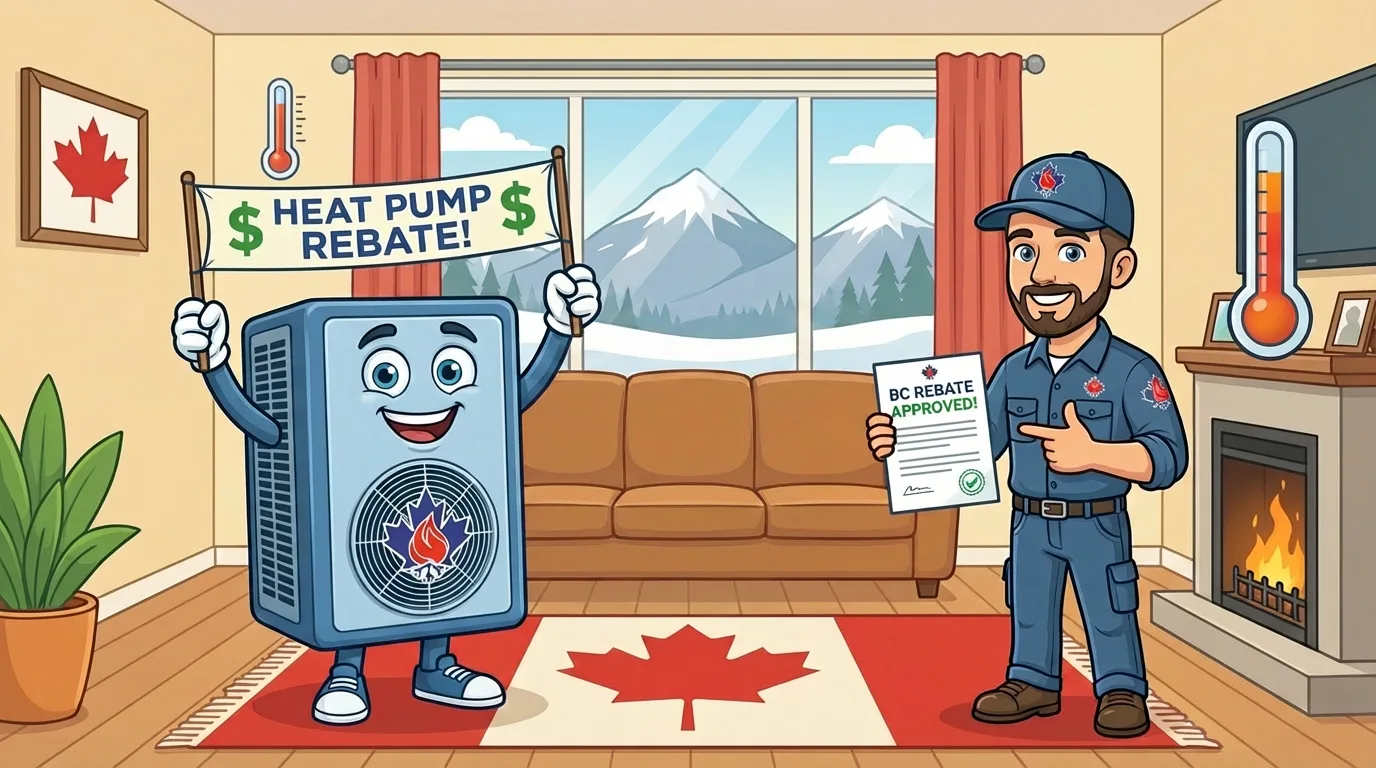
As of 2026, two active programs remain open to BC homeowners. Together they can stack up to $19,000 toward a new heat pump:
- CleanBC Better Homes - administered by the provincial government
- BC Hydro Power Smart - administered by BC Hydro for its electricity customers
That is the full active list for residential retrofits. The federal Canada Greener Homes Grant stopped accepting new applications in 2024, and older FortisBC renovation rebates have sunset.
What is left is a cleaner, simpler picture: two programs, both stackable, both applicable to most Vancouver homes heated by gas, oil, propane, or electric baseboards.
The simpler landscape has a catch. Advice from a friend who upgraded two years ago is probably out of date - program amounts, income thresholds, and approved-equipment lists have all shifted.
How the $19,000 Stack Actually Works
The $19,000 ceiling is not a single cheque, and the number itself can be misleading.
It is the combined total that becomes available when both programs pay at their upper tiers and income-qualified top-ups are triggered together. Most Vancouver households will see a smaller total - one that still makes a meaningful dent in the cost of a new heat pump.
Here is the realistic breakdown for a Vancouver single-family home in 2026:
| Program | Typical Range | Max (2026) | Key Condition |
|---|---|---|---|
| CleanBC Better Homes - Heat Pump | $3,000 - $6,000 | $6,000 | Replacing a fossil-fuel system with a cold-climate heat pump |
| CleanBC Income-Qualified Top-Up | $3,000 - $9,500 | $9,500 | After-tax household income below the regional threshold |
| BC Hydro Power Smart - Heat Pump | $1,000 - $3,000 | $3,000 | You must be a BC Hydro electricity customer |
| BC Hydro Income-Qualified Top-Up | up to $500 | $500 | Same income thresholds as CleanBC |
Most Vancouver households land between $4,000 and $11,000.
The $19,000 figure is reachable, but reserved for income-qualified homeowners installing a whole-home cold-climate heat pump that fully replaces their fossil-fuel system.
Why do the two programs stack cleanly? They are funded and administered independently. CleanBC flows from provincial carbon-tax revenue and federal cost-sharing. BC Hydro Power Smart is funded through ratepayer contributions to the utility’s conservation programs.
Neither program treats the other as a disqualifier. That is why most installers plan for both simultaneously rather than sequentially.
Who Qualifies for the Income-Qualified Top-Up?
Both CleanBC and BC Hydro use after-tax household income brackets, adjusted for family size and regional cost of living.
The Vancouver area uses the higher-cost-of-living brackets. A family of four earning $90,000 here may qualify for a partial top-up where the same family in a smaller BC community would not.
Approximate 2026 thresholds for a Vancouver family of four:
- Up to roughly $50,000 - full top-up eligibility
- $50,000 to $100,000 - partial top-up
- Above $100,000 - standard rebate only
These numbers shift each year. Confirm your exact tier before committing to equipment - the difference between tiers can be $3,000 to $6,000.
What Vancouver Homes Can Actually Claim
The rebate structure rewards full-home retrofits. Partial upgrades still qualify but at lower amounts.
Straightforward Qualifiers
- Single-family homes and townhouses with their own heating system
- Homes heated by natural gas, propane, oil, or electric baseboards
- Primary residences (not short-term rentals)
- Upgrades to a cold-climate air-source heat pump on the NEEP approved list
Edge Cases
- Condos - only qualify if each unit has a fully independent heating system. Most Vancouver condos do not.
- Single-zone mini-splits - eligible for smaller amounts unless they cover a meaningful share of the home’s heating load.
- New construction - not eligible. These programs are retrofit-only.
- Hybrid systems (heat pump + gas furnace backup) - eligible but at the lower end of the CleanBC range.
The Equipment Rules That Trip People Up
Both programs share the same approved-equipment list, which keeps decisions simple.
But the rules around installation and documentation still catch Vancouver homeowners off guard every month. The consequence of a misstep is almost always financial rather than technical - the heat pump still works, the rebate just does not arrive.
The most expensive mistakes tend to come from two places:
-
Homeowners self-coordinating an install with a contractor who is not registered with the programs
-
Treating the pre-approval stage as optional paperwork rather than a gating step
-
The heat pump must appear on the approved NEEP cold-climate product list
-
Installation must be completed by a registered program contractor
-
The old fossil-fuel equipment must be disconnected - you cannot use gas as the primary heat source with a heat pump as backup
-
The post-install invoice must be submitted within 6 months of completion
-
Pre-approval is strongly recommended, especially for income-qualified top-ups
Starting work before pre-approval is the single biggest reason Vancouver homeowners lose rebate money.
For income-qualified top-ups, all documentation must be filed before the contract is signed. The program administrator uses the contract date as the anchor for the income-verification window - a contract dated before your top-up approval cannot be retroactively covered.
We see this play out most often when a homeowner gets an urgent “my furnace just died” quote and signs the same day. The install goes fine. Four months later the rebate envelope is thinner than expected because the top-up was never properly queued.
Documents to Gather Before You Apply
You do not need everything in hand before you book an assessment. But getting these items together early makes the paperwork leg run smoothly.
For the income-qualified top-up specifically, missing paperwork is the top cause of multi-month rebate delays in Vancouver.
- Most recent Notice of Assessment (CRA) for every adult in the household
- Proof of home ownership (recent property tax notice or BC land title)
- Most recent BC Hydro bill for the service address
- Photos of your current heating equipment, including make, model, and serial number plates
- Any previous HVAC service records from the past three years, if available
Renting out part of your home? Bring the rental income breakdown too. Suite income is factored into household-income calculations but treated differently depending on whether the suite is legal or unregistered.
Your installer’s rebate coordinator can walk you through the specifics. Having the documents on hand saves a second trip.
Timing Your Install for Maximum Rebate
Rebate budgets reset on April 1 each year.
In high-demand years, top-up tiers can run out by late fall. Spring and early summer are the safer windows for homeowners hoping to claim the higher income-qualified amounts.
The other timing factor is equipment availability. Cold-climate heat pump inventory in BC tightens from July through September as installers work through the summer backlog. Specific models on the NEEP list can end up on 4 to 8 week backorders right when you want to be installing.
Locking in your equipment decision in April or May typically gives you the widest selection without having to compromise on sizing or brand.
A typical Vancouver rebate-tracked timeline with us:
- Week 1: In-home assessment and system design
- Week 2: Pre-approval submitted to CleanBC and BC Hydro
- Weeks 3-5: Equipment ordered and scheduled
- Week 6: Installation, commissioning, and old-equipment disconnection
- Week 7: Final paperwork submitted
- Weeks 15-23: Rebate cheques arrive
How Veteran HVAC Handles the Paperwork
We are a FortisBC Trade Ally and a registered contractor with both CleanBC Better Homes and BC Hydro Power Smart.
That matters because the paperwork load for the income-qualified top-up is significant. A single missing document can delay your cheque by months.
Our rebate coordinator has filed enough of these applications to know where each program tends to get picky:
- What CleanBC wants to see on a commissioning report
- What BC Hydro needs for proof of disconnection
- Which supporting documents can be submitted as scans versus originals
That institutional memory is the difference between a rebate cheque that arrives in 10 weeks and one that sits in a resubmission queue until the spring.
When you install with us, we handle:
- Program pre-approval submissions
- Equipment eligibility verification against the NEEP list
- Post-installation documentation (commissioning reports, old-equipment disconnection)
- Income-qualified top-up application if you qualify
- Follow-up with program administrators if your cheque is delayed
You sign the invoice. We do the rest.
Bottom Line for Vancouver Homeowners
The rebate landscape is smaller than it was two years ago. But the money still on the table is substantial enough to change the math on most heat pump upgrades.
A typical Vancouver home upgrading from a gas furnace to a cold-climate heat pump can realistically expect $4,000 to $7,000 in combined rebates. That often turns what looks like a $14,000 project into an $8,000 one.
Income-qualified households can push that into five figures. For families replacing an older oil or propane system, the payback window can be under five years once fuel savings are added.
Two rules to remember:
- Get pre-approval before signing the contract
- Use a registered program contractor
Everything else is paperwork we handle for you - from pre-approval submission through the final rebate cheque landing in your mailbox.
Call 604-991-4894 or send us a message to book a rebate-focused heat pump assessment for your Vancouver home.
Frequently Asked Questions
No. The federal Greener Homes Grant stopped accepting new applications in 2024. The Canada Greener Homes Loan (interest-free, up to $40,000) is still open but it is a loan, not a rebate. For 2026 rebates, your two active options are CleanBC Better Homes and BC Hydro Power Smart.
For households above the income-qualified threshold, the typical combined rebate is $4,000 to $7,000 on a whole-home cold-climate heat pump that replaces a gas furnace. Reaching the higher tiers requires qualifying for the income-based top-ups.
No, but it must be disconnected from active use. You cannot keep the furnace as your primary heat source and treat the heat pump as backup. Program auditors verify this during site inspections, and continued gas use will disqualify the rebate.
Typically 8 to 16 weeks from the day we submit the final paperwork, assuming everything is complete. Income-qualified top-ups can take longer because they require additional income verification.
Yes. As a registered program contractor, we handle pre-approval, equipment eligibility, post-install documentation, and the income-qualified top-up application if you qualify. You sign the forms; we manage the submission and follow-up.
Yes, the two programs are designed to stack. A single heat pump install can receive the CleanBC rebate (plus top-up if you qualify) and the BC Hydro rebate (plus its own smaller top-up). Each has its own application, but the supporting documents are largely the same.