Why Spring is the Right Time in Maple Ridge
The shoulder season between heating and cooling is the one window when your HVAC system is not being actively taxed.
That is exactly why it is the best window for a proper tune-up.
Temperatures in Maple Ridge sit in the 10 to 18°C range in April and early May. Cool enough that you do not miss the system for a few hours if something needs to be disassembled. Warm enough that a technician can run full cooling and heating cycles to take real measurements.
The other advantage is purely logistical.
The installer calendar in Maple Ridge still has flexibility in April. By early June, every reputable shop is booked three to four weeks out.
Here is what a tune-up technician can actually do in that shoulder window:
- Run the system in both heating and cooling modes without stressing it
- Take pressure readings at realistic ambient conditions
- Complete any repairs before the summer equipment backorder season starts
- Catch issues before they become emergency calls during the first heat wave
A proper spring tune-up takes 60 to 90 minutes on site for a single system. If someone quotes you 20 minutes for a “full tune-up”, they are doing a visual inspection and collecting a service call fee. The difference shows up in the paperwork - a real tune-up produces measurement readings you can compare year over year, while a visual inspection produces a generic checklist with no numbers on it.
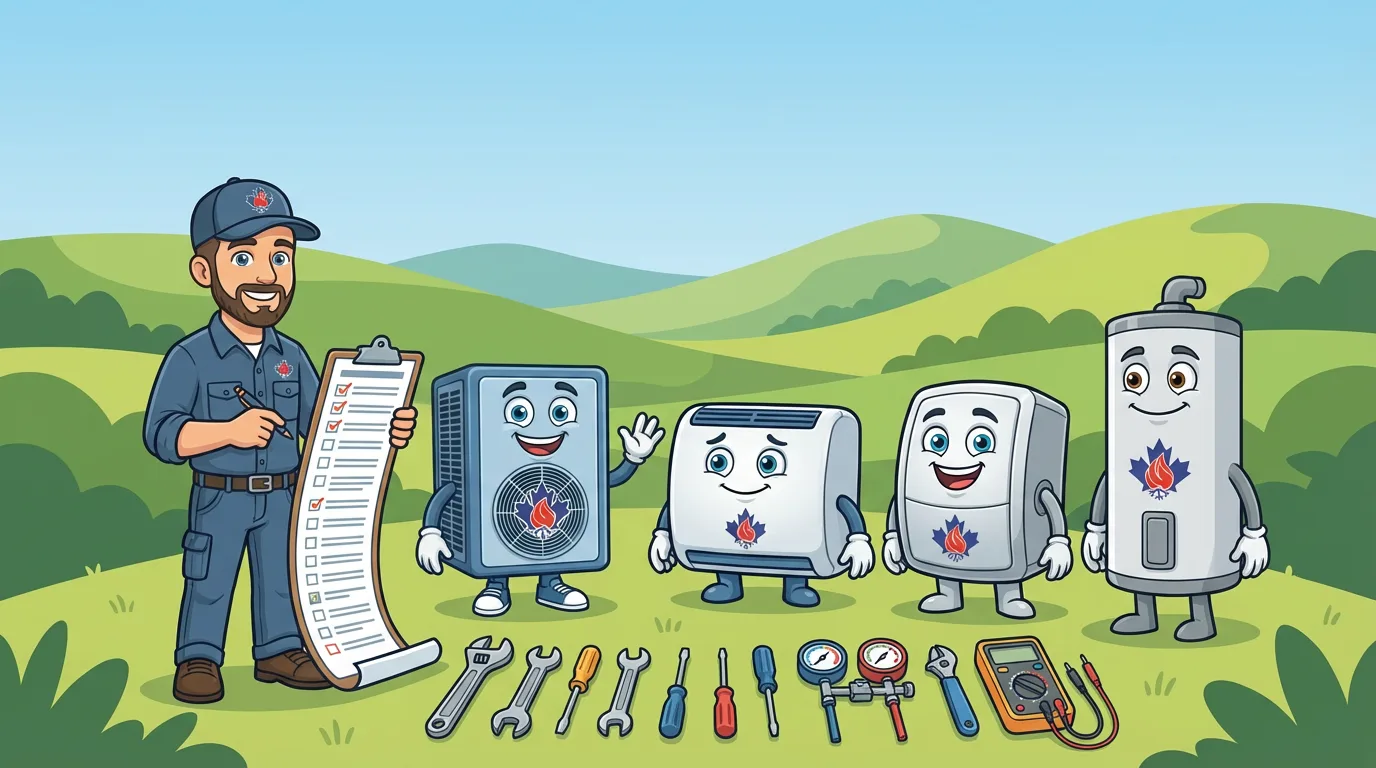
The 12-Point Checklist We Run
1. Outdoor Condenser Unit
- Clear all debris within a 2-foot perimeter
- Wash the coil from inside out with appropriate coil cleaner
- Inspect fins for damage; comb out any bent sections
- Check for level - a unit that has shifted on its pad stresses refrigerant lines
- Inspect the refrigerant line insulation for UV damage or rodent chew
2. Refrigerant Charge
- Hook up manifold gauges to measure suction and liquid line pressures
- Cross-check superheat and subcool against the manufacturer’s tag
- If the charge is off by more than 10%, locate the leak before topping up
A correctly-charged AC is 15 to 20% more efficient than an overcharged or undercharged one. This is the single highest-value item on the list for most homeowners, because small charge problems do not produce obvious symptoms - the system still runs, just less efficiently, and the difference quietly shows up on the hydro bill rather than as a comfort complaint.
3. Indoor Evaporator Coil
- Remove the access panel and inspect the coil visually
- Check for dust build-up on the fins, mould growth on the drain pan, and corrosion
- Clean the coil with appropriate no-rinse cleaner if build-up is present
4. Condensate Drain Line and Pan
- Flush the primary drain line with a vinegar solution to kill algae
- Verify the float switch triggers correctly (lifting it should shut the system off)
- Confirm the drain exits freely outside
- Check the secondary drain pan, if equipped, for rust or moisture
5. Blower Motor and Wheel
- Inspect the blower wheel for dust cake - a dusty blower loses 20 to 30% of its airflow
- Clean the wheel if needed (this is the step most “20-minute tune-ups” skip)
- Check motor amperage against the nameplate rating
- Lubricate bearings if the motor has oil ports (many modern ECM motors do not)
6. Air Filter
- Replace with MERV 8 to 13 appropriate to the system’s static pressure rating
- Verify the filter is installed with correct airflow direction
- Leave a labelled spare with the homeowner if requested
7. Electrical Connections
- Check all contactor points for pitting or arcing damage
- Torque-check terminal screws on the disconnect, control board, and transformer
- Measure capacitor microfarad rating against the nameplate - weak caps are the #1 cause of summer no-cool calls
- Inspect wiring insulation for heat damage or rodent activity
8. Safety Switches
- Test the high-pressure cutout
- Test the low-pressure cutout
- Verify flame sensor operation on the furnace side (for combined systems)
- Verify CO sensor operation if equipped
9. Thermostat
- Confirm programming is appropriate for spring schedules
- Test response time in both heat and cool modes
- Replace batteries if applicable
- Verify WiFi connection and remote access if applicable
10. Ductwork Inspection
- Visual check of accessible ducts for disconnected sections
- Check supply plenum insulation for sagging or detachment
- Note obvious leakage points for homeowner review
11. System Performance Test
- Run the system in cooling mode for 15 minutes and record supply/return delta
- Target delta-T: 18 to 22°F across the evaporator coil for Maple Ridge conditions
- If the delta is outside range, diagnose further (charge, airflow, or thermal expansion valve)
12. Documentation
- Photographs of equipment and all measurements
- Written report showing readings vs. manufacturer spec
- Specific recommendations, if any, with priority and estimated cost
What You Should See From a Legitimate Tune-Up
Ask for the report at the end. A tune-up that produces numbers is one you can use to track your system’s health over time and to demonstrate warranty compliance if something fails later. A tune-up that produces only a signed receipt is, in practical terms, no tune-up at all. The report should include:
| Measurement | Typical Healthy Reading | Red Flag |
|---|---|---|
| Supply/return delta-T | 18 - 22°F | Below 15 or above 25 |
| Refrigerant superheat | Within 5°F of spec | Off by 10°F or more |
| Capacitor microfarad | Within 6% of rating | More than 10% below rating |
| Blower motor amperage | Within 10% of nameplate | Above nameplate |
| Airflow (CFM per ton) | 350 - 450 | Below 300 or above 500 |
If your tune-up paperwork is a signed receipt with no measurements, you did not get a tune-up. You got a sticker.
Common Findings in Maple Ridge Homes
Maple Ridge housing skews older than the Metro Vancouver average.
Lots of 1970s to 1990s bungalows and split-levels, with pockets of newer Silver Valley and Albion construction.
That profile means more aging HVAC equipment per capita than newer communities. The tune-up findings reflect that. The spring issues we see most often:
- Weak capacitors - present in about 30% of units older than 8 years, even if the AC “seems fine”
- Clogged condensate drains - particularly in homes with below-grade furnace rooms where condensate pumps are involved
- Low refrigerant - about 15% of units more than 10 years old, usually a slow leak at a fitting
- Undersized return ducts - not fixable in a tune-up but worth flagging for future upgrade
- Disconnected flex ducts in attics or crawl spaces - surprisingly common in older homes
Pricing Expectations
Standalone spring tune-ups in Maple Ridge typically run $160 to $240 for a single system. Maintenance plan members pay less.
The price reflects the time a proper job takes, the cost of cleaners and replacement filters, and the measurement equipment a legitimate tune-up requires.
Beware of $59 tune-up coupons. Those are sales calls that will inevitably “find” $1,500 in urgent repairs.
Homeowners who take those coupons tend to end up replacing equipment that a straight-shooting tune-up report would have told them was fine for another three seasons.
Do You Need a Tune-Up Every Year?
For most Maple Ridge homes:
- Systems under 5 years old - every other spring is fine
- Systems 5 to 12 years old - every spring, without exception
- Systems over 12 years old - every spring, plus a fall heating tune-up
- Heat pumps - every year regardless of age (they cycle twice as much as single-function systems)
Book a tune-up at 604-991-4894 or request service online. Spring slots fill fastest in mid-to-late April, and by the time the first real heat wave hits in June the service calendar tightens to emergency-only. A little advance planning is the difference between a tune-up and a panic call.
Frequently Asked Questions
60 to 90 minutes for a single central HVAC system. Heat pumps and dual-fuel systems can take 90 to 120 minutes because both heating and cooling modes need to be tested. If a visit wraps up in 20 minutes, it was not a full tune-up.
An inspection is visual only - the tech looks at the equipment and writes a report. A tune-up includes cleaning, measurement, adjustment, and minor corrective work (capacitor replacement, drain flushing, electrical tightening). Tune-ups cost more but deliver measurable performance improvement.
Many manufacturer warranties require documented annual maintenance to stay valid. Keep your tune-up receipts and measurement reports for at least the length of your parts warranty (typically 10 to 12 years). Some warranties now require online registration of maintenance.
You can do 3 of the 12 items: filter replacement, outdoor unit clearing, and condensate drain flushing with vinegar. The other 9 require gauges, multimeters, and electrical safety training. DIY cleaning and filter work on a 3-month cycle complements an annual professional tune-up nicely.
Two tune-ups per year (spring cooling and fall heating), priority booking during heat waves and cold snaps, 15% off parts and repair labour, and documented measurement reports for warranty compliance. Plans start at a monthly rate that works out to less than the price of two standalone tune-ups.