Why Richmond Commercial HVAC Needs Its Own Pre-Summer Plan
Richmond’s commercial HVAC landscape is unlike almost any other municipality in Metro Vancouver. That means the pre-summer maintenance playbook needs to be different too.
The city has:
- The region’s highest density of food-processing warehouses
- A concentration of light-industrial shops along the Fraser River
- High-volume retail along No. 3 Road and in the airport mall cluster
- An unusually high percentage of buildings with rooftop package units rather than split systems or central plants
Add marine-influenced humid air from the Gulf of Georgia and salt exposure on the western edge of the municipality. You have a commercial environment where deferred HVAC maintenance compounds faster than it does further inland.
The Richmond business owners who avoid the July emergency-call scramble are the ones who treat May as an active maintenance window - not a quiet month.
Once the first real heat wave arrives - usually the last week of June or first week of July - the service calendar for every reputable commercial HVAC shop tightens to emergency-only work within about 72 hours.
Work booked in advance gets done on time. Work that waits for the first 30°C day gets done a week later. By then the rooftop unit you needed has already shut down mid-shift.
The Rooftop Unit Walkdown
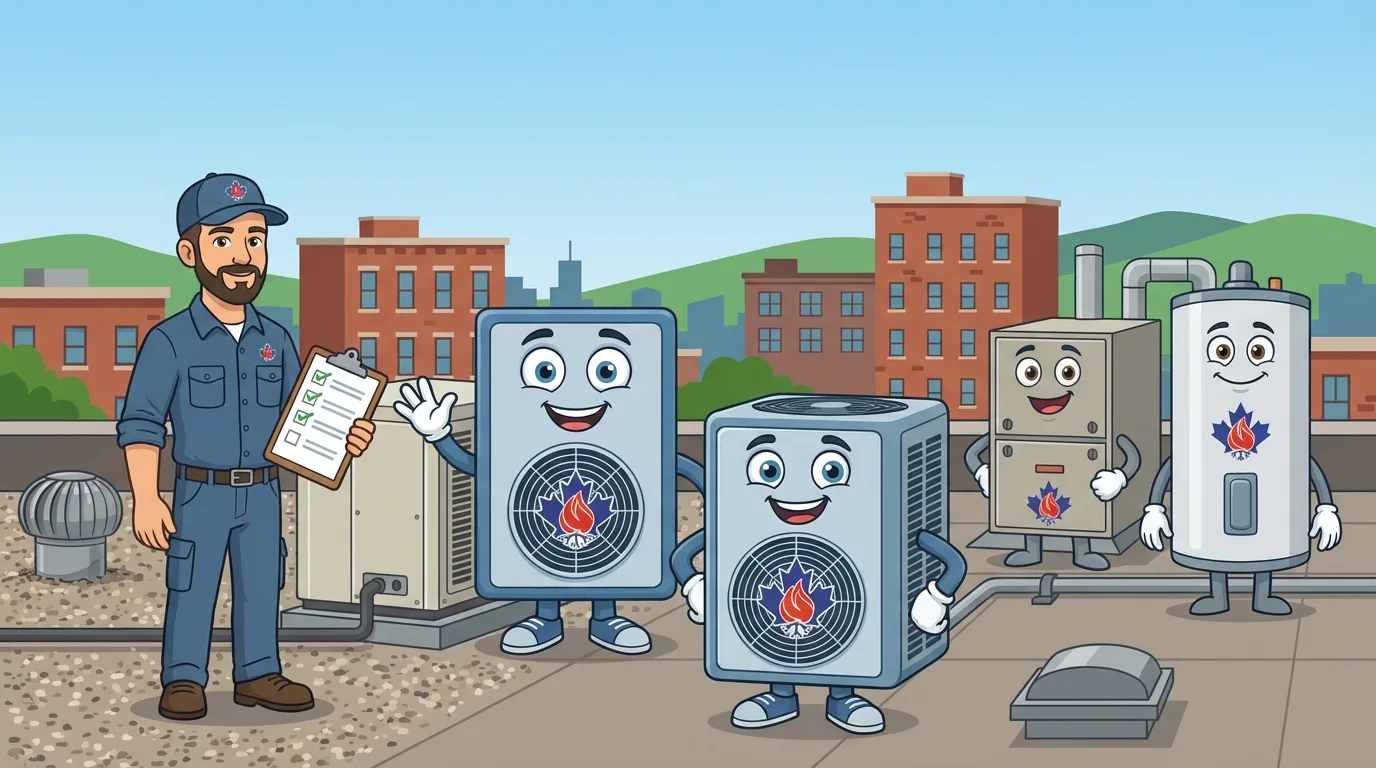
For most Richmond businesses - retail, restaurant, office, warehouse - the rooftop package unit is the single most important piece of mechanical equipment in the building, and also the one most likely to be forgotten until it fails. A proper pre-summer walkdown addresses the unit as a complete system rather than a list of isolated parts, because RTU failures almost always involve two or three components sliding out of spec at once.
Physical Inspection
- Check the condition of the unit’s cabinet, especially the base frame where winter snow load and standing water accelerate rust
- Inspect roof flashing and weatherproofing around the curb for winter damage
- Confirm all service panels are secured and the exterior disconnect is intact
- Look for evidence of rodent or bird nesting inside the economizer or fan section
Coil and Refrigerant System
- Wash the outdoor coil from the inside out with a cleaner appropriate to aluminum microchannel or copper-fin construction
- Measure suction and liquid pressures against manufacturer spec for the ambient temperature at the time of service
- Check subcool and superheat for signs of undercharge, overcharge, or a failing TXV
- Inspect refrigerant line insulation for UV damage, which is aggressive on unshaded Richmond rooftops
Electrical
- Torque-check all contactor terminals; contactor pitting is the single most common summer RTU failure
- Measure capacitor microfarad readings against nameplate; flag anything more than 10% below rating
- Inspect wiring insulation for heat damage around the compressor and fan motor
- Verify the disconnect is in good condition and appropriately sized
Controls and Building Automation Review
Many Richmond commercial buildings have some level of building automation, even if it is just a 7-day programmable thermostat. Pre-summer is the time to verify that the controls are actually doing what someone set them up to do, which is often not the case. We routinely find buildings running schedules that were set by a property manager two employers ago, with setpoints that made sense for an occupancy that no longer exists.
- Verify schedules reflect current operating hours - a lot of buildings are still running on 2022 or 2023 schedules
- Check setpoint ranges; summer cooling setpoints below 22°C waste energy without improving comfort
- Test occupancy sensors if installed - dead batteries in wireless sensors are a silent source of over-run
- Confirm economizer operation if equipped; a stuck-open economizer damper can drop effective cooling capacity by 30%
- Review alarm and fault history from the BAS - many units log recurring issues that operators have quietly learned to ignore
Ventilation and Indoor Air Quality
ASHRAE 62.1 ventilation requirements remain in effect regardless of season, but summer is when deficient ventilation becomes most noticeable. Richmond’s proximity to YVR and major transportation corridors means outdoor air quality can swing significantly - not just during wildfire season, but also during hot inversion days when ground-level pollutants concentrate. The pre-summer IAQ checklist:
- Replace all filters, not just the ones that are obviously dirty. Carbon pre-filters lose capacity on a time basis, not just a load basis.
- Upgrade to MERV 13 wherever system static pressure tolerates it; this has become the de facto standard for most commercial occupancies since 2020
- Verify makeup air units are operating and delivering design CFM, especially for restaurants where hood exhaust demand is high
- Check demand-controlled ventilation CO2 sensors if installed - recalibrate or replace any older than three years
Commercial Hot Water and Kitchen Support Systems
Restaurants, cafes, and food-service operations in Richmond have hot water and steam demands that peak when summer patio traffic arrives. A failing commercial tankless system or underperforming boiler that limped through spring will fail spectacularly at the worst possible time. Pre-summer tasks for hot water:
- Flush commercial tankless units for scale build-up (annual minimum, more often in harder-water neighbourhoods)
- Test temperature delivery at all fixtures under simulated peak load
- Inspect gas supply piping, especially exterior runs, for winter weather damage
- Verify combustion air provisions remain unobstructed
Priority Timeline for Richmond Businesses
| Window | Priority Actions | Why Now |
|---|---|---|
| Early May | Schedule all tune-ups, confirm parts availability | Parts lead times tighten by June |
| Mid-May | Complete RTU walkdowns, coil cleaning, electrical checks | Before ambient temperatures push equipment |
| Late May | Controls and BAS review, IAQ filter changes | Ahead of the first heat wave |
| Early June | Refrigerant verification under real load, final adjustments | Test in conditions that actually exist |
| Mid-June onward | Emergency-only work; avoid major projects | Service calendar tight, parts delivery slow |
The Real Cost of Deferred Maintenance
Deferring commercial HVAC maintenance in Richmond tends to cost three to eight times what the preventive work would have cost.
Once you factor in:
- Emergency call-out premiums
- Lost business hours
- Spoiled inventory (for restaurants and food service)
- Code violations if ventilation drops below required levels
A $600 preventive tune-up on a 7.5-ton rooftop unit is a cheap alternative to a $4,800 emergency compressor replacement during Friday evening service hours.
The cost that is harder to quantify is customer experience.
A retail location that becomes uncomfortable during a heat wave loses foot traffic that does not come back. Restaurants that lose kitchen cooling during dinner service get one-star reviews that persist for years.
For most Richmond businesses, the preventive maintenance budget is a tiny fraction of the revenue at risk.
Compliance Touchpoints
Richmond businesses should keep several compliance items in mind that tie into the pre-summer checkup:
- TSBC gas permit documentation should be current for all commercial gas-fired equipment
- Refrigerant handling records (for systems with regulated refrigerants) should be reviewed and updated
- Combustion safety testing for commercial boilers and water heaters is due annually
- Fire damper testing may be due depending on your occupancy classification
Keeping these up to date is a minor administrative task if done proactively and a major headache if a code inspection or insurance audit arrives first.
How Veteran HVAC Supports Richmond Commercial Clients
We provide commercial pre-summer maintenance across Richmond, from the airport area to Steveston to the industrial strip along No. 5 Road. Our typical commercial client signs a seasonal maintenance agreement that bundles spring and fall tune-ups, priority scheduling during heat waves and cold snaps, and after-hours emergency response. The predictable monthly cost is usually 15 to 30 percent less than pay-as-you-go maintenance, and the priority scheduling is often the difference between reopening the next day and waiting a week during a heat-wave equipment backlog.
Call 604-991-4894 or get in touch to schedule a pre-summer commercial walkdown at your Richmond location.
Frequently Asked Questions
Twice per year minimum - spring pre-cooling and fall pre-heating. High-runtime applications like restaurants and 24/7 warehouses benefit from quarterly service. BC building codes do not mandate a specific frequency, but refrigerant-handling regulations and most insurance carriers effectively require documented annual service.
A single 7.5-ton rooftop unit runs $450 to $650 for a full pre-summer service including coil cleaning and refrigerant verification. Multi-unit sites are priced per unit with volume discounts. Maintenance agreement members typically pay 20 to 30 percent less on a per-visit basis.
Yes for rooftop units - the work happens on the roof with minimal indoor impact. For split systems or central plants, there may be 30 to 60 minutes where cooling is interrupted. We typically schedule before peak hours (6 to 8 AM is standard for retail and food-service clients).
For low-runtime systems (office, retail) skipping one year rarely causes failure but accelerates coil fouling and reduces efficiency by 5 to 15 percent. For high-runtime systems, skipping can shorten compressor life by 20 to 40 percent and invalidate manufacturer warranties that require documented annual service.
Yes. We maintain refrigerant logs for each unit under service contract, file annual reports where required, and coordinate with property managers on TSBC gas permits and combustion safety documentation.
Yes, and we encourage it for chains and multi-site owners. A single agreement across multiple Richmond or Lower Mainland sites simplifies billing, keeps documentation consistent across locations, and unlocks multi-site pricing.