First Hot Day of the Year, First Cold Reality Check
Every May we get the same wave of calls from Burnaby homeowners:
“It hit 22 degrees today, I turned on the AC for the first time, and nothing is happening.”
Seven or eight months of sitting idle is rough on any piece of machinery. Central AC units are no exception.
What makes the first-warm-day wave especially bad is that it hits every installer in the region at the same time. The service calendar goes from comfortable in mid-April to booked solid by the end of May.
Homeowners who diagnose and address the small stuff themselves often skip the two-week wait for an emergency appointment.
The good news: most first-run-of-the-season issues come from a small list of predictable causes.
Work through them in order. The first few you can handle yourself in under fifteen minutes. The last couple need a certified tech.
Even if you end up calling anyway, having already ruled out the simple causes saves the technician diagnostic time - shorter service call, lower bill.
Quick Diagnostic Table
| What you see or hear | Likely cause | DIY or call? |
|---|---|---|
| Thermostat blank or unresponsive | Dead batteries or tripped low-voltage | DIY |
| System does nothing when called for cool | Breaker tripped, wrong mode, schedule override | DIY |
| Outdoor unit won’t turn on | Breaker, outdoor disconnect switch, dead capacitor | DIY first, tech if breaker re-trips |
| Outdoor unit hums, fan does not spin | Failed start capacitor | Call |
| Breaker trips repeatedly | Short, compressor fault, bad contactor | Call immediately |
| Vents blow air, but barely cool | Dirty filter, clogged coil, low refrigerant | Filter DIY, rest is tech work |
| Visible ice on copper lines or coil | Low refrigerant or airflow problem | Turn off, call |
| Indoor unit runs briefly, then shuts off | Clogged condensate drain, float switch tripped | DIY flush; call if it repeats |
| Water pooling around indoor unit | Clogged drain, cracked pan | Turn off, call |
1. Thermostat: Mode, Set Point, and Battery
This sounds obvious. It is also the most common cause.
Worth checking first because it takes about sixty seconds.
Modern thermostats have multiple modes, remote schedules, and sometimes a lingering memory of what season the system thinks it is. Any of those can end up in a state that looks nothing like “AC is on” - even when you meant for it to be.
- Is the thermostat actually set to Cool? If it was on Auto through the shoulder season, it may still be in heating mode.
- Is the set point below current room temperature? A thermostat set to 24°C when the room is 22°C will not call for cooling.
- Does your thermostat use AA or AAA batteries? They usually fail in early spring because the low-battery warning got ignored all winter.
Swap the batteries, confirm Cool mode, drop the set point 3 degrees below room temp, and wait 2 to 3 minutes for the system to respond.
2. The Breaker Might Have Tripped Over Winter
Central AC systems in Burnaby typically have two breakers: one for the indoor air handler or furnace and a separate one for the outdoor condenser unit. Power surges from winter storms, squirrel incidents in the outdoor disconnect, or simple age-related breaker fatigue can trip the outdoor breaker without anyone noticing until you try to use the system. This is especially common in older Burnaby homes where the outdoor disconnect sits in a weather-exposed location and has been dealing with eight months of rain and temperature swings.
Check both panels:
- Main electrical panel - look for the breaker labelled AC, A/C, or Condenser
- The disconnect box outside next to your condenser unit - flip it to On if it is Off
If a breaker trips again the moment you turn it on, stop there. That is an electrical fault and needs a tech.
3. Outdoor Condenser: Debris, Ice, and Critters
The outdoor unit spent seven months collecting leaves, pollen, blown garbage, and possibly a mouse nest. Before the system can run, airflow around and through the condenser coil needs to be clear. Burnaby’s tree canopy means maple keys and cottonwood fluff in particular end up matted against the coil by spring, and this is often the single fix that restores cooling on an otherwise healthy system. If the unit has also been used as an occasional patio side-table or plant stand over winter - we have seen it - clear the top surface too.
- Walk around the unit. Clear anything within 2 feet on all sides.
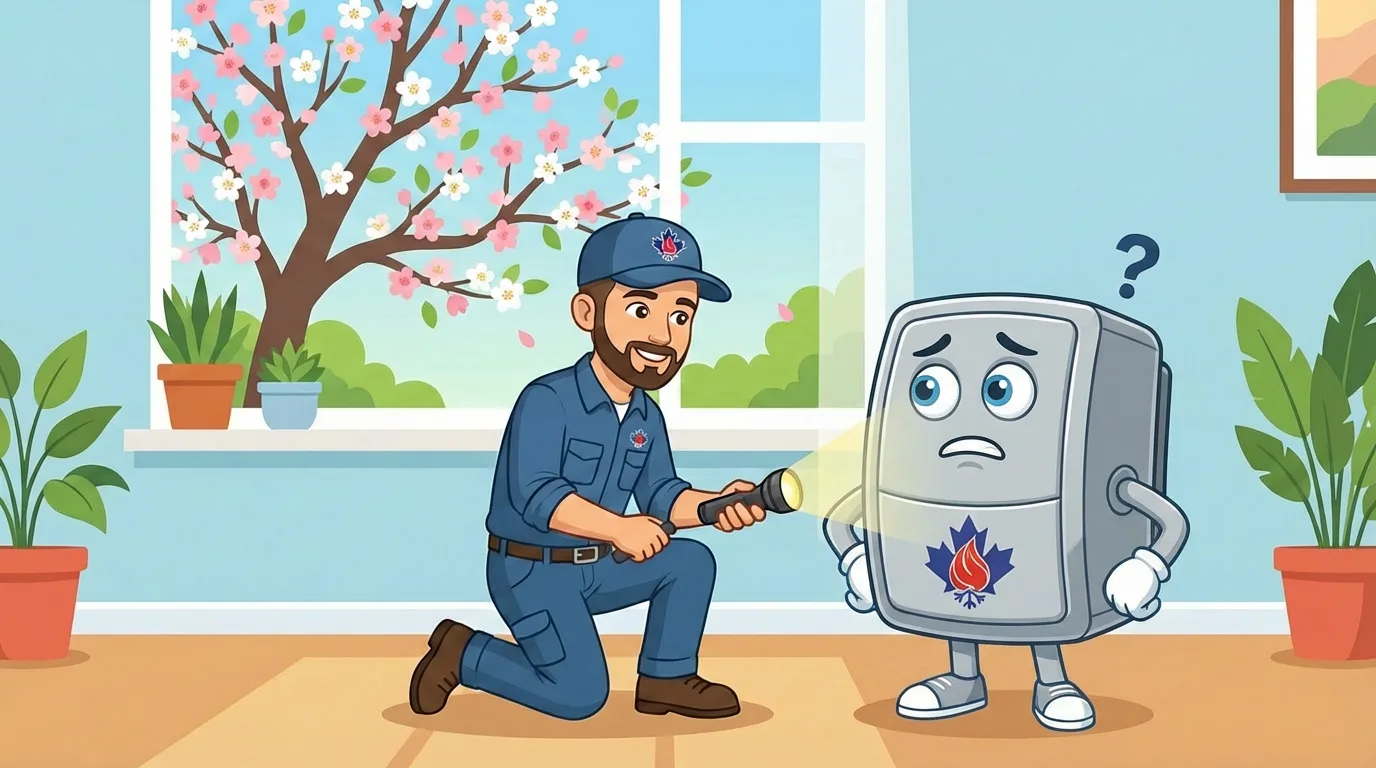
- Look through the top grille with a flashlight. Coil should be visible, not covered in a leaf mat.
- If you see a nest, do not just pull it out with gloves - check for live occupants first.
- Rinse the coil gently with a garden hose from the outside in. Low pressure only.
If the fins look crushed or badly bent, leave them - fin combing is a service-call job, not a DIY.
4. Indoor Filter: Almost Certainly Dirty
A filter that was fine last September is probably not fine now. Even unused, dust settles and winter furnace runs push stuff into the filter. A badly clogged filter will either prevent the system from reaching cooling temperature or cause the evaporator coil to ice over - which looks exactly like “the AC is not working.”
- Pull the filter. If you cannot see light through it, replace it.
- Standard pleated filters are fine for most Burnaby homes. MERV 11 is the sweet spot.
- Run the fan-only mode for 10 minutes after replacing to clear the duct dust.
5. Condensate Drain: The Summer Clog That Shuts Everything Down
AC units pull humidity out of the air and drain it away, usually through a small PVC line that exits the house or runs to a floor drain.
Over winter, that drain line can dry out, develop algae, or get a clog that only becomes visible the first time the system runs in humid weather.
The drain path is one of the few parts of an AC system that genuinely benefits from preventive annual cleaning. A clog here can stop the entire system from running - no matter how healthy the compressor and refrigerant charge are.
Many modern systems have a float switch in the condensate pan. If the drain is clogged, the float switch kills the system to prevent water damage to ceilings below.
Symptom: indoor unit runs briefly, then shuts off, and you see water pooling under it.
A Burnaby condensate overflow that reaches drywall is usually a $2,000 to $5,000 repair - before factoring in insurance deductibles and time without cooling.
Quick check:
- Look for the condensate drain line (usually 3/4 inch white PVC coming out of the air handler)
- Pour a cup of plain water into the access tee. It should drain freely.
- If it backs up, the line is clogged. A wet/dry shop-vac on the exterior drain outlet usually clears it.
6. Refrigerant and Icing: Symptom of a Bigger Problem
If the system runs but the air from the vents is barely cool, and the outdoor unit or indoor evaporator coil has visible ice on it, you are almost certainly low on refrigerant. This is not a DIY fix, and it is worth being skeptical of any contractor who offers to simply “top up” a system without diagnosing why the level dropped in the first place.
Low refrigerant means you have a leak. Adding refrigerant without finding the leak is a short-term patch that will fail again in weeks, and it wastes the expensive refrigerant that leaks back out. A technician will pressure-test the system, find the leak using an electronic detector or UV dye, make the repair, and then recharge to manufacturer spec using precise weight rather than gauge pressure. That last point matters because modern inverter systems are sensitive to even small overcharge or undercharge conditions.
If you spot ice on copper lines or the coil, turn the system off and let it thaw completely (4 to 6 hours) before the tech arrives. Running a frozen system damages the compressor.
7. Capacitor or Contactor: The “Humming but Not Running” Case
If the outdoor unit hums but the fan does not spin, or the fan spins for a moment and stops, the start capacitor has likely failed. Capacitors are a normal wear item and fail more often in the first run of the season after a winter of no use.
Symptoms:
- Humming sound from the outdoor unit with no fan movement
- Fan that starts with a manual push but stops when you release
- System clicks on and off rapidly (short cycling)
Capacitor replacement is a 30-minute job for a technician and inexpensive ($150 to $300 installed). Do not attempt it yourself - capacitors hold a dangerous charge even with the breaker off.
Burnaby-Specific Patterns We See
Burnaby has a mix of housing stock that makes it a useful case study for AC startup issues - older Burnaby East bungalows, mid-century North Burnaby homes, and newer Brentwood and Metrotown townhouses all have their own failure signatures. The problem patterns we see depend on home type, and knowing what is common for your vintage of house often narrows the diagnosis before a tech has picked up a meter:
- Older bungalows - condensate drain clogs are the #1 first-run issue, followed by outdoor unit debris
- Mid-century homes with retrofitted AC - capacitor failures are over-represented due to older wiring and fluctuating voltage
- Newer townhouses - thermostat programming errors are #1 - many are multi-stage systems where the default programming is set conservatively
When to Stop DIYing and Call
Call a tech if:
- Breaker trips again immediately after reset
- You see ice anywhere in the system
- There is water pooling indoors from the AC
- Outdoor unit hums but fan does not spin
- You completed the first 5 checks and the system still will not cool
Burnaby first-run service calls run us 45 to 90 minutes on-site in most cases, and we book spring appointments fastest in April before the heat wave volume hits in late May. If you are reading this in March or early April and your system has not been serviced in more than a year, a proactive tune-up costs less than an emergency call and tends to catch the issues in this list before they become a problem on the first hot afternoon.
Call 604-991-4894 or request service to get on the schedule.
Frequently Asked Questions
Most residential systems take 2 to 3 minutes to respond after a thermostat change, and 15 to 30 minutes to noticeably drop room temperature. If the vents are blowing cool air within 5 minutes, the system is working; reaching set point takes longer.
A bit louder than normal for the first 5 minutes is common - lubricant has settled and bearings are cold. If the noise is a new grinding, screeching, or metal-on-metal sound, shut the system off and call a tech. First-run noise that persists past 10 minutes is worth a service call.
Yes for systems older than 5 years, and every other year for newer systems. A tune-up catches the issues in this post before they cause a no-cool call during a Burnaby heat wave. Spring appointments are easier to book and cheaper than emergency summer service.
Usually yes. Swap the batteries first. If the display stays blank after new batteries, the 24V transformer in the furnace may have failed, which is a service call. Hard-wired thermostats that lose power often indicate an issue at the furnace end.
No. Handling refrigerant requires ODP certification in Canada, and adding refrigerant without finding the leak is a short-term patch that costs more in the long run. A proper repair locates the leak, fixes it, and recharges to manufacturer spec.