Pets Change the HVAC Math
If you have lived in a Delta home with pets for more than a season, you already know something non-pet homeowners do not.
Fur, dander, and pet-related dust accumulate in ways that quietly ruin HVAC efficiency and, in some cases, pet-owner respiratory health.
Delta is an especially pet-heavy community:
- Single-family homes with yards
- Proximity to Boundary Bay off-leash areas
- Agricultural surroundings of Ladner and the dike walks
It is a dog-friendly suburb in a way denser parts of Metro Vancouver are not. The HVAC load from pets, tracked-in dust from rural roads, and seasonal allergens is higher here than almost anywhere else in the Lower Mainland.
This guide covers what pet owners in Delta should know about running an HVAC system well through summer:
- Filter strategy
- Outdoor unit hazards
- Thermostat settings that keep pets comfortable when the house is empty
Most of it is low-cost. Much of it is DIY. A few items are the difference between a system that lasts 15 years and one that fails at year 9.
1. Filter Frequency: Double the Normal Recommendation
Standard HVAC advice suggests replacing filters every 90 days.
For a pet household, that guidance is closer to 45 to 60 days for a single pet and 30 to 45 days for multi-pet homes.
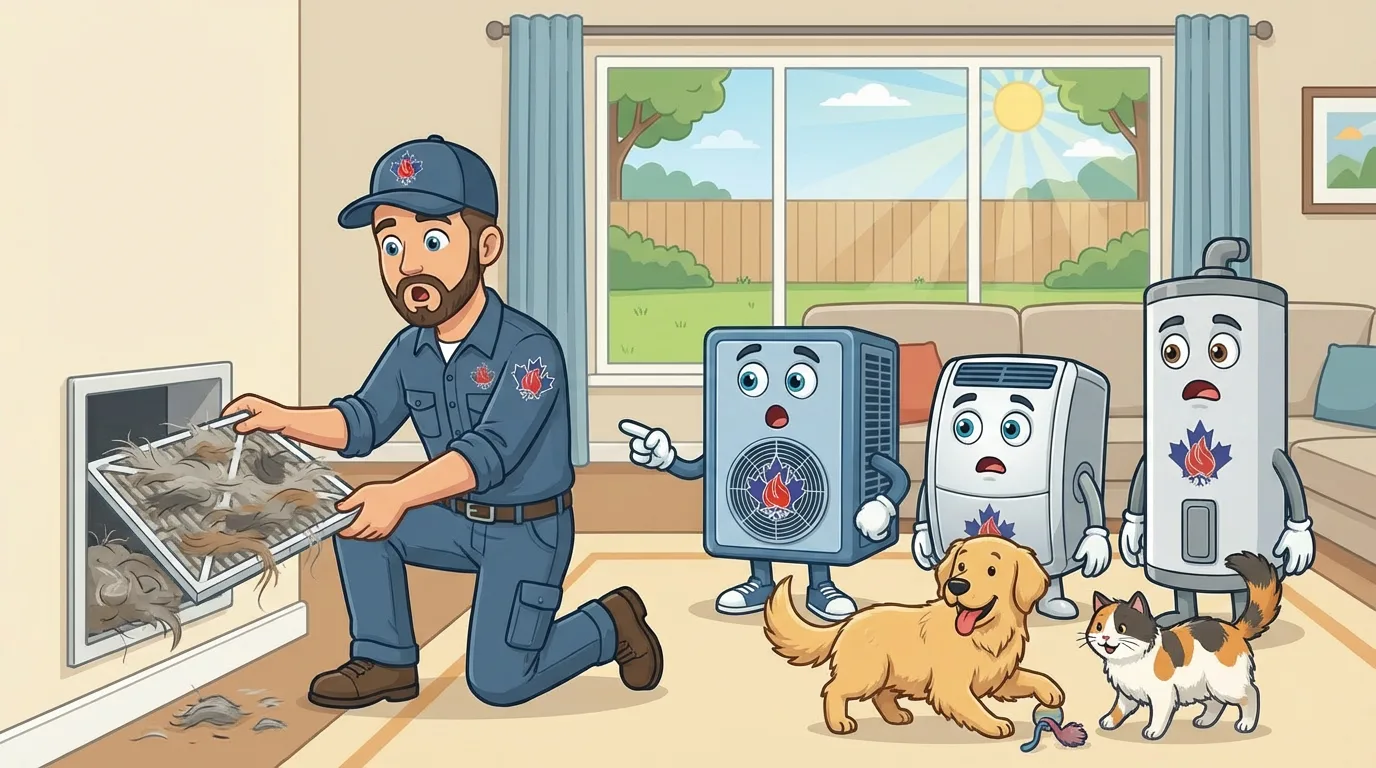
The reason is simple: pet hair and dander are physically larger and more persistent than typical household dust. A filter that looks “a bit loaded” at 60 days in a non-pet home will be matted and restricting airflow at the same age in a pet home.
A restricted filter costs you money in two ways:
- Your blower motor works harder to pull air through, using more electricity
- Reduced airflow lowers cooling capacity, so the system runs longer to hit the same temperature
In a Delta home with a dog and a cat during summer cooling season, we routinely measure 15 to 25 percent efficiency losses on a filter that a pet-less homeowner would describe as “not that bad yet.”
Replacement Frequency by Pet Load
| Pet Situation | Recommended Filter Change |
|---|---|
| No pets | Every 90 days |
| One cat | Every 60 days |
| One medium-to-large dog | Every 45 days |
| Multiple pets (2-3) | Every 30 to 45 days |
| Multiple pets with heavy shedders (Huskies, Goldens, Labs) | Every 30 days |
| Pets plus a pet-prone allergy sufferer in the household | Every 21 to 30 days |
2. MERV Rating for Pet Households
MERV 11 is the minimum we recommend for pet households; MERV 13 is better if your system’s static pressure tolerates it. MERV 8, which is the default in many builder-grade installs, catches visible hair but does not meaningfully reduce airborne dander, which is the primary allergen. MERV 13 catches smaller particles including dander, dust mite debris, and wildfire smoke particles.
The tradeoff with higher MERV ratings is airflow restriction. A blower motor sized for MERV 8 operation may struggle with MERV 13, leading to reduced capacity and premature motor wear. A good installer can measure your system’s static pressure and tell you whether MERV 13 is safe in your specific system, and if not, can often upgrade the return duct sizing to accommodate it. Many Delta homes built before 2005 need a return upgrade to run MERV 13 cleanly.
3. Ductwork: The Pet Owner’s Hidden Problem
Over time, ducts in pet households accumulate a layer of hair, dander, and fine dust - especially in return ducts where airflow is slower.
Two effects:
- Reduced effective duct cross-section (lower airflow capacity)
- A reservoir that sheds particles back into the air during normal operation, especially after the system has been off and turns back on
Professional duct cleaning for a pet household is worth considering every 3 to 5 years. For non-pet homes, every 5 to 7 years is fine.
It is a $450 to $850 job for a typical Delta single-family home.
Signs cleaning is overdue:
- Visible dust on supply register vanes within a week of cleaning them
- A detectable “pet smell” in the air even when pets are not in the room
- Allergy symptoms that worsen when the HVAC system is running
4. The Outdoor Unit: Pet Hazards and Pet Damage
Pet Hazards to Protect Against
- Male dogs marking the outdoor unit - urine is acidic and accelerates corrosion on coil fins and electrical connections
- Cats climbing onto the top of the unit - can trigger a falling hazard and damage the fan grille
- Small pets squeezing into the service area - rare but serious if it happens during operation
- Chemical residue on pet paws (from sidewalk de-icer in winter, fertilizer in summer) tracked against the unit
Practical Precautions
- Install a low fence or landscape barrier 50 to 80 cm from the unit on all sides; maintains airflow while deterring direct pet contact
- Plant non-acidic ground cover around the unit (avoid mint, which cats find attractive)
- Rinse the outdoor unit with a garden hose 2 to 3 times per season, more often if you see urine staining
- For male dogs with a specific habit, a commercial pet repellent spray applied to the cabinet base lasts 2 to 3 weeks
5. Thermostat Strategy for Pets Home Alone
Many Delta homeowners set back the thermostat aggressively when leaving the house for work, which saves energy but can put pets in uncomfortable or dangerous conditions during heat waves. The right strategy depends on the pet:
- Dogs - keep indoor temperature below 26°C when alone during hot days. Brachycephalic breeds (pugs, bulldogs, boxers) need stricter limits, below 24°C.
- Cats - more tolerant, but 27°C is a reasonable upper limit for most cats home alone.
- Rabbits and small mammals - heat-sensitive, keep below 24°C at all times.
- Reptiles - depends on species; many need specific temperatures and humidity levels that the ambient room thermostat should not override.
A smart thermostat with geofencing that raises the setpoint when you leave (instead of a rigid setback) and lets you override remotely during heat waves is worth the $300 it costs for pet owners. Some smart thermostats can also trigger an alert if indoor temperature rises above a set safety threshold, which is useful for owners who travel or work long shifts.
6. Indoor Humidity for Pet Comfort
Delta summers can run humid, especially on the Ladner lowlands where morning fog lingers. Most dogs and cats are more comfortable at 40 to 55 percent relative humidity, which is also the range where mould and dust mite proliferation is minimized. Humidity above 60 percent can exacerbate pet skin issues and make it harder for pets to thermoregulate through panting.
A whole-home dehumidifier integrated with the HVAC system ($1,800 to $3,500 installed) is the cleanest solution for homes where summer humidity is a persistent problem. For less serious cases, running the AC continuously during humid stretches (rather than cycling) provides some dehumidification benefit as a side effect.
7. Quiet Units for Noise-Sensitive Pets
If your pet is noise-sensitive - dogs with storm phobias, cats that hide from loud sounds - the noise profile of HVAC equipment matters. Newer inverter-driven heat pumps and ACs are significantly quieter than older single-stage equipment. Outdoor noise ratings below 60 dB at high speed and below 50 dB at low speed are readily available in the current Daikin, Gree, and Tosot lineups. Indoor air handlers with ECM motors run far quieter than the older PSC motors, which makes a noticeable difference in homes with dogs that startle easily.
A Note on Wildfire Smoke Season
Delta sits in a path that wildfire smoke from interior BC fires regularly reaches by July or August. For pet households, this doubles the IAQ stakes - pets with asthma, older animals, and brachycephalic breeds all suffer more from smoke exposure than healthy humans do. A MERV 13 filter plus a portable HEPA air cleaner in the room your pets sleep in is usually enough to keep particulate levels manageable during smoke events. We cover whole-home filtration options in more depth in our other summer-prep posts, but for pet households, the basic upgrade is always worth it.
Bottom Line
The three highest-impact things a Delta pet owner can do for their HVAC system:
- Replace filters on a pet-adjusted schedule, not a generic 90-day schedule
- Upgrade to MERV 13 filtration if system static pressure allows
- Set the summer thermostat with pet comfort limits rather than aggressive energy-saving setbacks when the house is empty
Call 604-991-4894 or request service if you want a pet-aware HVAC assessment for your Delta home. We can measure your system’s static pressure, recommend the right filter strategy, and identify any duct or outdoor-unit issues that pet-heavy living has created.
Frequently Asked Questions
Every 45 to 60 days for single-pet households and every 30 to 45 days for multi-pet homes. Heavy-shedding breeds push the frequency closer to 30 days. The standard 90-day recommendation is based on non-pet homes and substantially underestimates the load in pet households.
True HEPA filters have too much airflow resistance for most residential HVAC systems and can damage the blower motor over time. MERV 13 is the realistic ceiling for most homes. If you want HEPA-level filtration, a standalone air purifier is the right approach, not a HEPA filter in the ducted system.
Under 26°C for most healthy adult dogs, under 24°C for brachycephalic breeds (pugs, bulldogs, boxers, frenchies), seniors, and dogs with heart or respiratory conditions. During heat waves, cooler is better. Pets do not sweat like humans, so they rely on panting which becomes ineffective above about 32°C indoor temperature.
Yes. Dog urine is acidic enough to corrode aluminum fins and copper coil connections over time. Male dogs that habitually mark outdoor equipment can cause visible corrosion within a single season. A physical barrier or a pet repellent spray, plus periodic rinsing with a garden hose, prevents most damage.
Yes, on a 3 to 5 year cycle for multi-pet homes. The visible improvement is usually subtle, but the measured reduction in airborne dander and the improvement in system airflow are real. Signs cleaning is overdue include persistent pet odour when the HVAC runs, rapid dust accumulation on register vanes, and allergy symptoms tied to system operation.
You need MERV 13 filtration, a pet-adjusted replacement schedule, and ideally a standalone HEPA purifier in bedrooms. A full-house HVAC rebuild is rarely necessary - the issue is usually filter grade and frequency rather than equipment capacity. Allergy symptoms that persist despite good filtration warrant a duct inspection.