Heat Pumps Get Quieter, Not Louder
A healthy heat pump makes roughly the same amount of noise throughout its life.
Actually - modern heat pumps often get slightly quieter in the first 6 to 12 months as rubber isolation mounts settle in.
So when your New Westminster neighbour’s heat pump is fine but yours is suddenly waking the baby at 3 AM, something has changed.
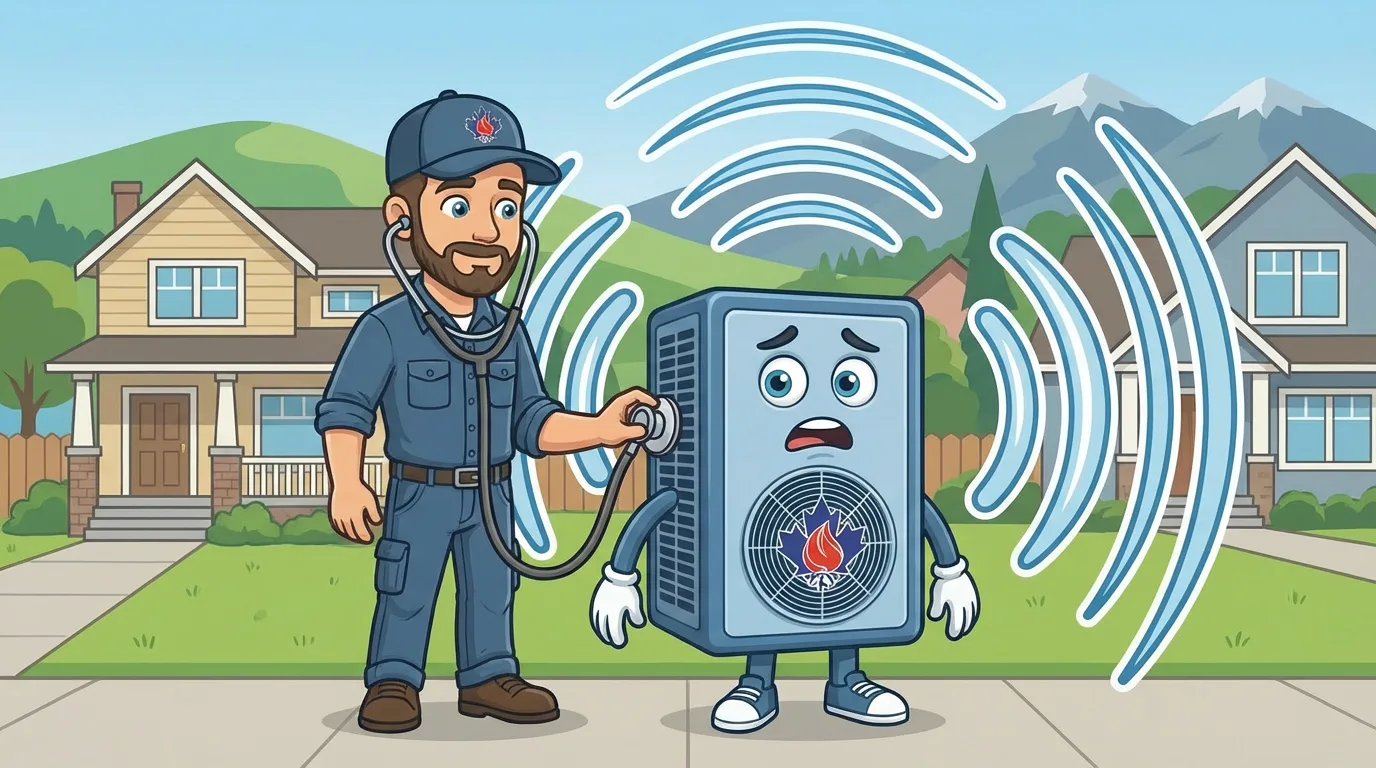
The good news: heat pump noise is one of the most diagnosable symptoms in residential HVAC. Each type of sound maps to a specific cause.
In a dense urban setting like New West - where townhouses share walls, detached homes sit 3 metres from the next lot, and the city has real noise bylaws with real teeth - figuring out what your heat pump is telling you matters for both system longevity and neighbourhood peace.
Noise Diagnostic Table
| What you hear | Likely cause | DIY or tech? |
|---|---|---|
| Rattling or buzzing panel | Loose service cover or screws | DIY - tighten |
| Rhythmic clicking or ticking | Fan blade hitting debris or ice | DIY - clear debris; tech if ice |
| Low humming that was not there before | Failing contactor or capacitor | Tech |
| High-pitched whine from indoors | Blower motor bearing wear | Tech |
| Grinding or metal-on-metal | Compressor or fan bearing failure | Shut down, call tech |
| Hissing or gurgling | Refrigerant leak or low charge | Tech |
| Banging on startup/shutdown | Normal defrost cycle, or loose panel | DIY check panels first |
| Whistling from outdoor unit | Fan blade damage or refrigerant leak | Tech |
| Vibration through the wall | Worn isolation pads or bad mounting | Tech for pad replacement |
| Loud defrost cycle (winter) | Normal heat pump operation | Not a fault |
The Common Culprits
1. Loose Panels and Service Covers
The easiest fix and one of the most common causes.
Outdoor unit covers are held by 6 to 12 screws. Vibration slowly backs them out. A loose cover rattles against the cabinet on every compressor cycle.
Fix: walk around the unit with a Philips screwdriver, tighten every screw you can reach. 5-minute job.
2. Debris in the Fan Blade
Leaves, twigs, small branches, or ice chunks in the fan cage create a rhythmic ticking or clicking synchronized with fan speed.
New Westminster’s tree canopy - especially the older maples in Queen’s Park and the West End - means this is a normal annual occurrence.
Fix: turn off power at the disconnect, remove the top grille, clear debris. 10-minute job if you are comfortable with it.
Do not: try this while the unit is running.
3. Isolation Pad Wear
Heat pumps sit on rubber or composite isolation pads that absorb vibration.
Those pads compress over time - especially under units installed on wooden decks or above grade-level landings common in New West townhouses and older homes.
When the pads are shot, the whole cabinet starts transmitting vibration into the structure. Neighbours notice first.
Fix: isolation pad replacement ($180 to $350). Takes a technician 30 to 60 minutes.
4. Fan Motor Bearing Wear
A high-pitched whine or whirring that was not there before usually means the outdoor fan motor bearings are failing.
Common on units 8+ years old, especially in coastal BC where salt air accelerates bearing wear.
Ignored long enough, a failing fan motor seizes. Once it seizes, the compressor often follows within weeks because the condenser coil can no longer shed heat.
Fix: fan motor replacement ($600 to $1,100). 1 to 2 hours of labour.
5. Compressor Noise
The compressor is the big sealed dome inside the outdoor cabinet. It should make a steady hum.
Red flags:
- Grinding or metal-on-metal sounds
- Knocking on startup
- A noticeable change in pitch under load
- Rapid cycling on and off
Any of these warrants immediate shutdown and a service call. A failing compressor that runs to failure typically means full replacement rather than rebuild - and that can mean the whole system if the unit is old enough that compressor parts are scarce.
6. Hissing and Refrigerant Issues
A hissing sound, especially near the copper line set, usually means a refrigerant leak.
You may not be able to see the leak - refrigerant is invisible - but the sound is distinctive.
Do not ignore this. Running a system low on refrigerant damages the compressor through overheating. A $1,200 leak repair becomes a $4,500 compressor replacement if left untreated.
Sound That Is Actually Normal
Not every new sound is a problem. A few heat-pump sounds are normal but startle homeowners who are not familiar with them.
Defrost Cycle
In winter, heat pumps periodically reverse into cooling mode briefly to melt frost off the outdoor coil.
During defrost you may hear:
- A loud “whoosh” or hiss as refrigerant reverses
- Steam coming off the outdoor unit
- The outdoor fan stopping while the compressor continues
- A brief louder period that lasts 3 to 10 minutes
All normal. Defrost cycles run every 30 to 90 minutes depending on conditions.
Mode Switch Sounds
When the system transitions between heating and cooling, the reversing valve shifts. That creates a distinctive “whoosh” of refrigerant.
Startling the first time, normal thereafter.
Thermal Expansion Clicks
Copper refrigerant lines expand and contract with temperature. You may hear occasional clicks or ticks from the lines, especially during startup and shutdown.
These are not a problem unless they are accompanied by hissing (refrigerant leak) or banging (improperly secured line set).
New Westminster Noise Bylaw Considerations
New West has specific noise bylaws that apply to mechanical equipment, especially in the older neighbourhoods where homes are close together.
Typical limits:
- 55 dB during daytime hours (7 AM to 10 PM)
- 45 dB during nighttime hours (10 PM to 7 AM)
- Measured at the property line
A healthy modern heat pump on low speed runs around 45 to 55 dB at 1 metre from the cabinet. At the property line, most installations comply.
A unit that has become noticeably louder than installation may now be violating bylaw - which is a complaint waiting to happen from a neighbour.
If a neighbour has complained, a sound reading at the property line gives you objective data to work with (either to prove compliance or to justify remediation).
When the Noise Means “Shut Down Now”
Some sounds warrant immediate power-off:
- Grinding or metal-on-metal
- Burning electrical smell paired with noise
- Loud hissing with visible ice buildup
- Repeated rapid cycling on and off
- Any banging accompanied by the system losing function
Cut power at the breaker and the outdoor disconnect, then call for service.
Preventing Noise Issues
Annual maintenance catches most noise-producing problems before they become audible:
- Tightening panels and screws
- Checking fan motor bearings
- Inspecting isolation pads
- Verifying refrigerant charge
- Cleaning debris from the fan cage and coil
For New Westminster homeowners in dense settings, this matters twice - once for system longevity, and once for neighbourhood relations.
Call 604-991-4894 or book service for a noise diagnostic on your New Westminster heat pump. Most calls resolve in a single visit.
Frequently Asked Questions
Yes. Defrost cycles involve briefly reversing into cooling mode to melt frost off the outdoor coil, which produces distinctive whoosh and hiss sounds lasting 3 to 10 minutes. This happens every 30 to 90 minutes in cold weather. It is normal operation, not a fault.
Modern residential heat pumps run 45 to 60 dB at 1 metre from the outdoor unit on low speed, and 55 to 70 dB on high speed. Inside the home, the indoor air handler should be under 40 dB at 3 metres. Anything louder than installation levels suggests a problem worth diagnosing.
Partially. Adding sound-blanket wraps around the compressor, upgrading isolation pads, and installing an acoustic fence can reduce noise at the property line by 3 to 8 dB. Full sound enclosures compromise airflow and usually are not worth it. Addressing the underlying cause of excess noise matters more than sound-proofing a noisy unit.
Start with a sound reading at the property line. If it exceeds New West bylaw (55 dB daytime, 45 dB nighttime), remediation is probably required. Common fixes include isolation pad replacement, relocating the unit, adding an acoustic fence, or replacing an older unit with a quieter modern one.
Winter operation has defrost cycles that do not happen in summer cooling mode. Also, cold-weather operation generally requires the compressor to work harder, which is audibly louder than summer cooling cycles. If the difference is dramatic (not just noticeable), a low refrigerant charge may be contributing.
Most modern heat pump motors use sealed bearings that are not serviceable. Older units (pre-2010) may have oil ports on the fan motor that accept a few drops of motor oil annually. Check your owner manual before attempting - adding oil to a sealed bearing does nothing, and adding the wrong oil can damage bearings.