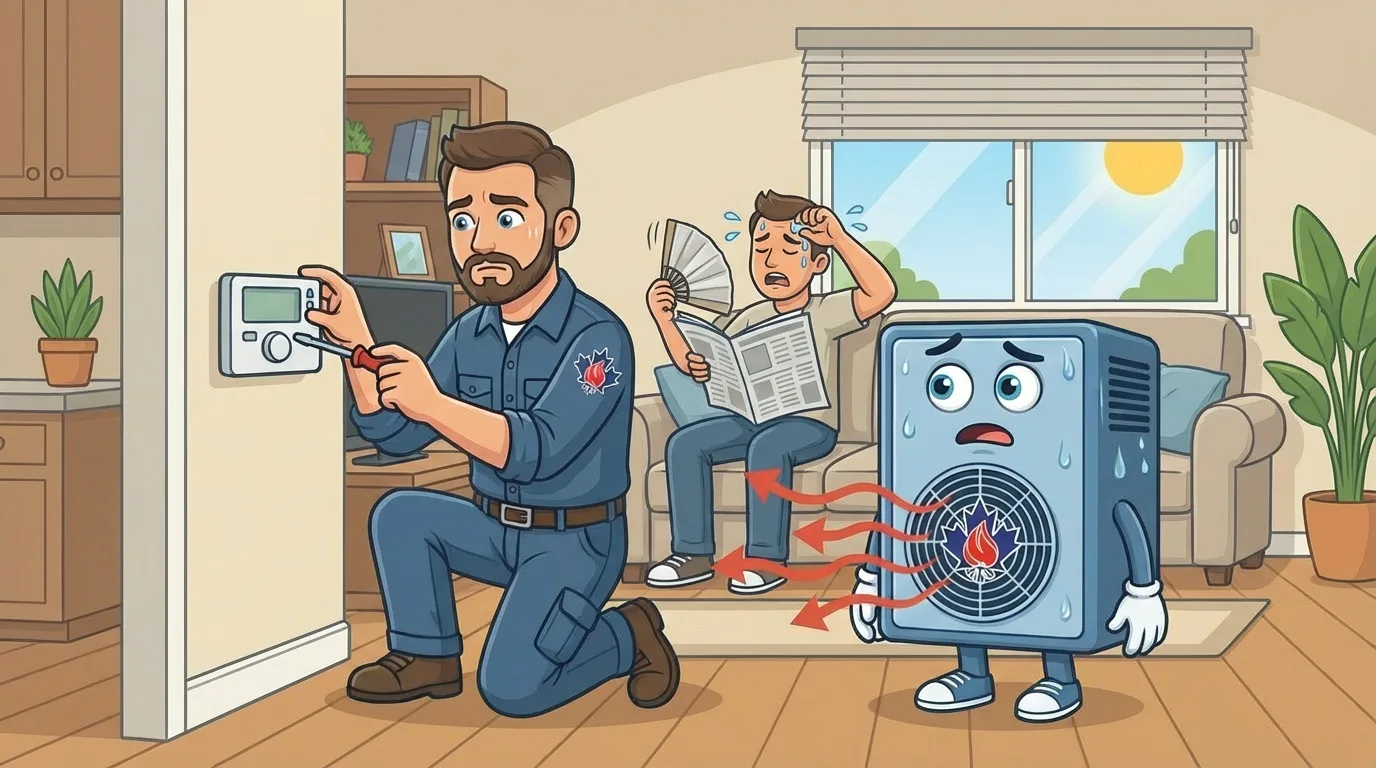
The First-Warm-Day Heat Pump Call We Get Every May
Tuesday afternoon, last week of May. The temperature has hit 24°C.
You switch your thermostat from heat to cool for the first time since October.
Five minutes later, the vents are still blowing air that feels slightly warm, and your indoor temperature is trending in the wrong direction.
This is one of the most common first-warm-day calls we get from Port Coquitlam homeowners.
Good news: it almost always comes down to one of four specific causes. Three of them you can diagnose (and sometimes resolve) yourself in about ten minutes.
Port Coquitlam has a heat-pump heavy housing stock. Much of the development in the northeast sector - Fremont, Birchland, the newer Burke Mountain adjacent projects - went in when heat pumps were becoming the default for new builds.
That means the city has a higher-than-average share of heat pumps in the 5 to 15 year age range. Which is exactly the period when reversing valves and control boards start showing their age.
Quick Diagnostic Table
| What’s happening | Likely cause | DIY or call? |
|---|---|---|
| Vents blow warm air when you ask for cooling | Thermostat still in heat mode, or Auto with wrong setpoint | DIY |
| Outdoor unit runs, compressor active, wrong temperature air | Reversing valve not energizing or stuck | Call |
| System does nothing when called for cool | Control board relay, outdoor temperature lockout | Check lockout DIY, rest call |
| Hissing sound on mode switch, then no change | Reversing valve mechanically stuck | Call |
| Barely cool air even after 15 minutes | Reversing valve leaking through, or low refrigerant | Call |
| Intermittent cooling - works some days not others | Control board or wiring issue | Call |
| Error code on thermostat or outdoor LED | System self-diagnosed fault | Record the code, then call |
How a Heat Pump Switches Between Heating and Cooling
Understanding the failure modes is easier if you know what the system is supposed to be doing.
A heat pump moves heat in one direction to heat your home. And in the opposite direction to cool it.
The component that reverses refrigerant flow is called the reversing valve. It sits near the compressor in the outdoor unit.
When you switch the thermostat from heat to cool, the system sends a signal to the reversing valve. The valve physically shifts to redirect refrigerant flow.
If anything breaks the chain between thermostat and valve - or if the valve itself fails to shift - the system keeps running in whatever mode it was last in.
1. Thermostat Settings - The Most Common Cause
Before suspecting the hardware, rule out the thermostat.
It sounds obvious. But the majority of “heat pump stuck in heating mode” calls we respond to end up being thermostat configuration issues.
Sixty seconds to correct, once you know where to look.
- Is the thermostat mode actually set to Cool? Many smart thermostats have an Auto mode that picks heating or cooling based on setpoint, and if the setpoint is above room temperature, Auto will still call for heat.
- Is the set point at least 2 to 3 degrees below the current room temperature? If the room is 23°C and you set the thermostat to 24°C, the system has no reason to cool.
- Is there a “heat only” or “emergency heat” switch still engaged? Some older thermostats have a physical switch that locks the system in heating mode independent of the main mode selector.
- Is the thermostat’s schedule overriding your manual change? A programmed schedule can revert a manual change after 30 to 60 minutes.
If the thermostat is correctly set and the system still blows warm air after 5 to 10 minutes, move to the next check.
2. Outdoor Temperature Lockout
Many heat pumps - especially those paired with a gas furnace backup in a dual-fuel configuration - are programmed with an outdoor-temperature lockout that disables cooling below a certain threshold. This is typically set in the 15 to 18°C range, because running AC when the outdoor air is cooler than desired indoor temperature is wasteful and can cause coil freezing.
On a 24°C Port Coquitlam afternoon this lockout is not a factor, but the lockout logic can misbehave when outdoor sensors fail or get incorrect readings. If your outdoor unit sits against a west-facing wall that traps afternoon heat, or if the outdoor temperature sensor has been damaged by rodents or UV exposure, the thermostat may be reading an incorrect ambient temperature and refusing to engage cooling. If you can access the thermostat’s technical settings, verify that the current outdoor temperature reading matches reality.
3. The Reversing Valve Problem
If the thermostat is set correctly and there is no lockout issue, the most likely cause is the reversing valve.
Three failure modes:
Reversing Valve Not Energized
The valve is held in heating or cooling position by a 24V solenoid coil.
If the coil is not receiving power when you call for cooling, the valve stays in whatever position it was last in.
Symptoms: outdoor unit runs, compressor is operating, but air from the vents is the wrong temperature.
Causes: failed solenoid coil, broken wire, bad relay on the control board.
This requires a tech.
Reversing Valve Stuck Mechanically
Sometimes the coil energizes properly but the valve itself refuses to shift - internal corrosion, debris, or a damaged slide.
You can often hear it: the compressor kicks on with a different sound than usual (a louder “whoosh” or “hiss” as refrigerant tries to shift), and then nothing changes.
Sometimes a rubber mallet tap (tech only) will free a mechanically stuck valve. More often the valve needs replacement.
Reversing valve replacement runs $800 to $1,500 - the refrigerant has to be recovered, the valve brazed out, a new valve brazed in, and the system evacuated and recharged.
Reversing Valve Leaking Through
A worn valve may shift but fail to seal completely. Refrigerant leaks between the two sides of the circuit.
Result: a system that runs but delivers very weak cooling (or heating) because the refrigerant effectively short-circuits.
This is a replacement job, not a repair.
4. Control Board or Wiring
The signal from the thermostat has to travel through a control board in the air handler or outdoor unit before it reaches the reversing valve. A failed relay on the control board, a burned-out pin connector, or a chewed wire in an attic run can all break the signal chain. Control board failures often have other symptoms (flashing error codes, intermittent operation, the system working some days but not others). Diagnosis requires a multimeter and the service manual for your specific unit, so this is usually where the DIY path ends and the service call begins.
What You Can Do Right Now
- Double-check thermostat mode, setpoint, schedule override, and any secondary switches
- Wait 10 minutes after any change - heat pumps have built-in short-cycle protection that delays restart
- Listen to the outdoor unit when you call for cooling - if the compressor runs but the sound does not change from when it was heating, the reversing valve is the likely suspect
- If you have an accessible outdoor temperature sensor, clear any debris or obstruction from it
- Check for any error codes on the thermostat or the outdoor unit (most modern units have a small LED that flashes a pattern corresponding to a fault code)
When to Call a Tech
If you have ruled out thermostat settings and the outdoor unit runs but cooling will not engage, the problem is almost certainly in the reversing valve circuit or the control board. Neither is safely diagnosed or repaired by a homeowner - you are working with a pressurized refrigerant system and 240V electrical. A service call runs 60 to 90 minutes for diagnosis, and the repair ranges from a $150 relay replacement to a $1,400 reversing valve replacement depending on what failed.
Heat pumps under 12 years old will sometimes have parts warranty coverage on the reversing valve, even if the original parts warranty expired - manufacturers occasionally extend coverage on known-problem components. Mention your unit’s model and serial number when you call; we will check the current warranty status before the tech arrives.
Preventing It Next Year
The reversing valve issue is best caught during an annual maintenance visit. A proper heat pump tune-up exercises the valve in both directions, verifies the solenoid coil is operational, and checks the control board for any stored fault codes that might indicate an impending problem. Port Coquitlam heat pumps that receive annual service are significantly less likely to produce a first-warm-day no-cool call.
Call 604-991-4894 or request service if your heat pump is stuck in heating mode and the thermostat checks have not resolved it. We typically have same-week availability in Port Coquitlam in late May, though that window tightens quickly once the first real heat wave hits.
Frequently Asked Questions
Not necessarily. The most common cause is a thermostat configuration issue rather than a hardware failure. Work through the thermostat checks first. If those are all correct and the system still will not cool, the reversing valve or control board is the next suspect and that is a service call.
In the Lower Mainland, a reversing valve replacement on a residential heat pump typically runs $800 to $1,500 including labour, refrigerant recovery and recharge, and the valve itself. The wide range reflects differences in system size, valve type, and accessibility of the outdoor unit.
No - running the system in the wrong mode wastes energy and does not cool the home. If you need temporary relief while waiting for a service call, turn the system off entirely, open windows during cooler evening hours, and use portable fans. Avoid running any mode that is not delivering the temperature you want.
Reversing valves often fail slowly over time but do not produce symptoms until the system is asked to switch modes. A valve that worked imperfectly in October can fail completely by May after six months of not being exercised. This is one of the reasons annual maintenance matters for heat pumps more than for single-function systems.
If you have a dual-fuel system with a gas furnace backup, the furnace runs only in heat mode - it cannot help you cool. If your system has auxiliary electric resistance heat, the same applies. There is no backup cooling in most residential heat pump installations, which is why diagnosing a cooling-side failure promptly matters during heat waves.