The Call Every Abbotsford Business Owner Dreads
It is 2:15 on a Thursday afternoon in July. Outdoor temperature: 32°C.
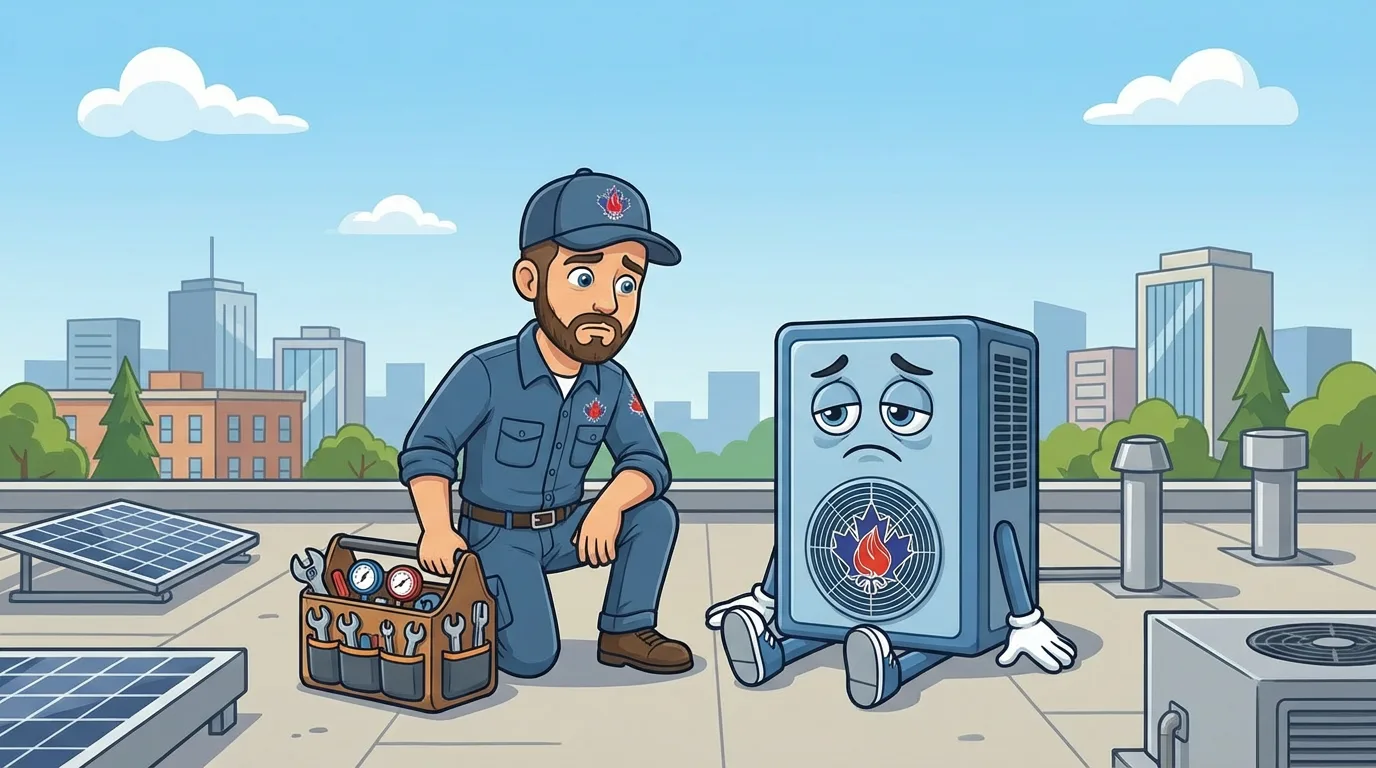
Your rooftop unit just quit.
The thermostat in the main retail floor reads 27°C and climbing. Staff are starting to ask questions. Customers are starting to leave.
This is the Abbotsford commercial HVAC emergency that every shop, restaurant, and warehouse eventually faces.
Good news: how you spend the first 15 minutes often determines whether you are reopening tomorrow morning or Monday.
This is the triage playbook - what to do, what to check, and what to tell the tech on the phone so the right parts arrive on the first truck.
Step 1: Confirm It Is Actually the RTU
Before you call, rule out the obvious.
- Check the thermostat. Is it set to Cool? Is the setpoint below current room temperature? Is the display alive?
- Check the breaker. Main panel for the RTU circuit. A tripped breaker looks like it is “between” on and off - flip it fully off, then back on.
- Check the disconnect on the roof. If it is safe to access (and only if you have roof access as part of your normal operations), confirm the exterior disconnect is in the ON position.
- Listen for the unit. If the outdoor fan is spinning and you can hear the compressor, the RTU is running - the problem may be in the distribution side (frozen coil, blower, duct collapse).
If the RTU is completely silent and the breaker is fine, move to step 2.
Step 2: Quick Triage Table
| What’s happening | Likely cause | Typical repair time |
|---|---|---|
| RTU completely silent | Control board, contactor, or electrical | 1 to 4 hours on site |
| Outdoor fan spins, compressor does not | Failed start capacitor or compressor | 1 to 6 hours (capacitor fast, compressor slow) |
| Compressor cycles on and off rapidly | Safety switch tripping - overheat or pressure | 2 to 5 hours |
| System runs, air barely cool | Low refrigerant, dirty coil, failing TXV | 2 to 4 hours |
| Ice visible on refrigerant lines | Low refrigerant or airflow problem | Shut down first, 3 to 6 hours to diagnose |
| Loud grinding or metal-on-metal sound | Fan bearing or compressor bearing failure | Shut down, 4 to 12 hours |
| Burning smell from vents | Motor winding failure - immediate shutdown | Shut down, 4 to 8 hours |
| Water dripping from ceiling below RTU | Condensate drain clog or pan leak | 1 to 3 hours |
Step 3: Call the Tech With the Right Information
The phone call is where speed gets earned or lost.
A tech dispatched with accurate information brings the right parts on the first truck. A vague dispatch means two or three trips.
Have this ready when you call:
- RTU make and model. Printed on the cabinet nameplate. Snap a photo if you are already on the roof.
- Age of the unit. If you do not know, look for the install sticker or check building records.
- Symptoms in order. “Was fine at 1 PM, making a grinding sound by 1:45, shut off at 2:15” is far more useful than “it’s broken.”
- What you have already tried. Breaker flipped? Thermostat reset? Saves the tech 10 minutes of diagnosis.
- Business hours and urgency. “Closing at 9 PM” vs. “open 24 hours” changes the priority.
Step 4: What to Do While You Wait
Stabilizing the building while the tech is en route matters. A few practical moves:
- Close blinds and drapes on sun-exposed windows to cut solar gain
- Shut down unnecessary heat-producing equipment - ovens, display lighting, unused computers
- Turn off the RTU at the thermostat if it is cycling or making concerning sounds - let the tech diagnose a cold unit rather than a damaged one
- Consider staggered staff breaks if interior temperature is climbing above 28°C
- Protect temperature-sensitive inventory - pharmaceuticals, electronics, perishables - ahead of time, not after they are at risk
For Abbotsford food-service operations: BC health code requires specific storage temperatures. Losing cooling during service hours can create a compliance problem within 90 minutes.
Common Failure Modes on Abbotsford RTUs
Abbotsford commercial HVAC has a particular failure profile because of the climate and building stock.
Heat-Driven Contactor Failure
Contactor points pit and weld during repeated on-off cycles. The Fraser Valley heat dome pattern - sustained 35°C+ with cool overnights - drives more cycling than coastal Vancouver.
Result: RTUs in Abbotsford tend to see contactor failure 1 to 3 years earlier than coastal installations.
Condenser Coil Dust Loading
Proximity to agricultural operations means airborne dust and organic matter load condenser coils faster than elsewhere in Metro Vancouver. A coil that would last two years clean in Vancouver needs attention every 6 to 9 months in some parts of Abbotsford.
Refrigerant Leaks at Line-Set Connections
Temperature swings between 5°C winter mornings and 38°C summer afternoons cycle copper connections more aggressively than milder coastal conditions. Line-set flare fittings and brazed joints are the most common leak points.
Typical Cost Ranges for Common Repairs
| Repair | Typical Cost (Abbotsford, 2026) |
|---|---|
| Contactor replacement | $250 - $450 |
| Capacitor replacement | $280 - $500 |
| Fan motor replacement | $800 - $1,600 |
| Refrigerant leak repair + recharge | $900 - $2,200 |
| Control board replacement | $650 - $1,400 |
| Compressor replacement | $3,500 - $7,000 |
| Full RTU replacement (5 to 10 ton) | $14,000 - $28,000 |
Emergency service premium (after hours, weekends) typically adds 30 to 60 percent to labour.
When Replacement Beats Repair
Rules of thumb for Abbotsford commercial RTUs:
- Unit older than 15 years + major repair needed - replace
- Repair quote above 40% of replacement cost - replace
- Second major repair in 24 months - replace
- Refrigerant is R-22 (phased out) - replace at next major failure
- Unit is older than 12 years and lacks a variable-speed compressor - evaluate replacement for efficiency
Preventing the Next Emergency
The Abbotsford businesses that avoid repeat emergencies share three habits:
- Twice-yearly preventive maintenance - spring cooling prep, fall heating prep
- Quarterly filter changes in high-dust environments (ag-adjacent, warehouse, food processing)
- Refrigerant log review - flagging gradual loss before it becomes a failure
A maintenance agreement bundles this and adds priority dispatch during heat waves - often the difference between a same-day response and a 3-day wait.
Call 604-991-4894 or get in touch for emergency commercial service or to set up a preventive maintenance agreement for your Abbotsford business.
Frequently Asked Questions
During a Fraser Valley heat wave, standard emergency response is 4 to 24 hours. Maintenance agreement clients typically get same-day response. Non-contract dispatch during peak demand can mean a 2 to 4 day wait, which is why maintenance agreements pay for themselves on the first real emergency.
Yes. Shutting down a unit making grinding, metal-on-metal, or burning smells prevents the failure from cascading into collateral damage. A failed capacitor is a $350 repair. Letting that failed capacitor damage the compressor turns it into a $4,000 repair.
15 to 20 years with routine maintenance. 10 to 12 years without. Abbotsford rooftop units tend toward the lower end of the range because of ag-related dust loading and aggressive temperature swings compared to coastal Vancouver.
For an approximate quote, yes. Firm quotes require a site survey to confirm existing curb dimensions, electrical capacity, gas or electric configuration, and access for crane or forklift staging. We typically provide same-week firm quotes on standard replacements.
For Abbotsford businesses running long hours with variable occupancy (restaurants, retail, offices), yes. Operating cost savings are typically 20 to 35 percent versus single-stage units, with faster payback in Abbotsford than in cooler coastal locations because of the longer cooling-degree-day season.
For most commercial clients with more than one RTU, yes. A typical Abbotsford maintenance agreement covers spring and fall tune-ups, filter changes, and priority dispatch. Annual cost is usually 15 to 25 percent less than pay-as-you-go service, and the priority dispatch is often the deciding factor during heat waves.