The Short Answer
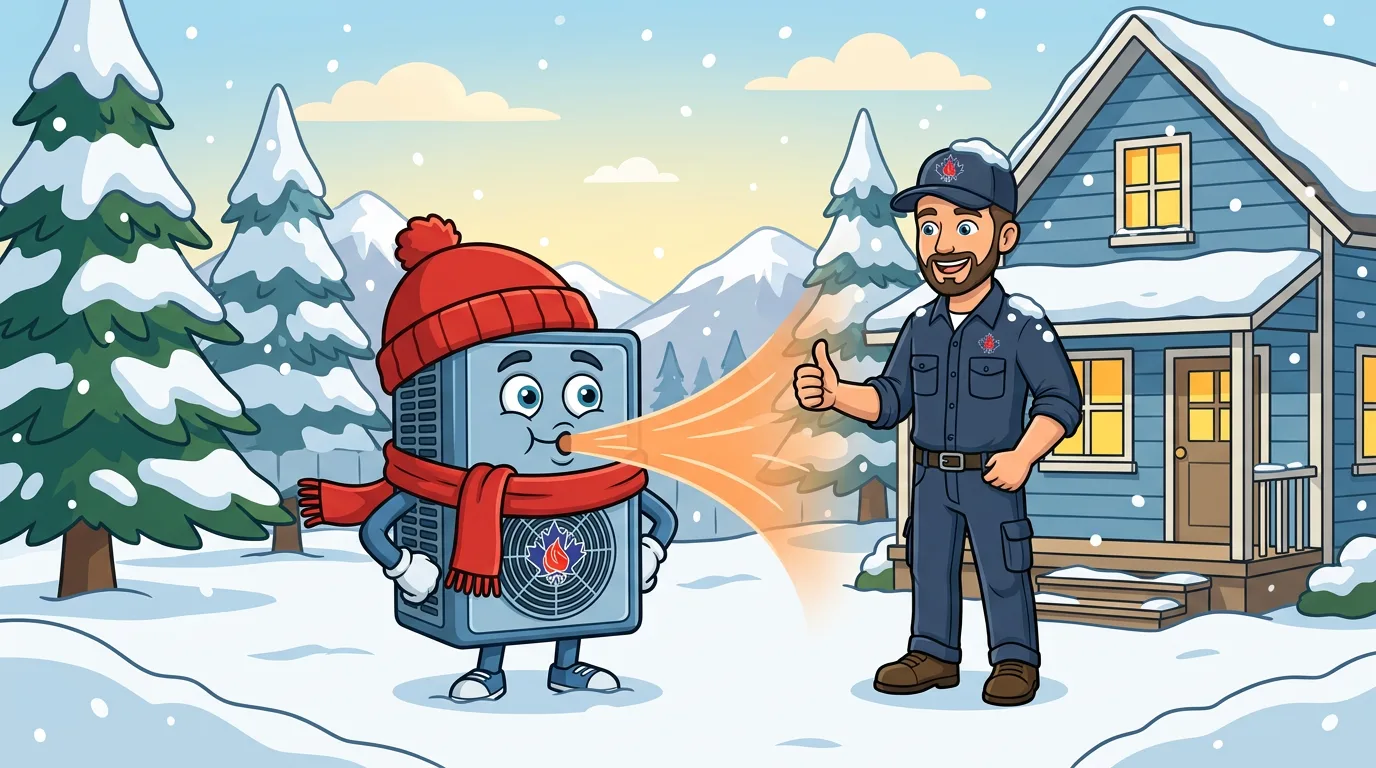
Yes, a modern cold-climate heat pump will keep up when the Fraser Valley drops to -10°C. Leading models sold in Canada are rated to keep 100% of their heating capacity down to about -15°C to -23°C and to keep operating to about -25°C to -30°C. For example, Mitsubishi Electric Canada rates its Hyper-Heat (H2i) line at full heating capacity at -15°C, with some models holding full capacity to -20°C or -23°C.
The real questions are whether your unit is actually a cold-climate model, whether it’s sized for your coldest week rather than an average day, and what backup heat covers the few hours a year it can’t.
What “Cold-Climate” Actually Means
“Cold-climate” isn’t just marketing. The benchmark most programs use is the NEEP Cold Climate Air Source Heat Pump specification. To be listed, a heat pump must:
- Have a variable-capacity (inverter) compressor
- Deliver a COP of at least 1.75 at -15°C (5°F) at maximum capacity, meaning it still produces 1.75 units of heat for every unit of electricity at that temperature
- Be ENERGY STAR certified, with an AHRI-matched indoor and outdoor system
For BC homeowners this matters for rebates: CleanBC Better Homes requires rebate-eligible heat pumps to be variable speed and listed on the NEEP cold-climate list, along with minimum efficiency ratings. Check the current Better Homes BC program requirements before you buy, because a non-listed unit can cost you the rebate.
How Heat Pumps Behave as It Gets Colder
| Outdoor temperature | Standard single-speed heat pump | Cold-climate variable-speed heat pump |
|---|---|---|
| +10°C to 0°C | Efficient (COP ~3-4) | Very efficient (COP ~3.5-5) |
| 0°C to -5°C | Capacity falling; frequent defrost in damp weather | Full capacity, efficient |
| -5°C to -15°C | Significant capacity loss; backup heat often running | Full or near-full capacity (COP ~2-3) |
| -15°C to -25°C | Often below useful capacity or shut off | Most models still heating; capacity tapering on some (COP ~1.5-2) |
| Below -25°C | Off | Many still operating; backup heat carries more of the load |
COP ranges are typical, not model-specific. Check the manufacturer’s extended performance data for the exact unit being quoted.
Two things to understand:
- Capacity drops before the unit stops. A heat pump that “operates to -30°C” may only deliver part of its rated output at that temperature. The number that matters for comfort is capacity at your design temperature, not the minimum operating temperature.
- Even at COP 1.5, it beats electric baseboards. A heat pump running at a COP of 1.5 on a -20°C night is still 50% more efficient than baseboard heat.
Defrost: The Steam Is Normal
Lower Mainland winters are damp, and damp air around 0°C is the hardest condition for frost. When frost builds up on the outdoor coil, the heat pump briefly reverses to melt it. You’ll see clouds of steam from the outdoor unit and feel a short pause in warm air indoors. That is normal and usually lasts a few minutes.
Call for service if the outdoor unit is encased in solid ice, the fan is iced in, or the unit seems to be in defrost constantly. That usually points to a drainage problem, a failed defrost sensor, or a refrigerant issue.
Sizing for the Coldest Week, Not the Average Day
The most common cause of a heat pump that “can’t keep up” in winter isn’t a bad heat pump. It’s an undersized one. A heat pump sized for a typical 5°C day will struggle during an outflow. Proper sizing works backwards from your home’s heat loss at the local design temperature:
- A heat-loss calculation for your actual house (insulation, windows, air leakage), not a rule of thumb per square foot
- A unit whose capacity at that design temperature covers most or all of the heat loss
- A plan for the remaining gap: electric backup strips, a dual-fuel furnace, or existing baseboards left in place
Oversizing has its own problem: short-cycling and poor dehumidification in shoulder seasons. Variable-speed compressors reduce that risk, which is one reason they’re required for rebates.
Backup Heat Options
| Backup | How it works | Best for |
|---|---|---|
| Electric resistance strips in the air handler | Turn on automatically when the heat pump can’t keep up or during defrost | Coastal homes, all-electric homes |
| Gas or propane furnace (dual-fuel) | Thermostat switches to the furnace below a set outdoor temperature | Fraser Valley, propane properties, homes with a newer furnace |
| Existing baseboards left in place | Cover specific rooms during cold snaps | Ductless installs replacing baseboards |
| Wood or gas fireplace | Supplemental heat in the main living area | Rural properties, power-outage resilience |
In a dual-fuel setup, the “switchover” temperature can be set by comfort or by cost. At 2026 BC rates, a cold-climate heat pump is usually cheaper to run than a gas furnace down to well below 0°C. Our heat pump vs furnace running cost comparison has the numbers.
Rebate note: starting Oct. 15, 2026, FortisBC pays up to $4,000 (up to $8,000 if income-qualified) for a qualifying dual fuel system that replaces a gas furnace at least 15 years old. One of the conditions is that the switchover to the furnace is set at 5°C or lower in the Lower Mainland, so the heat pump must be sized to carry the home down to that temperature. A cold-climate heat pump makes that easy.
Protecting Your Outdoor Unit in an Arctic Outflow
- Raise it. The unit should sit on a stand or wall bracket above the usual snow line so meltwater can drain away during defrost.
- Keep it clear. Leave 30-60 cm of open space around it. Never pile shovelled snow against it.
- Watch the roofline. If the unit sits under a roof edge without a gutter, dripping water can refreeze on top. A small canopy or a gutter solves it.
- Don’t wrap it. Tarps and covers trap moisture and block airflow while the unit is running.
- Hold a steady setpoint. Deep night setbacks force the heat pump to recover on the coldest morning hours, which is exactly when backup heat kicks in. During a cold snap, keep the setpoint steady.
Cold Snaps in the Fraser Valley vs. the Coast
Abbotsford, Chilliwack, Mission and Hope. The eastern Fraser Valley is where cold-climate capability earns its keep. When arctic air pours out of the Interior through the Fraser Canyon, strong, dry outflow winds can push Abbotsford and Chilliwack to -10°C or colder for several days, and wind chill makes it feel far colder. Hope sits right at the canyon mouth and gets the harshest of it. For homes here we size to the local design temperature and specify units with strong low-temperature capacity, typically paired with electric backup or a dual-fuel furnace. Rural Chilliwack and Agassiz properties on propane often see the biggest savings, because a heat pump displaces expensive propane for most of the winter. In Hope, we also look closely at unit placement: sheltering the outdoor unit from the prevailing outflow wind direction reduces frost and capacity loss.
Langley, Maple Ridge, Surrey and Coquitlam. These areas sit in between. Outflow events reach them in weaker form, with a few days a year around -5°C to -10°C. A good cold-climate variable-speed heat pump handles most homes on its own, with electric strips covering the rare extreme.
Vancouver, Richmond, Delta and White Rock. The coast rarely drops below about -5°C, and only briefly. Almost any rebate-eligible (NEEP-listed) heat pump is more than capable here. The bigger concerns are damp-weather defrost and, near the water in White Rock and Tsawwassen, corrosion protection for the outdoor coil.
Bottom Line
A cold-climate heat pump will heat a Fraser Valley home through a -10°C outflow without breaking a sweat, and the best units keep going well past -20°C. Make sure the model is NEEP-listed (which you need for CleanBC rebates anyway), that it’s sized to your home’s heat loss at the local design temperature, and that there’s a sensible backup plan for the handful of coldest hours each year.
Planning a heat pump before winter? Call 604-991-4894 or send us a message. We size, install and service heat pumps across the Lower Mainland and Fraser Valley, and we’ll confirm your unit qualifies for current rebates.
Frequently Asked Questions
A cold-climate heat pump is a variable-speed air-source heat pump designed to keep heating efficiently in sub-zero weather. The common benchmark in North America is the NEEP Cold Climate Air Source Heat Pump specification, which requires a variable-capacity compressor and a coefficient of performance (COP) of at least 1.75 at -15°C (5°F) at maximum capacity. In practice, leading models keep 100% of their rated heating capacity down to about -15°C to -25°C and keep operating to -25°C to -30°C or lower.
Cold-climate models do. Several leading cold-climate heat pumps sold in Canada are rated to keep full heating capacity at -15°C to -23°C and to keep operating down to about -30°C. Standard heat pumps lose capacity much faster below about -10°C and rely more on backup heat.
To get CleanBC rebates, effectively yes: rebate-eligible heat pumps must be variable speed and listed on the NEEP Cold Climate Air Source Heat Pump list. On performance, coastal cities like Vancouver, Richmond and White Rock rarely need full cold-climate capability, but the eastern Fraser Valley (Abbotsford, Chilliwack, Mission, Hope) gets arctic outflow cold snaps where a true cold-climate unit makes a real difference.
Its heating capacity and efficiency drop as the outdoor temperature falls, and it runs defrost cycles more often to clear frost from the outdoor coil. A properly sized cold-climate unit still meets most or all of the home's heat demand, and backup heat (electric strips or a gas or propane furnace in a dual-fuel setup) covers any gap on the coldest days.
Yes. Clouds of steam from the outdoor unit for a few minutes usually mean it is in defrost mode, melting frost off the coil. That is normal, especially in damp weather around 0°C. A unit that is encased in solid ice, or that never seems to finish defrosting, needs service.
Make sure the outdoor unit sits on a stand or wall bracket above the typical snow line, keep at least 30 to 60 cm clear around it, never pile snow from shovelling against it, and don't cover it with a tarp while it's running. If it is under a roof edge, add a small canopy so dripping meltwater doesn't refreeze on top. Leave the thermostat at a steady setpoint rather than deep setbacks during a cold snap.