The Real Cause Is Almost Never What People Assume
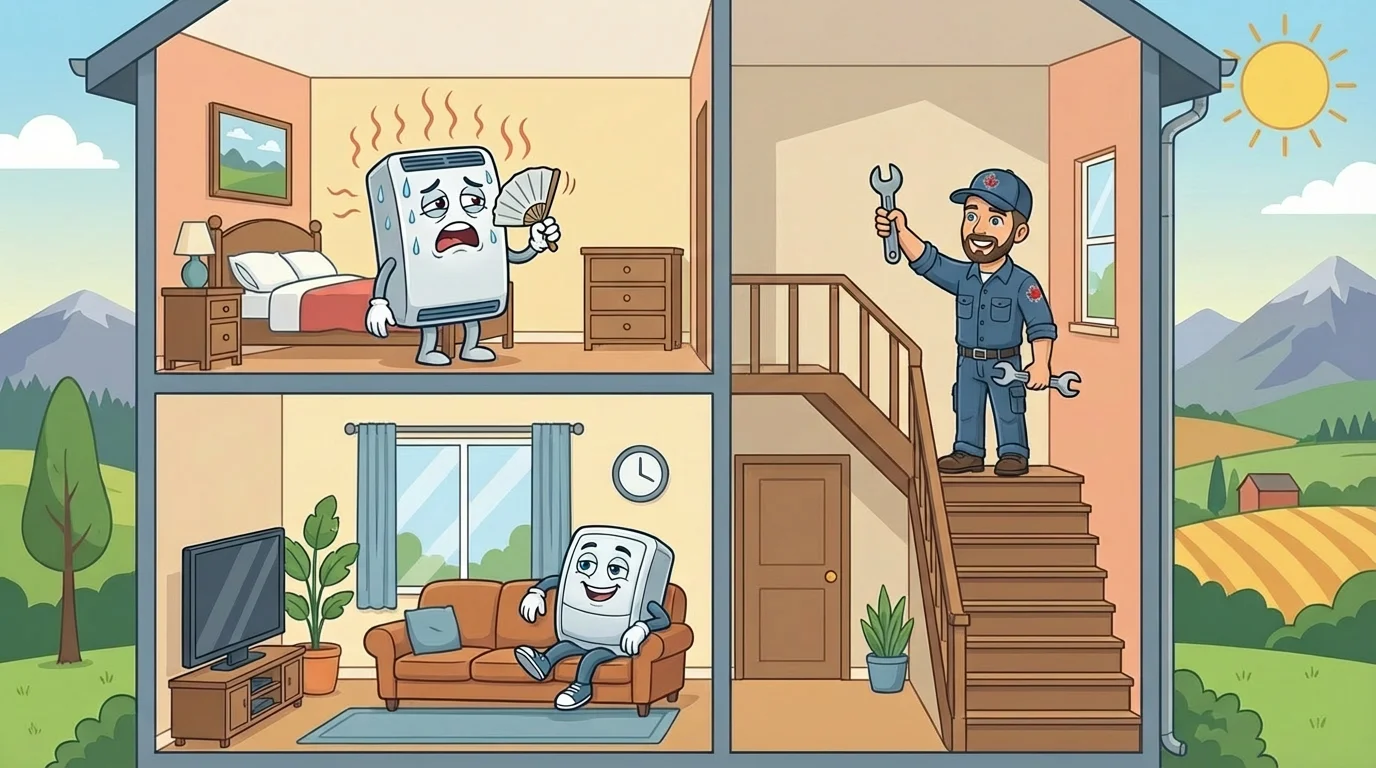
Most Abbotsford homeowners with a hot upstairs assume the same thing: their air conditioner is undersized, or their AC is dying, or their house just runs hot.
It is almost never any of those.
The actual cause is structural - the way air moves through a typical two-story Abbotsford home virtually guarantees that the upper floor runs warmer than the main floor. The good news: once you know which of the five common causes is at play, the fix is usually surgical and surprisingly affordable.
This post is the same diagnostic walk we use on Abbotsford service calls before recommending any equipment changes.
The Physics: Why Upstairs Wins (Or Loses)
Three things are working against your upstairs in summer:
- Hot air rises. Heat from the main floor naturally collects upstairs.
- The roof radiates heat downward. An attic on a hot Abbotsford summer day can hit 60°C, and that radiant load pushes into the second-floor ceilings all day.
- The duct run is longer. Air heading from a basement or first-floor furnace to the upstairs supply registers loses static pressure and velocity at every elbow and transition.
By the time the cool air arrives upstairs, it is moving slower, has less of it, and is fighting more incoming heat than the main floor ever does.
That is true in any two-story home in BC. The Abbotsford-specific factor is sun exposure: open lots, southern exposure, and minimal mature canopy in newer Abbotsford subdivisions mean upper-floor ceilings absorb more solar radiation than equivalent homes in tree-shaded Lower Mainland neighbourhoods. A West Abbotsford home built in 2015 with full southern exposure can run 10 to 12 degrees warmer upstairs than the main floor on a heat-wave afternoon, even with the AC running flat out.
The Five Real Causes (in Frequency Order for Abbotsford Homes)
1. Damper Imbalance
Most ducted Abbotsford homes have manual dampers in the supply trunk that were balanced once - usually right after construction - and never touched since. Over years of seasonal use, vibration shifts the damper positions, or a previous tech rebalanced for winter heating without rebalancing back for summer cooling.
The result: too much cool air going to main-floor rooms, too little reaching upstairs.
Diagnostic clue: One specific room is much warmer than the others, but not the whole upper floor.
2. Inadequate Return Air Upstairs
This is the most common structural problem in Abbotsford two-story homes built before 2015. Many builders installed only one central return - usually on the main floor - to save cost. That means cool air can be pushed upstairs, but warm upstairs air has nowhere efficient to go.
The result: a pressure imbalance that throttles cooling capacity on the upper floor.
Diagnostic clue: The whole upper floor is uniformly warm, especially in late afternoon.
3. Duct Leakage in Unconditioned Space
Abbotsford homes commonly run flexible duct through unconditioned attic space. If those ducts have separated at joints, been crushed by stored items, or were never properly sealed at the trunk takeoffs, you can lose 20 to 30 percent of conditioned air before it reaches the upstairs registers.
Diagnostic clue: Cool air at the registers feels weaker than the system size would suggest, and the supply ducts feel cool to the touch in unexpected places.
4. Insufficient Attic Insulation
Older Abbotsford homes - especially those built in the 1980s and 1990s before the stronger BC insulation codes took hold - often have R-30 to R-40 attic insulation. Current best practice is R-50 minimum, R-60 for high-performance homes.
The difference shows up most in afternoon upstairs comfort. With marginal attic insulation, ceilings radiate heat down all evening even after outdoor temperatures drop.
Diagnostic clue: Upstairs stays warm well into the evening even with windows open.
5. AC Sizing or Configuration
This is last on the list because it is rarely the actual cause - but it does happen. The most common version: a single-stage AC that cycles too quickly to dehumidify properly. The upstairs feels warmer than the thermometer reads because humidity is still high.
The other version: a heat pump with a poorly tuned blower that runs at a single speed regardless of demand, missing the slow-and-steady airflow profile that actually balances multi-floor distribution.
The 30-Minute Diagnostic You Can Do Yourself
Before paying a tech, work through this checklist:
- Walk every register upstairs with a piece of tissue paper. Air should visibly move it. Compare to main-floor registers - if upstairs is dramatically weaker, you have airflow loss somewhere.
- Check return air openings on each floor. Is there a return on the upper floor at all? If the only return is in the basement or main floor hallway, that is your structural problem.
- Pop your attic hatch. Look at the visible duct runs. Are they intact, or sagging at joints? Are any register boots crushed or pulled away from the ceiling?
- Check your damper positions in the basement trunk. If you can find them, see whether the upstairs runs have full-open dampers. Many Abbotsford homes have these labelled “summer” and “winter” - mark which is which.
- Take a temperature reading at each upstairs register and at the thermostat at the same time. Register air should be 18 to 20 degrees cooler than ambient. If it is only 8 to 10 degrees cooler upstairs while the basement registers are reading 18+ degrees cooler, your problem is duct loss between the unit and the second floor.
The Three Realistic Fix Tiers
Tier 1: Damper Rebalance and Duct Sealing ($300 - $1,200)
For most Abbotsford homes with localized hot spots upstairs, this is the first move. A tech rebalances the dampers for summer airflow priority, seals visible duct leakage with mastic at trunk takeoffs and major joints, and verifies airflow at every register.
This solves about 40 percent of upstairs-hot complaints in homes under 15 years old.
Tier 2: Adding Upstairs Return Air ($1,800 - $4,500)
If the issue is structural - no upstairs return - cutting in a proper return on the upper floor and running a return trunk back to the air handler is the right answer. This is the single most effective retrofit for Abbotsford two-story homes built before 2015.
The cost varies based on whether the existing duct framing has space for the return run and how accessible the air handler is.
Tier 3: Adding a Ductless Mini-Split for the Upper Floor ($4,500 - $8,500)
For homes where Tier 1 and 2 fixes are not enough, or where the central AC is also nearing replacement, a single-zone or two-zone ductless mini-split for the upstairs is often the cleanest solution. It dedicates capacity to the floor that needs it most and decouples upstairs cooling from the central system entirely.
Many Abbotsford homeowners pair this with a smart thermostat strategy that lets the central system run a higher setpoint while the ductless handles the bedroom level.
What Almost Never Works
- Upgrading to a bigger central AC. If the duct system cannot deliver air to the upper floor, more capacity at the source does not solve the problem - it just runs the new oversized unit harder while wasting the extra capacity.
- Closing main-floor registers. This raises static pressure across the system and can damage the blower motor over time. It does not redirect meaningful air upstairs.
- Box fans in the upstairs hallway. They create the perception of comfort but do not actually move conditioned air - they just stir warm air around.
- Cranking the thermostat down. The main floor freezes, the upper floor still does not catch up, and the energy bill spikes.
The Abbotsford-Specific Factors That Change the Math
Three things about Abbotsford skew the typical decision compared to other Lower Mainland cities:
- More open lots and full sun exposure than tree-canopied Vancouver or West Vancouver neighbourhoods. Solar radiation through second-floor ceilings is a bigger factor here.
- More homes with attic-routed ducts than concrete-slab basement homes seen in older Burnaby or New Westminster builds. Duct leakage in attics is more impactful and harder to detect from inside.
- Newer subdivisions in West Abbotsford and Sandy Hill often have well-built envelopes with marginal duct design - typical builder pattern. The fix is in the airflow side, not insulation.
What This Costs vs. What It Saves
A typical Tier 2 retrofit in a 2,200 sq ft Abbotsford two-story home is $2,500 to $3,500 installed. Real-world impact for clients we have done this work for:
- Upstairs temperature differential dropped from 7 to 9 degrees down to 1 to 2 degrees
- Cooling system run time dropped 20 to 30 percent (because it no longer fights an unwinnable upstairs setpoint)
- Bill savings of about $25 to $40/month in cooling season
- Payback window 4 to 7 years on energy alone, faster if it postpones an AC replacement
Bottom Line
If your Abbotsford upstairs runs hot, do not start with a bigger AC. Start with the diagnostic above, identify which of the five causes is at play, and match the fix to the cause.
For most homes, Tier 1 (damper and duct work) or Tier 2 (proper upstairs return air) solves the problem at a fraction of the cost of replacement. Tier 3 (ductless retrofit) is the right answer when the central system is already due for replacement or when the main-floor and upstairs zones simply have different needs.
If you want a tech who will actually run the diagnostic before recommending equipment, call 604-991-4894 or send us a message. We service Abbotsford daily.
Frequently Asked Questions
Three things stack against the upper floor: hot air rises naturally, attic radiant heat pushes downward, and conditioned air loses pressure on the longer duct run upstairs. Most upstairs-hot complaints in Abbotsford come down to inadequate return air on the upper floor or damper imbalance, not undersized AC.
Almost never. If the duct system cannot deliver air to the upper floor, a larger AC just produces more conditioned air that the ducts still cannot push upstairs. The fix is on the airflow side - returns, dampers, sealing, or a dedicated ductless head - not on the cooling capacity side.
Typically $1,800 to $4,500 depending on framing access and how easily a return trunk can be routed back to the air handler. This is the most effective single retrofit for Abbotsford two-story homes built before 2015 that have only a main-floor return.
Yes, and increasingly common. A single-zone or two-zone ductless system dedicated to the upper floor decouples upstairs cooling from the central system, lets you set a different setpoint for bedrooms, and pays back faster than oversizing the central AC.
No. Closing registers raises static pressure across the entire system, can damage the blower motor over time, and rarely produces meaningful redirection of air. Damper rebalancing in the trunk is the correct way to shift airflow upstairs.
Current BC best practice is R-50 minimum, R-60 for high-performance homes. Many older Abbotsford homes have R-30 to R-40, which is a meaningful contributor to upstairs heat gain. Topping up attic insulation typically runs $1,500 to $3,500 for a typical home and pays back in both cooling and heating seasons.