The White Rock Coastal Reality
White Rock sits on Boundary Bay with most of the residential area within a kilometre of the water. That means most White Rock homes - whether on the waterfront, the bluff, or up the slope toward the ridge - are exposed to salt-laden marine air carried inland by prevailing winds.
For your heat pump, that is a slow but reliable enemy. Salt does not damage units overnight. It chips away at outdoor coils, fins, fasteners, and electrical components over years - and the first sign most White Rock homeowners notice is a major repair bill on a unit that is supposedly only halfway through its rated life.
This post covers what is actually happening, the post-summer maintenance routine that meaningfully extends outdoor unit life, and when to spec sea-coast options on new heat pump installations in coastal White Rock.
What Salt Air Actually Does to a Heat Pump
Three failure modes:
1. Aluminum Coil Corrosion
Outdoor heat pump coils are typically copper tubing with aluminum fins. Salt deposits on the fins and copper-aluminum junctions accelerate galvanic corrosion - a chemical reaction where the aluminum slowly dissolves in the presence of saltwater electrolyte.
The visible result over 5 to 10 years: white powdery oxidation on fins, gradual fin disintegration, and eventually pinhole leaks at the copper-aluminum joints that cause refrigerant loss.
2. Cabinet and Fastener Rust
Standard outdoor unit cabinets are powder-coated steel with stainless or galvanized fasteners. Salt accelerates rust on every exposed steel surface, particularly:
- Service panel screws and hinges
- Cabinet welds at the base
- Fan grille fasteners
- Refrigerant line set fittings
Rust is mostly cosmetic in the first 3 to 5 years but becomes a service-access problem when fasteners seize and a maintenance visit that should take 30 minutes turns into a 90-minute extraction job.
3. Electrical Component Degradation
Salt-laden moisture penetrating around contactors, capacitors, and circuit boards causes accelerated terminal corrosion and arcing. This is the failure mode that produces the “premature compressor failure” or “unit will not start” calls 6 to 9 years into what should be a 12 to 15 year unit life.
The Signs You Are Already Seeing Salt Damage
Walk to your outdoor unit and look for:
- White or grey powdery deposits on the aluminum fins (oxidation from salt corrosion)
- Visible rust on cabinet edges, screws, or the unit base
- Bent or disintegrating fins in the bottom 1/3 of the coil (where salt deposits concentrate)
- Discolouration around line set fittings or refrigerant valves
- The unit running louder than it used to at the same setpoint (often an early sign of compressor stress from electrical or coil issues)
If you see two or more of these on a unit under 8 years old, you are running ahead of expected wear - and a maintenance routine plus possible coil treatment can slow it down.
The Post-Summer Rinse Routine (15 Minutes, Annually)
End-of-summer is the right time. Salt accumulation peaks during the warmest months when winds carry the most marine moisture inland.
Step 1: Power Down at the Disconnect
The outdoor disconnect (a small grey box mounted near the unit) cuts power to the outdoor section. Flip it to off. This is non-negotiable - never rinse a powered unit.
Step 2: Remove Surface Debris
Use a soft brush (the kind sold for HVAC fin cleaning, or a soft long-handled paintbrush) to clear loose dirt, leaves, and dry debris from the fins and grille. Brush in the direction of the fins, not against them - bent fins reduce airflow and never fully recover.
Step 3: Rinse with Fresh Water
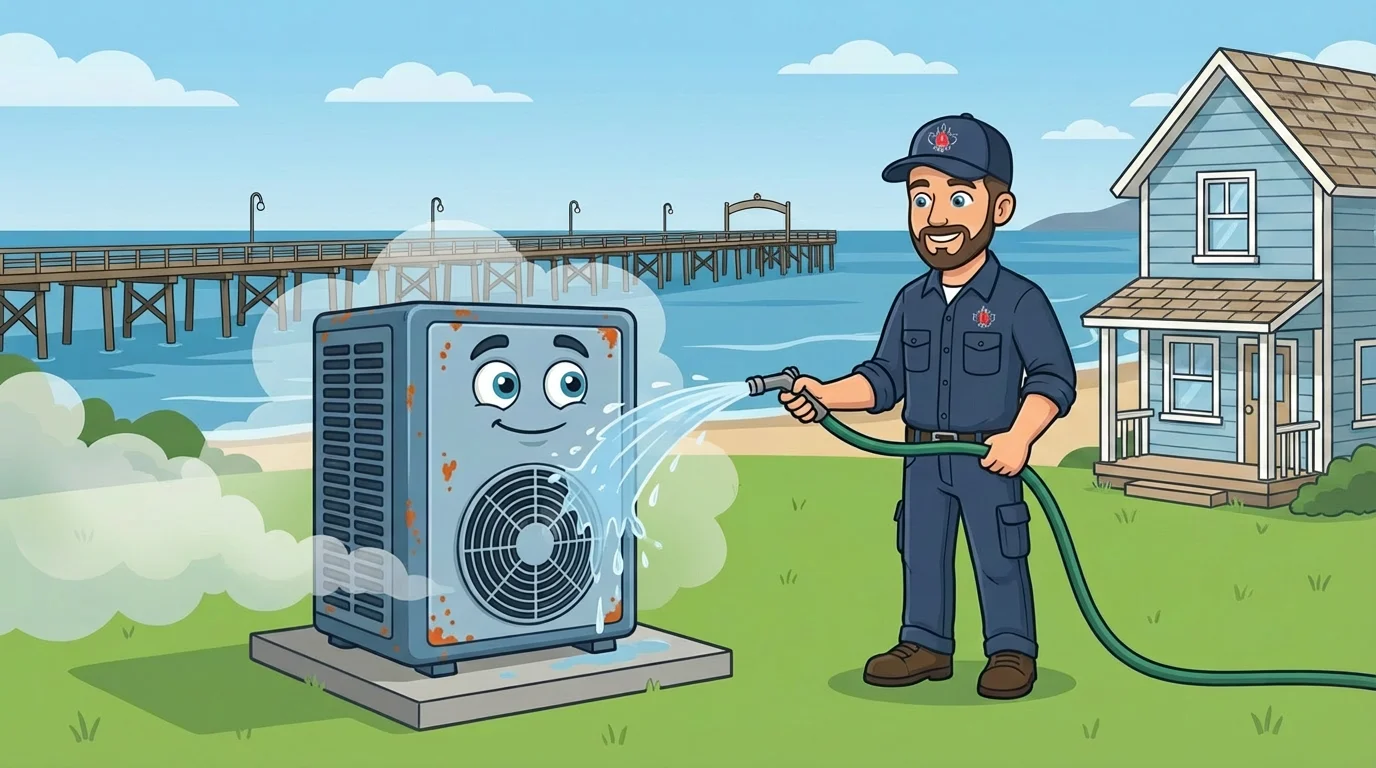
Use a garden hose on a fan or shower setting (not a high-pressure jet). Rinse the entire outdoor coil from the top down, letting fresh water flow over the fins and wash away salt deposits. Spend extra time on the bottom 1/3 of the coil where salt accumulation is heaviest.
For homes within 200 metres of the water, do this at the start and end of every summer. For homes 200 metres to 1 km from water, end-of-summer is sufficient.
Step 4: Inspect and Photograph
While the unit is open and you are looking at it, take a few phone photos of the fin condition, cabinet edges, and line set fittings. Year-over-year photos make it easy to track gradual corrosion and catch sudden changes that warrant a service call.
Step 5: Restore Power and Verify Operation
Flip the disconnect back to on. Wait 5 minutes. Cycle the system briefly in cooling mode to verify normal operation. Listen for any unusual sounds.
The Annual Maintenance Bump for Coastal Homes
Standard heat pump maintenance schedules call for once-a-year professional service. White Rock homes within 1 km of the water benefit meaningfully from twice-a-year service:
- Spring visit: Pre-summer tune-up, refrigerant pressure check, electrical inspection, fin straightening if needed
- Late fall visit: Post-summer salt assessment, coil cleaning (professional-grade no-rinse coil cleaner if needed), fastener inspection, electrical terminal cleaning
The incremental cost is about $150 to $250 per visit. The math works out: the average 12-year heat pump in coastal White Rock that gets twice-yearly service typically delivers 14 to 16 years of useful life - a 20 to 30 percent extension that pays for the additional service many times over.
The Sea-Coast Option for New Installs
If you are installing a new heat pump in White Rock, the most important coastal-specific decision is whether to spec the manufacturer’s sea-coast or anti-corrosion option.
Most premium ductless and central heat pump brands offer it for a $300 to $700 upcharge:
- Mitsubishi - Full PVC overspray on coil and chassis (the most thorough option in the market)
- Fujitsu - Lighter coil-only treatment
- LG - Mid-range option using different coil chemistry
- Daikin - Available on most cold-climate models
- Carrier and Lennox - Available on premium central units, less common on entry tier
For White Rock, we recommend sea-coast treatment for any home within 1 km of the water. The lifecycle math is unambiguous - a $400 upgrade typically extends outdoor unit life by 3 to 5 years and reduces mid-life repair frequency by roughly half.
The White Rock Micro-Zones
Not every White Rock home is equally exposed. Three zones with different salt-air loading:
Zone 1: Marine District (Marine Drive, Buena Vista, Coldicutt)
Direct waterfront and first-block-back. Highest salt-air loading. Sea-coast equipment strongly recommended for new installs. Twice-yearly maintenance is the right baseline.
Zone 2: Bluff and Hillside (Centennial, Hillside)
Up the bluff but still within 500 metres of water. Significant salt-air exposure, especially with prevailing southwesterly winds in summer. Sea-coast option recommended; annual maintenance with twice-yearly inspection works well.
Zone 3: Upland (East Beach Hill, areas north of 16 Avenue)
500 metres to 1 km from water, partially sheltered. Salt-air exposure is real but lower. Standard equipment with annual maintenance is typically sufficient.
Cost Expectations
| Service or Add-on | Typical Cost |
|---|---|
| DIY end-of-summer rinse | $0 - $25 (brush, hose) |
| Professional maintenance visit (per visit) | $150 - $250 |
| Professional coil cleaning (no-rinse) | $80 - $150 add-on |
| Sea-coast option on new install | $300 - $700 |
| Premature coil replacement (avoidable) | $1,800 - $3,500 |
| Premature compressor failure (avoidable) | $2,500 - $5,000 |
Bottom Line
Salt air is the silent factor that quietly determines whether a White Rock heat pump lasts 8 years or 14. The 15-minute end-of-summer rinse routine costs nothing and meaningfully extends life. Twice-yearly professional maintenance is the right baseline for waterfront and near-waterfront homes. And on new installs, the sea-coast option is one of the highest-ROI add-ons available.
If your unit is showing salt-corrosion symptoms or if you are planning a new install in any of the White Rock micro-zones, call 604-991-4894 or send us a message. We service White Rock coastal homes weekly and know which equipment configurations actually hold up in salt-air conditions.
Frequently Asked Questions
Yes, meaningfully. Coastal heat pumps in White Rock typically lose 20 to 30 percent of their expected service life if untreated and unmaintained. The mechanism is galvanic corrosion at copper-aluminum coil junctions and accelerated electrical component degradation. The good news: a simple maintenance routine and sea-coast equipment options largely close the gap.
For homes within 200 metres of the water, twice a year - start and end of summer. For homes 200 metres to 1 km from water, once a year at end of summer. Use a garden hose on a fan or shower setting; never high pressure. Power off at the outdoor disconnect first.
Sea-coast is a manufacturer-applied anti-corrosion treatment on the outdoor coil and cabinet, available as an upgrade on most premium heat pump brands for $300 to $700. For White Rock homes within 1 km of water, it is one of the highest-ROI add-ons available - typically extends outdoor unit life by 3 to 5 years and meaningfully reduces mid-life repair frequency.
No. Outdoor units are designed to operate uncovered in all conditions, and covering them in winter (when most heat pumps are running heating mode) blocks airflow, traps moisture, and causes more damage than salt air does. Resist the urge - a regular rinse and maintenance schedule is the right approach.
Look for white or grey powdery deposits on aluminum fins, visible rust on cabinet edges or fasteners, bent or disintegrating fins in the bottom third of the coil, and discolouration around line set fittings. Two or more signs on a unit under 8 years old means you are running ahead of expected wear and a service visit is warranted.
No. The Marine District (waterfront and first-block-back) sees the heaviest exposure. The bluff and hillside neighbourhoods are still significantly affected. Areas above 500 metres from water and uphill from the bluff are partially sheltered and have lower exposure. We adjust maintenance recommendations and sea-coast guidance based on which White Rock micro-zone your home is in.