The “On Vacation” Symptoms
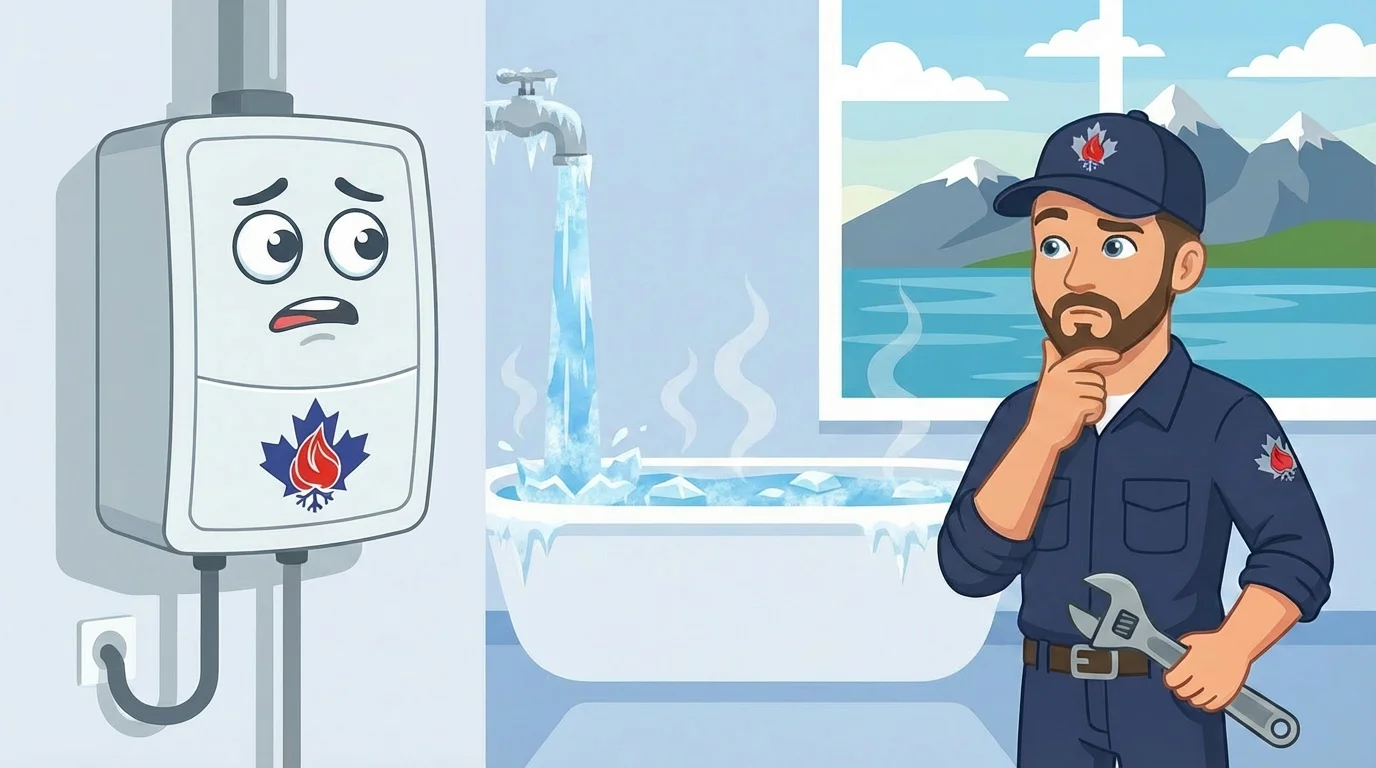
You know the feeling. You are second in line for the morning shower and the water turns lukewarm before you have rinsed your hair. By the time the third person tries, it is cold.
The first instinct is “the kids took too long.” But if it keeps happening through summer, your hot water tank is not lazy - it is telling you something specific. Three things are usually behind a tank that suddenly cannot keep up in summer, and the diagnostic to tell them apart takes about fifteen minutes.
This post is the same walk we do on a Port Coquitlam service call before quoting any repair or replacement.
Why Tanks Slow Down in Summer Specifically
Effective tank capacity depends on three things: the heating element or burner, the dip tube that delivers cold water to the bottom, and the volume of usable hot water (which is reduced as sediment builds up).
Summer reveals problems that winter masks because:
- Household demand goes up - more guests, more laundry from outdoor activities, more showers per day, more dishes from BBQs and entertaining
- Cold incoming water carries more silt and sediment in summer (Port Coquitlam pulls from Coquitlam Lake, which sees more turbidity in late summer)
- Higher ambient temperatures around the tank reduce the temperature differential the tank’s recovery system has to work against - which sounds like a good thing, but actually means small failures (a weakening element, a sticky thermostat) get masked until peak demand reveals them
The same tank that ran fine all winter can hit a wall in August. That is not your imagination.
The Three Real Reasons Your Tank Is Slow
1. Sediment Buildup at the Bottom of the Tank
This is the most common cause in Port Coquitlam, particularly in older homes (Mary Hill, Glenwood, Riverwood) where the original tank is still in place.
Coquitlam Lake water carries fine mineral sediment that settles at the bottom of the tank over time. On a gas tank, this sediment insulates the burner from the water, forcing it to run longer for less heat transfer. On an electric tank, the lower element gets buried in sediment and either fails outright or runs at degraded efficiency.
Diagnostic clue: Popping or rumbling sounds from the tank, especially when it is heating. Visible sediment in hot water from a faucet that has not run for a few hours.
Fix: Tank flush. $150 to $300 service call. Catches the problem early but does not reverse advanced sediment damage.
2. Dip Tube Degradation
The dip tube is a long plastic tube that runs from the cold-water inlet down to the bottom of the tank, ensuring incoming cold water mixes properly with hot water at the bottom rather than at the top.
Tanks built in the late 1990s and early 2000s sometimes used dip tubes that degrade over time. When the tube cracks or breaks, incoming cold water mixes directly with the outgoing hot water at the top of the tank - and you get lukewarm water at the tap even when the tank is technically “full” of hot water.
Diagnostic clue: Tank seems to have hot water (and the thermostat shows full temperature), but tap water arrives lukewarm even on the first call of the morning. White plastic flecks in faucet aerators are a classic sign.
Fix: Dip tube replacement. $200 to $400 if the tank is otherwise sound. On a tank over 8 years old, this is often a strong signal to start planning replacement instead.
3. Failing Heating Element or Gas Valve
An aging electric element gradually loses output before it fails completely. A gas valve that is sticky or partially blocked similarly delivers reduced burner intensity. Either way, the tank takes longer to recover after a draw - which goes unnoticed in winter when demand is steady but becomes very noticeable when summer demand spikes.
Diagnostic clue: Plenty of hot water for one or two normal showers, but recovery time between draws stretches longer than it used to. Two showers in 30 minutes used to work, now the second one runs cool.
Fix: Element replacement on electric tanks ($250 to $450). Gas valve service on gas tanks ($300 to $600). On older tanks, this is often the failure that pushes the decision to replacement.
The 15-Minute DIY Diagnostic
- Note the tank’s age. Look at the manufacturer label - the serial number usually encodes the build year. Tanks over 10 years old are statistically near end of life regardless of which symptom appears.
- Listen during a heating cycle. Run hot water for 5 minutes to trigger heating, then listen near the tank for popping, rumbling, or kettling sounds. These indicate sediment.
- Check the temperature setpoint. Many homes have it cranked low for energy savings. Try raising it to 60°C (140°F) for the test - if the slow-recovery problem disappears, you may not have a tank failure at all, just a setpoint that no longer matches household demand.
- Run two showers back-to-back. If the second shower runs cool within 7 to 10 minutes of the first ending, your recovery rate is below spec. That points toward elements, gas valve, or sediment.
- Check faucet aerators. Unscrew them and check for white plastic flecks. Plastic flecks point toward dip tube degradation.
The Decision Tree: Repair or Replace
| Tank Age | Symptom | Recommendation |
|---|---|---|
| 0 - 6 years | Any single symptom | Repair almost always |
| 7 - 10 years | Sediment only | Flush + raise setpoint |
| 7 - 10 years | Element or dip tube | Run the math; often replace |
| 11 - 13 years | Any symptom | Replace (warranty likely expired anyway) |
| 14+ years | Any symptom | Replace immediately - failure risk is high |
Tanks rarely fail gracefully past year 12. The most expensive failure is a leak that floods a basement or a mechanical room - far more expensive than a planned replacement at year 11.
The Port Coquitlam-Specific Factors
Hard Water from Coquitlam Lake
Port Coquitlam draws drinking water from Coquitlam Lake via the Coquitlam dam. That water is generally soft compared to interior BC, but mineral content rises in late summer when reservoir levels drop and concentration increases. Homes on older galvanized supply lines see additional precipitate accumulation.
The practical consequence: tanks in Port Coquitlam typically need flushing every 12 to 18 months to stay efficient, versus 24 months in lower-mineral areas.
Older Neighbourhoods with Original Tanks
Mary Hill, Glenwood, and the original Riverwood subdivisions have a meaningful share of homes still on their original 1990s-or-earlier hot water tank. These tanks are well past their service life and represent both efficiency and leak risk.
If you bought a Port Coquitlam home recently and have not replaced the tank, get the age verified. Most insurance policies have specific clauses about tanks over 10 years old.
Multi-Generational Households
Port Coquitlam has a higher-than-average share of multi-generational households. A 40-gallon tank that was sized for a young family in 1998 may not match the realistic demand of the same home with an extended family living there in 2026. Sometimes the slow-recovery complaint is not a failing tank - it is a correctly-functioning tank that is simply too small for the current household.
Cost Benchmarks (Port Coquitlam, 2026)
| Service or Replacement | Typical Cost |
|---|---|
| Tank flush | $150 - $300 |
| Element replacement (electric) | $250 - $450 |
| Gas valve service or replacement | $300 - $600 |
| Dip tube replacement | $200 - $400 |
| 40-gallon gas tank replacement | $2,200 - $3,200 |
| 50-gallon gas tank replacement | $2,600 - $3,800 |
| Heat pump water heater replacement | $5,500 - $8,000 (rebate-eligible) |
| Tankless conversion (gas) | $5,500 - $9,500 |
Should You Switch Technologies While You Are Replacing?
If your tank is failing and you are already going to spend money, three alternatives are worth thinking about for Port Coquitlam:
- Heat pump water heater - Currently the most rebate-friendly option. CleanBC offers $1,000 rebates on qualifying units, with stackable BC Hydro rebates. Net cost is competitive with premium gas tanks once rebates are applied. Most efficient operating cost.
- Tankless gas - Endless hot water and a smaller mechanical footprint. Higher upfront, but pays back over 12 to 15 years for households with high or variable demand. See our tankless install service.
- Right-sized tank replacement - For households where demand is steady and the existing footprint works, a properly sized replacement tank ($2,200 to $3,800 for gas) remains the lowest-friction choice. See our tank install service.
Bottom Line
If your Port Coquitlam tank seems to have gone on vacation this summer, run the 15-minute diagnostic above. Sediment, dip tube, or element failure each point to different fixes - and the right call depends as much on tank age as on the specific symptom.
For tanks under 7 years old: almost always worth repairing. For tanks 11+ years old: replacement is the safer financial decision regardless of the specific failure. The middle band is where the math actually matters.
Want a tech who will run the diagnostic and quote both options honestly? Call 604-991-4894 or send us a message. We service Port Coquitlam daily.
Frequently Asked Questions
Three things compound: household demand rises (guests, laundry, showers), incoming water carries more sediment from late-summer reservoir conditions, and small recovery-rate failures that winter masked become visible at peak demand. The tank itself may not have changed - the load on it has.
Typically 10 to 13 years for gas tanks, 12 to 15 years for electric. Port Coquitlam mineral content nudges the lower end of those ranges. Past year 12, leak risk rises sharply - planned replacement is cheaper than emergency replacement after a flooded basement.
For tanks under 7 years old with no prior issues, a DIY flush is reasonable if you are comfortable with the steps. For tanks over 7 years, get a tech to do it - aging tanks can have stuck drain valves, and forcing them risks a leak that turns a $200 service call into a $3,500 emergency replacement.
Almost certainly a degrading dip tube inside your hot water tank. Plastic flecks indicate the tube has cracked or fragmented, which causes lukewarm water at the tap even when the tank is full of hot water. On tanks under 8 years old, dip tube replacement is straightforward; on older tanks, it is usually a signal to plan replacement.
Yes for most homes. Heat pump water heaters are 3 to 4 times more efficient than electric tanks and qualify for CleanBC and BC Hydro rebates that bring net installed cost in line with premium gas tanks. They need adequate space (typically a basement or utility room with at least 700 cu ft of air volume), so check footprint before committing.
A two-adult, two-child household typically needs 50 to 60 gallons of tank capacity, or a tankless unit rated for 7 to 9 GPM at a 35F rise. Multi-generational households often need 75-gallon tanks or properly sized tankless to avoid the cascading-shower problem that drives most slow-recovery complaints.